Roulette Money Management
 | Updated:
 Proper Money Management: The Best Strategy to Win in Roulette
 If you do not want to leave the casino with only $2 in your pocket, stay disciplined and set a spending limit. Losing everything on a single bet will quickly take the enjoyment out of the game. Therefore, having a plan to manage your money is the best strategy to win in roulette.
It may even be a good idea to leave your credit cards at home and take only the amount you have set aside for the playing session. Do not become fixated on winning at any cost, as this could leave you without enough money for essentials such as groceries. Be sensible and play responsibly. Keep in mind that you should wager only money you do not need for living expenses. When it comes to gambling and bankroll management, every player should know when it is time to quit the game.
This guide highlights the importance of setting up a separate gambling budget that players can afford to lose. We examine different bankroll management systems, including single-session management and monthly bankroll management. Players should understand these management strategies, as well as the different betting systems available. Most importantly, remember that self-control is essential whether you are winning or losing, so read on for more tips.

-
 Sign Up Bonus
Up to $3500
350% Bonus!9.7 -
Sign Up Bonus
Up to $500
400% Bonus!9.4 -
Sign Up Bonus
Up to $3000
300% Bonus!9.3






Determine Your Gambling Budget
 Most players have a limited budget because everyone has essential living expenses. Therefore, it is unwise to spend all your money on ill-considered casino bets. To avoid financial difficulties, it is best to separate your gambling money from the funds you use for everyday expenses. With a separate bankroll, you will have a fixed amount available only for gambling and will be less tempted to spend your entire budget. Your gambling account should contain only money you can afford to lose. In practice, the money in this account is your bankroll. If you plan to play games other than roulette, consider setting aside a separate bankroll for them.
Bankroll Management Strategies
 There are different strategies for managing your bankroll. Every player has different budget limits and goals, so it is difficult to identify a single method that works for everyone. To determine the best way to manage your gambling budget, consider your playing style and the intensity of the game. Every player should also understand the difference between bankroll management and betting systems. In short, bankroll management concerns all the money you have set aside for your playing sessions, while a betting system determines how much you wager after winning or losing a bet.
Single-Session Management
 As the name suggests, this method applies to a single playing session. Players need to set a reasonable win goal that matches their expectations. The win goal is the amount of money you aim to win during the playing session. Under this method, the size of your bankroll is determined by your win goal. Your bankroll should be five times your win goal. For example, if your win goal for the session is $20, your bankroll should be $100. This approach can also help you remain realistic when setting your goal.
Suppose your win goal is $200, but you cannot afford to allocate $1,000 to your bankroll. In that case, your win goal is beyond your means. Keep in mind that once you reach your win goal, your playing session is over. Inexperienced players may become overexcited during a winning streak and continue playing until they lose their winnings. Once you reach your goal, it is time to leave the table.
Another advantage of this method is that you do not need to set a separate loss limit because your entire session bankroll serves as the limit. However, even if you lose your whole bankroll, the worst thing you can do is chase your losses. Stop playing and take a break.
Monthly Bankroll Management
 Monthly bankroll management involves planning your gambling budget for the entire month. This should be money you can afford to lose without affecting your living expenses. Decide in advance how much you are prepared to spend over the course of the month.
Another important step is to divide your bankroll by the number of betting sessions you plan to play. Even after setting a specific budget for each session, some players exhaust their monthly bankroll early in the month. If that happens, you should leave the roulette table and stop playing to protect yourself from further losses.
It is also wise to determine a base betting unit according to the size of your bankroll. It is generally recommended that the betting unit should be between 2% and 5% of the overall budget for the particular betting session. Players should stick to that limit and resist the urge to chase their losses.
Guarantee That Your Profit Stays Safe
 Whichever method you choose, if you achieve a substantial win, it is a good idea to split your winnings in half. Set aside one half as protected profit and use the remainder if you want to continue the betting session. This approach helps reduce the risk of losing everything you have won that day.




Bail Out When Bad Runs Come
 If it is not your lucky day, remember that discipline is essential. Once the money you have set aside for the session is gone, you need to quit the game. Before visiting the casino, every player should have a plan for handling a bad betting session. That is why experienced players set a loss limit. One approach is to set this limit at no more than 50% of the amount you started with. For example, if you join the table with $100, your maximum loss limit would be $50. This means you should not play until you have lost your last chip. Instead, quit once you reach your loss limit.
Many players lose control during long losing streaks. This can devastate their budget and take the enjoyment out of the game. To avoid exhausting their bankroll, players should learn to quit the game whether they are winning or losing. If you lose the first four spins, consider ending your betting session rather than trying to recover the money immediately.
Cash-Affecting Rules of the Game
 Even inexperienced players know that it is difficult to overcome the house edge, but they can still choose games with more favorable rules. The house edge differs between American and European roulette. The European and French tables share the same house edge of 2.70%, while the American table has a house edge of 5.26% because it features two zero-numbered pockets.
Another crucial factor that directly affects your bankroll is the table’s betting limits. Every table has its own limits, which are usually displayed on a plaque so that players can ensure their bets comply with the rules. Some tables have minimum bets as low as $5, while others have considerably higher minimums. Your choice should depend on your budget and the amount you are willing to lose. Players with smaller bankrolls usually feel more comfortable at lower-limit tables.
Game Strategies Compatible with Your Bankroll
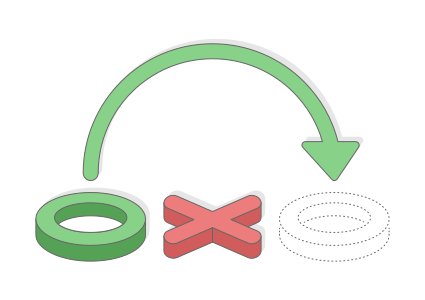 Every seasoned player should have a plan before the game begins. In roulette, there are two major types of progression strategies. Determining which one suits you best is a matter of personal preference, risk tolerance, and budget limits.
Negative Progression Systems
 One popular roulette strategy is the Martingale approach. This approach involves doubling your bet after every loss so that a subsequent win can recover the previous losses. For instance, if you lose a $5 bet, you would wager $10 on your next bet. This type of betting approach applies specifically to even-money bets such as red or black, 1-18 or 19-36, and odd or even. The problem with this strategy is that it can require substantial sums of money, and there is no guarantee that your luck will turn around. Keep in mind that the wheel has no memory.
| Roulette Martingale Betting System | |||
|---|---|---|---|
| Bet Number | Bet Size | Spin Outcome | Net Winnings |
| #1 | 1 | LOSS | -1 |
| #2 | 2 | LOSS | -3 |
| #3 | 4 | LOSS | -7 |
| #4 | 8 | WIN | +1 |
| #5 | 1 | WIN | +2 |
| #6 | 1 | LOSS | +1 |
| #7 | 2 | LOSS | -1 |
| #8 | 4 | WIN | +3 |
Positive Progression Systems
 Some players prefer positive progression betting. This technique involves increasing the bet after a win rather than after a loss. Keeping the wagers small can help ensure that any subsequent loss is not too substantial.
Bear in mind that each roulette outcome can be determined by a single spin of the wheel. Players who want to prolong their gaming sessions should manage their bankrolls carefully and stay within the available table limits. The most important principle is to maintain self-control whether you win or lose. This may be common advice, but it remains essential. Do not try to take revenge on the casino after a loss or chase life-changing sums during a lucky streak. Casino games should be treated as entertainment.
FAQ
Smart play starts with deciding what budget you can afford to spare for gambling purposes. Set aside a bankroll reserved exclusively for roulette play, and never gamble with money you need for essentials like your rent or electricity bill. Your bankroll’s size should be proportionate to the table limits of the roulette games you intend to play.
You can split your overall roulette budget for the day into several session bankrolls. Then set a win target that corresponds to your daily budget and walk away from the tables as soon as you reach it.
It depends on how often you intend to play during the respective month and for what stakes. The wisest thing to do would be to split your overall monthly roulette budget into several weekly or daily bankrolls. Each weekly/daily bankroll should then be divided into session bankrolls, assuming you plan on playing multiple sessions. Remember to hit pause until the calendar flips if you happen to lose your entire monthly bankroll.
Most roulette players bet in increments consisting of multiples of their base betting units. There is no specific rule for selecting a betting unit as its size generally depends on your overall session bankroll and table limits. For example, if you allocate $200 for your betting session and plan on joining a $5-minimum table, your base betting unit should be ideally $5 and no more than $10.
Picking a betting strategy that matches your bankroll and your individual risk tolerance is essential. Got a tight budget? Positive progression betting can make those wins count without a major risk. Conversely, if you are more daring and have a larger bankroll, you might try negative betting progressions like the Martingale but remember, the roulette wheel has no memory. Wins and losses do not follow a predictable pattern.