
Roulette Casino Systems
 | Updated:
 Best Roulette Systems Explained
 Roulette offers exciting gameplay and the thrill of anticipation. It is one of the most popular casino games among players worldwide. Roulette is predominantly a game of chance because there is no reliable way to predict the number on which the ball will land. Although a strategy cannot help you correctly predict the next winning number, a structured betting approach can help you manage your wagers and bankroll.
Roulette has long drawn the attention of players interested in number sequences and betting patterns. As a result, numerous betting systems have emerged, most of which aim to help players organize their wagers and manage their losses. Besides roulette, many well-known betting systems can be applied to other casino games, including blackjack and baccarat. Roulette is particularly suitable for applying betting systems because the player’s primary decision is where and how much to wager. However, no betting system can change the house edge or guarantee a profit in roulette.
Overall, there are three main types of betting systems: negative progression systems, positive progression systems, and flat betting systems. Common choices include the Martingale and Fibonacci systems, both of which are established roulette betting methods. Other systems examined below include the Parlay, Labouchere, and D’Alembert betting systems. Many systems require players to keep a record of previous wins and losses, and their risks may become more apparent over longer sessions. Roulette players should remember that betting systems can provide structure and support bankroll management, but they cannot predict outcomes. Keep reading to learn more.

-
 Sign Up Bonus
Up to $100
100% Bonus!9.7 -
Sign Up Bonus
Up to $30000
100% Bonus!9.4 -
Sign Up Bonus
Up to $1000
200% Bonus!9.3



Overview
 There are numerous betting systems that you can apply in roulette. They differ in how wagers are adjusted, but they all have one thing in common: each betting system provides only a plan for placing your bets. In games such as blackjack, these systems do not decrease the house edge or improve your chances of winning. The same principle applies to roulette, even though many betting systems have been designed specifically for the game. Most systems are easy to apply to roulette because your main decisions involve where and how much to bet.
In brief, a betting system is a plan that you can use to make more structured betting decisions. In many cases, you must consider your previous wins or losses before determining the size of your next wager. The plan is based on the outcome of each round, while other factors are generally not considered. Some systems involve greater risk than others, particularly when used over extended periods. No system can eliminate the house edge or ensure long-term profits.
Types of Betting Systems in Roulette
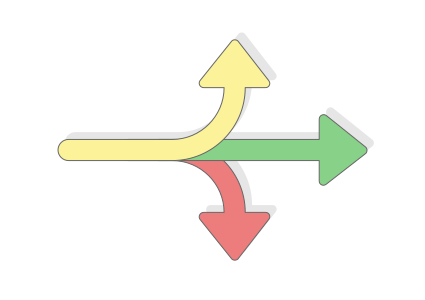 As noted above, each betting system is categorized according to its main principle: whether it requires you to increase or decrease your bet or consistently wager the same amount. Systems in which you increase your bet after a win are known as positive progression betting systems. In contrast, negative progression betting systems generally require you to decrease your wager after a win and increase it after a loss. This is why most negative progression systems are considered riskier than positive progression systems. To apply a negative progression system, you need a bankroll that can withstand the rapidly increasing wagers that may result from a losing streak.
Another type of betting system requires you to place a wager of the same size every time. These methods are known as flat betting systems because they do not involve changes to the betting pattern. When using flat betting, it is particularly important to set a reasonable amount for your initial unit. Flat betting systems use a more moderate approach, making it easier to plan your spending and avoid rapid increases in wager size.
Popular Betting Systems for Roulette
 Various betting systems have become popular among roulette players. These methods can help you manage your funds and keep track of game outcomes more easily. Instead of relying solely on intuition when choosing your wager size, you can follow a predefined set of rules. A betting system can add structure to your play and help you monitor wins and losses.
However, betting systems cannot overcome the house edge, and some can cause wager sizes to increase substantially before a win occurs. Their purpose is to provide an organized betting approach, not to guarantee profits or predict future outcomes.
Parlay Betting System
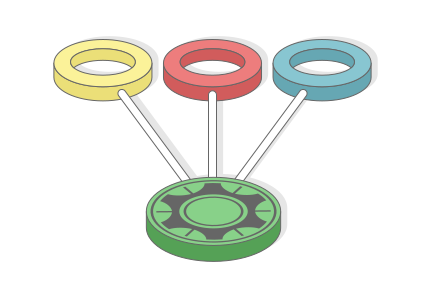 The Parlay betting system is classified as a positive progression system. Under its rules, you increase your wager after each win and continue doing so until you lose. After a loss, you return to your initial bet. If you use this system, you must consider the outcome of the previous round when determining the size of your next wager. Before each session, it is important to set a win goal and a betting limit and follow them carefully. Doing so can help you avoid continuing the progression for too long. The Parlay system does not change the house edge, and its risk increases as your wagers grow.
| Roulette Parlay Betting System | |||
|---|---|---|---|
| Bet Number | Bet Size | Spin Outcome | Net Winnings |
| #1 | 1 | LOSS | -1 |
| #2 | 1 | LOSS | -2 |
| #3 | 1 | WIN | -1 |
| #4 | 2 | WIN | +1 |
| #5 | 4 | WIN | +5 |
| #6 | 8 | LOSS | -3 |
| #7 | 1 | LOSS | -4 |
| #8 | 1 | WIN | -3 |
Labouchere Betting System
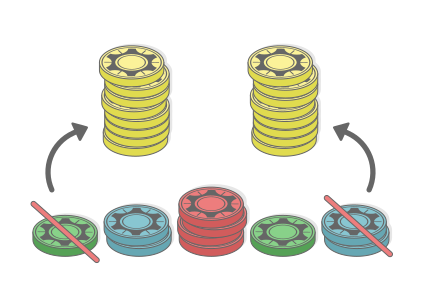 The Labouchere betting system belongs to the negative progression category, meaning that you generally increase your bet after a loss and reduce it after a win. It is one of the most popular but also one of the more complicated betting systems used by roulette players. The method uses a sequence of numbers to determine the size of each wager. Although the system is designed to recover previous losses when the sequence is completed, there is no guarantee that this will happen. Because Labouchere is a negative progression system, you need a bankroll capable of handling increasing bets during a losing streak. There is also a Reverse Labouchere betting system that applies the progression in the opposite direction.
| Roulette Labouchere Betting System | |||
|---|---|---|---|
| Bet Sequence | Bet Size | Spin Outcome | Net Winnings |
| 1-2-3 | 4 | LOSS | -4 |
| 1-2-3-4 | 5 | LOSS | -9 |
| 1-2-3-4-5 | 6 | LOSS | -15 |
| 1-2-3-4-5-6 | 7 | WIN | -8 |
| 2-3-4-5 | 7 | WIN | -1 |
| 3-4 | 7 | LOSS | -8 |
| 3-4-7 | 10 | WIN | +2 |
| 4 | 4 | WIN | +6 |
Martingale Betting System
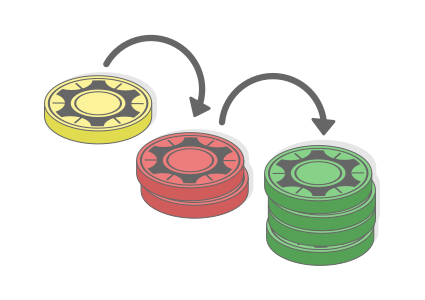 The Martingale betting system is a negative progression method in which you double your wager after every loss. After a win, you return to your original bet size. The underlying idea is that a winning bet will recover the accumulated losses and produce a profit equal to the initial betting unit. However, a long losing streak can cause the required wager size to increase very quickly. You could run out of funds or reach the table limit before placing the next required bet. Because this system can require very large wagers, players with limited bankrolls should approach it with particular caution.
| Roulette Martingale Betting System | |||
|---|---|---|---|
| Bet Number | Bet Size | Spin Outcome | Net Winnings |
| #1 | 1 | LOSS | -1 |
| #2 | 2 | LOSS | -3 |
| #3 | 4 | LOSS | -7 |
| #4 | 8 | WIN | +1 |
| #5 | 1 | WIN | +2 |
| #6 | 1 | LOSS | +1 |
| #7 | 2 | LOSS | -1 |
| #8 | 4 | WIN | +3 |
D’Alembert Betting System
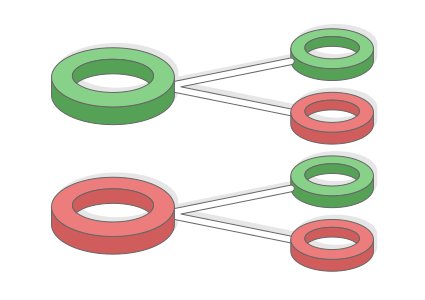 Another negative progression method is the D’Alembert system, which requires you to increase your wager after a loss and decrease it after a win. Initially associated with roulette, the system is now also applied to games such as baccarat, craps, and blackjack. It is used predominantly for even-money bets, making it particularly suitable for roulette. Unlike the Martingale system, D’Alembert adjusts the wager by one unit at a time. This creates a more gradual progression, but a long losing streak can still have a significant effect on your bankroll. A series of wins may help offset previous losses, but it cannot be relied upon to produce a profit.
| Roulette D’Alembert Betting System | |||
|---|---|---|---|
| Bet Number | Bet Size | Spin Outcome | Net Winnings |
| #1 | 5 | WIN | +5 |
| #2 | 4 | LOSS | +1 |
| #3 | 5 | LOSS | -4 |
| #4 | 6 | WIN | +2 |
| #5 | 5 | WIN | +7 |
| #6 | 4 | LOSS | +3 |
| #7 | 5 | WIN | +8 |
| #8 | 4 | WIN | +12 |
Fibonacci Betting System
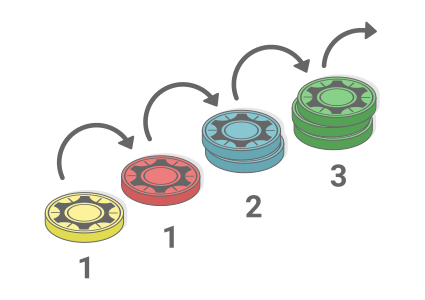 The Fibonacci betting system is a negative progression method based on the Fibonacci sequence of numbers. If you choose this system, you can select the value of your initial betting unit according to your available bankroll. The progression follows the Fibonacci sequence, with each new number equal to the sum of the previous two. Compared with the Martingale system, the wager size generally increases more gradually. However, the required bets can still become substantial during an extended losing streak and may significantly reduce your bankroll.
| Roulette Fibonacci Betting System | |||
|---|---|---|---|
| Bet Sequence | Bet Size | Spin Outcome | Net Winnings |
| 0-1 | 1 | LOSS | -1 |
| 0-1-1 | 2 | LOSS | -3 |
| 0-1-1-2 | 3 | LOSS | -6 |
| 0-1-1-2-3 | 5 | LOSS | -11 |
| 0-1-1-2-3-5 | 8 | LOSS | -19 |
| 0-1-1-2-3-5-8 | 13 | WIN | -6 |
| 0-1-1-2-3 | 5 | WIN | -1 |
| 0-1-1 | 2 | WIN | +1 |
Paroli Betting System
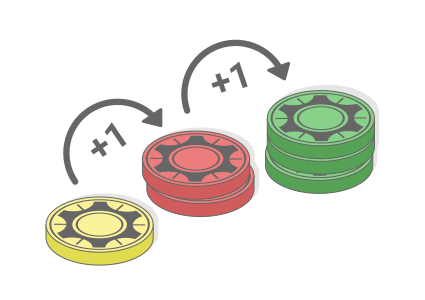 The Paroli Betting System is based on a positive progression, meaning that roulette players increase their wager after a win and return to their base unit after a loss. The system is intended to capitalize on winning streaks rather than recover losses through increasingly large wagers.
The Paroli Betting System is also known as the Reverse Martingale. Its underlying principle is straightforward: players double the staked amount after a winning bet and return to their chosen base unit after a loss. Players must decide in advance how long they will continue the progression, keeping in mind that the amount at risk increases with each consecutive win.
For example, assume that the selected base unit is $10. If the first $10 wager wins, the next bet is $20. If the $20 wager also wins, the third bet is $40. After winning the third bet, the player returns to the $10 base unit. If a loss occurs at any point, the player also returns to the $10 base bet.
The Paroli Betting System is widely used because it limits progression increases to winning streaks. Since players return to flat betting after a loss, the system does not require them to chase losses with rapidly increasing wagers. Nevertheless, an increased wager can still be lost, and the system cannot change the house edge or guarantee short-term profits.
Oscar’s Grind
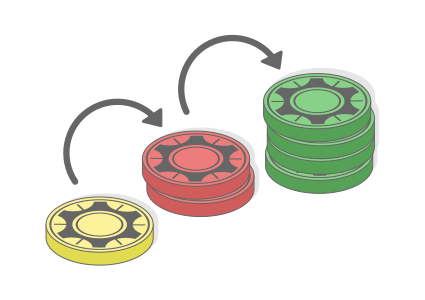 Roulette players looking for a relatively simple progression may consider Oscar’s Grind. Like several of the systems described above, it can be used on bets that pay even money. Its rules do not require complicated calculations, making the progression easier to follow than some sequence-based systems.
Before using Oscar’s Grind, players must choose a winning goal for the betting session. Although the progression is designed to work toward that goal, there is no guarantee that it will be reached. An extended sequence of unfavorable outcomes can consume a significant portion of the player’s bankroll.
Oscar’s Grind differs from negative progression systems such as Martingale, Fibonacci, and Labouchere. Instead of increasing the wager after a loss, players generally keep the same bet size. They increase the wager by one unit after a win, subject to the rules of the progression and the selected profit goal. The bet size increases more gradually than it does under the Martingale system, but losses can still accumulate over time.
To begin using the betting system, players must choose a bankroll, set a winning goal, and select a betting unit. After joining a roulette table, they place a wager equal to the chosen unit on black/red, even/odd, or high/low. If the wager loses, they keep the same stake for the next round. After a win, the next wager is increased by one unit, provided that doing so does not exceed the amount needed to reach the selected goal.
The progression can be illustrated as 1-2-3-4. Players add one unit to the wager after each win until they reach four units. They return to the beginning of the progression whenever their accumulated profit reaches the selected goal of one betting unit, regardless of the stage they have reached.
Consider an example to clarify how Oscar’s Grind works. Assume that you begin by betting one unit and the wager loses. On the next round, you place the same one-unit bet. If that wager wins, you increase the next bet to two units. If you then experience three consecutive losses, you continue betting two units until a wager wins. After that win, you increase the next wager to three units. If the following bet wins, you increase the wager to four units. If it loses, you continue wagering four units under the version of the progression described here.
Players should avoid betting more than four units under this version of the system. Increasing the wager beyond that point would involve greater risk and could have a serious effect on the bankroll during a long losing streak.
Kavouras Bet Roulette System
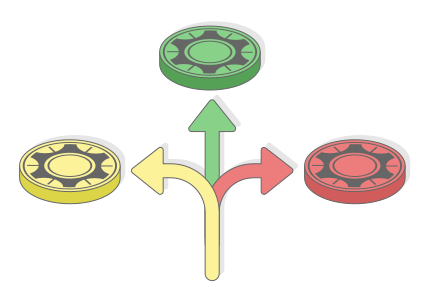 The Kavouras Bet is a roulette betting system that covers 20 numbers in total. Because the method covers a substantial portion of the wheel, winning outcomes may occur more frequently than they would with a single-number wager. However, the broader coverage also requires a larger total stake, and it does not remove the volatility or house edge of the game.
The numbers used by the system are distributed across different parts of the wheel. Another important feature is that the total amount wagered is not divided equally among all covered numbers. The resulting return depends on which number in the selection wins.
Although the covered numbers remain the same, the amount placed on each type of bet varies. Players who want to try the Kavouras Bet should use a single-zero roulette version. To apply the system, players place a corner bet on 0, 1, 2, and 3, which costs one unit.
Players then place five split bets on 8 and 11, 13 and 14, 15 and 18, 17 and 20, and 27 and 30. These five split bets require a total of eight betting units. Finally, players place a double-street bet covering 31, 32, 33, 34, 35, and 36, which requires two units.
The Kavouras Bet has another variant in which players do not place the corner bet on 0, 1, 2, and 3. Under this version, players cover 16 numbers in total, and the maximum available profit is also reduced.
The Shotwell Roulette Strategy
 Players can choose from a wide variety of roulette betting systems at land-based and online casinos. The Shotwell Strategy is a coverage-based approach that combines straight-up wagers with a six-line bet.
Like the Kavouras Bet, the Shotwell Roulette Strategy is neither a negative nor a positive progression because players do not adjust the value of their bets according to the outcome of the previous round. Its main feature is that it covers several parts of the wheel while combining bets with different payout rates.
For a single-zero roulette variant, players place six straight-up bets on 15, 27, 30, 9, 7, and 36, along with a six-line bet covering the numbers 1 through 6. Players may choose the value of each chip, but they need at least seven chips to place all the required wagers.
For double-zero roulette variants, the Shotwell Strategy involves straight-up bets on 20, 26, 8, and 10, as well as a six-line bet covering the numbers 1 through 6. This is not the only possible way to apply the strategy to American Roulette, but alternative six-line selections may produce a less even distribution across the wheel. Under the version described here, players use four chips for the straight-up bets and one chip for the six-line bet. The respective payouts are 35:1 and 5:1.
3/2 Roulette System
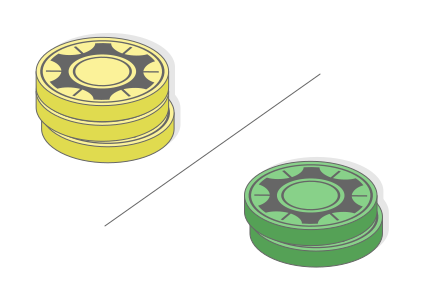 The 3/2 Roulette System is intended for players who prefer broader coverage of the roulette layout. This betting system can be used with a wager on red or black and combines two bets per spin: one on a color and another on a column.
To apply the 3/2 System with red, players make a three-unit bet on red and a two-unit bet on the middle column. If they prefer black, they place a three-unit wager on that color and a two-unit wager on the third column.
The logic behind the 3/2 System is that it covers a substantial portion of the roulette layout. A red or black wager covers 18 numbers and pays even money. A column wager covers 12 numbers and pays at a rate of 2:1. Because some of the numbers overlap, the two wagers do not cover 30 unique outcomes.
The color and column combinations are based on the distribution of red and black numbers across the three columns. The first column contains an equal number of red and black pockets. The second column contains eight black and four red pockets. When players wager on red and the middle column, the combined bets cover 18 red pockets and 8 additional black pockets. This represents 26 of the 37 pockets on a single-zero roulette wheel.
Conclusion
 Roulette offers numerous betting systems, each with its own rules, progression, and level of risk. To apply a system correctly, you need to understand its basic principles and set reasonable limits for your bankroll and wager size. Betting systems can provide structure, help you track wins and losses, and make it easier to follow a predefined plan. However, they cannot predict winning numbers, change the house edge, or guarantee a profit. Progression systems can also expose your bankroll to substantial losses, especially during extended sessions or losing streaks.
FAQ: Roulette Casino Systems
The Martingale system is notably beginner-friendly due to its simplicity. It requires you to double your bet after every loss and aims to help you recoup your losses with a single win. Remember, it requires a solid bankroll to withstand potential losing streaks, especially longer ones.
No system can guarantee wins in roulette. Each system, whether it’s the Martingale, Fibonacci, or D’Alembert, aims to help you manage your bets and potentially minimize your losses, but the game’s inherent randomness means outcomes can’t be predicted with certainty.
Yes, the Fibonacci system can be applied to any roulette variation. It involves following a betting sequence where each bet is equal to the total of the previous two numbers in the sequence. The Fibonacci is not for the faint of heart as its betting progression is steeper and more aggressive than the Martingale.
The D’Alembert system is suitable for smaller bankrolls. It involves increasing or decreasing your bet by one unit depending on the outcome, offering a more gradual bet increase that can help preserve your bankroll.
The Reverse Martingale, or Paroli, suggests doubling your bet after a win instead of a loss. It aims to capitalize on winning streaks, but remember to set a cap on how many consecutive wins you will chase to avoid significant losses.
Systems like Kavouras Bet or Labouchere add structure to your betting patterns and can make the game more engaging. However, effectiveness varies by player experience, not to mention no system can alter the house edge or guarantee profits.
High rollers might prefer the James Bond betting system, which involves placing higher bets across different segments of the roulette layout to cover more outcomes. Covering more outcomes obviously requires more money per round and involves significant risks.
No betting system can change the house edge in roulette. Such systems are strategies for wagering, not for altering the game’s odds. The house edge remains constant regardless of the betting pattern.
For cautious play, consider flat betting where you consistently wager the same amount. It doesn’t promise big wins but can help manage your bankroll effectively, making it a safer choice for risk-averse players.
Select a system based on your bankroll size, risk tolerance, and playing style. Systems offer structured betting approaches but remember, roulette is a game of chance. No system can provide consistent wins, so choose one that enhances your enjoyment of the game.