
Roulette Call Bets
 | Updated:
 What Are Roulette Call Bets?
 Roulette is a popular casino game with simple rules. It is one of the most popular games in both online and land-based casinos. Its basic rules have remained largely unchanged over the years. Roulette depends mostly on luck rather than strategy. Therefore, players should focus on understanding the available bets and wagering only money they can afford to lose.
Players can control their level of risk by placing specific bets on particular numbers or colors. Each type of bet has a different payout. Naturally, bets with a lower probability of winning offer higher payouts. Covering larger sections of the betting layout gives players a better chance of winning, but the payout is lower. To determine which options suit them best, players should understand the details of the different bet types and their payouts.

-
 Sign Up Bonus
Up to $500
400% Bonus!9.7 -
Sign Up Bonus
Up to $3500
350% Bonus!9.4 -
Sign Up Bonus
Up to $3000
300% Bonus!9.3






The rules of roulette are simple, but the complexity comes from the betting options available. To understand the different bets, every player should know that there are three main variations of the game: American, French, and European. In fact, European and French roulette tables follow many of the same rules. Some European tables also apply French roulette rules. Before playing, make sure you can access the betting layout comfortably and are familiar with the rules at the table.
We will start by introducing players to the main variations of roulette and the two main categories of bets, namely inside and outside bets. Then, we will provide further information about the betting options available on French roulette tables. We will examine the two major groups of call bets in detail: variable call bets and fixed call bets.
Variations of the Game
 Although the basic framework is the same for each game, the main difference lies in the number of pockets. In American roulette, there are thirty-eight pockets in total: thirty-six numbered pockets and two zero pockets. The presence of the second zero pocket increases the house edge to 5.26%, which is why American roulette is considered less advantageous to players than the other two variations. Although one might think that a single extra pocket is trivial, it can make a considerable difference in terms of risk.
On the other hand, European roulette has only one zero pocket, for a total of thirty-seven pockets. The single zero reduces the house edge significantly to 2.70%.
Placing a Bet
 The game starts when all players place their bets using the betting layout provided at every table. It includes an inside section containing all the numbers represented on the wheel. The outside section represents different categories of numbers, such as black/red, even/odd, and high/low. To place a bet, players need to put their chips on the appropriate section of the layout. The exact chip placement depends on the type of bet they want to make.
Additional Betting Options on the French Table
 In addition to the two bet categories common to all three variations of the game, another category is associated with French roulette. It is also available at many European and virtual tables. These wagers are known as “call bets.” The name hints at how the bet works. Players announce the bet aloud without initially covering it with chips. For this reason, it is also referred to as a bet on credit and is forbidden in most casinos.
Announced bets are similar to call bets, but money on the table covers the wager. These bets are made before the croupier announces “No more bets” and before the ball lands in a pocket on the wheel. There are several types of announced and call bets.




The Variable Call Bets
 Call bets fall into two major groups: “fixed” and “variable” bets. Variable bets cover numbers selected by the player rather than predetermined sections of the wheel. Several variable call bets are described below.
The Neighbors
The Neighbors bet covers five numbers in total. This type of bet involves wagering on one selected number and the two adjacent numbers on either side. The bet costs five chips and is placed as five straight-up bets. For instance, if a player places a Neighbors bet on 0, the wager covers 15, 32, 0, 26, and 3. With this type of bet, the player selects the central number, and the other four numbers are determined by its position on the wheel.
To calculate the odds of the bet, we need to consider that the French wheel has one zero pocket and 37 pockets in total. Therefore, the player’s chance of winning is 5 out of 37, which equals approximately 13.5%.
The Finals
This is another type of variable bet, also known as a “finale” bet. These wagers are divided into two types:
Finales en Plein Bet
This bet is placed on a digit selected by the player and on all other numbers ending with that digit. For example, if the selected digit is 3, the player places a “Finales 3” bet. This wager covers 3, 13, 23, and 33. Depending on the selected digit, the bet covers either three or four numbers. If the player selects 9 as the final digit, the bet is placed on 9, 19, and 29. The odds of winning are 8.1% for three covered numbers or 10.8% for four covered numbers.
Finales a Cheval Bet
This bet is similar to the Finales en Plein Bet. Here, the player selects two digits and wagers on all numbers ending with those digits. For instance, “Finales 4/5” covers 4, 14, 24, 34, 5, 15, 25, and 35. This wager uses a combination of split and straight bets, which can make it more complicated for inexperienced roulette players. Depending on the selected digits, the bet covers six or eight numbers and costs between three and five chips.
Full Complete Bet
The Full Complete Bet, also known as the Maximum Bet, is normally preferred by high-stakes roulette players. It covers every available inside bet involving a selected number. Although some players also use the Full Complete Bet to cover outside bets such as dozens and columns, this is rarely the case.
The main reason players favor this bet type is that it allows them to cover a wider range of numbers and spread the risk. It can also provide a substantial potential return when successful. Despite its appeal, players should remember that these bets can quickly deplete their bankroll because of the high total stake.
An important point to remember is that players do not place their own chips on the betting layout when making this bet. In a land-based casino, players tell the dealer that they want to make a Full Complete Bet. The wager can proceed once the dealer acknowledges the bet type and the amount staked.
If a player makes this bet on 17, they place a straight-up bet on that number, along with four split bets on 17/14, 17/16, 17/18, and 17/20. Additionally, they place four corner bets on 17/16/13/14, 17/18/14/15, 17/16/19/20, and 17/18/20/21. Finally, they make two six-line bets, one on 17/16/18/13/14/15 and another on 16/17/18/19/20/21.
The Fixed Call Bet
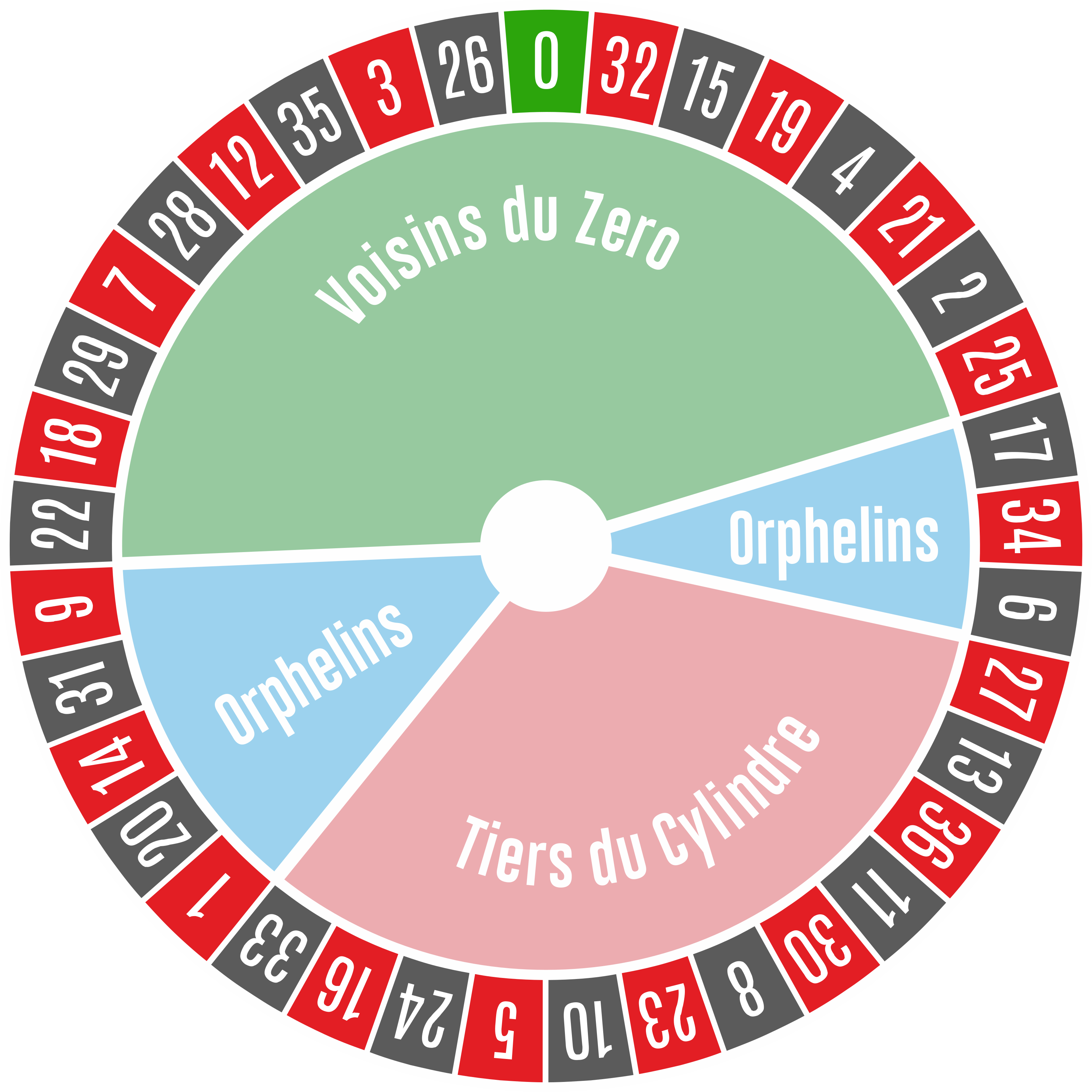
Unlike variable call bets, fixed call bets cover predetermined sections of the wheel. The wheel is divided into three main sections that define the different fixed bet types.
Voisins du Zero Bet
The name describes this type of bet. Those familiar with French will recognize that the wager covers the “neighbors of zero,” including zero itself. On the wheel, this is the section running from 22 to 25. In other words, the bet covers the following numbers: 22, 18, 29, 7, 28, 12, 35, 3, 26, 0, 32, 15, 19, 4, 21, 2, and 25.
The bet covers 17 numbers and combines split, trio, and corner bets. Players place two chips on the 0/2/3 trio and two chips on the 25/26/28/29 corner. The remaining numbers are covered by split bets, with one chip placed on each pair. The wager costs nine chips in total, and the odds of winning are approximately 45.9% because it covers the largest portion of the wheel.
Tiers du Cylindre Bet
This type of bet covers the 12 numbers opposite the “neighbors of zero” section. The name means “third of the wheel.” The bet covers 12 numbers in the section running from 27 to 33. These numbers are 27, 13, 36, 11, 30, 8, 23, 10, 5, 24, 16, and 33. It consists of six split bets and requires six chips. The odds of winning are approximately 32.4%, and it covers the second-largest portion of the wheel.
Orphelins Bet
This bet covers all numbers not included in either the Tiers du Cylindre or Voisins du Zero Bet. They are called orphans because they are not included in either of the two opposing sets. The numbers covered are 1, 6, 9, 14, 17, 20, 31, and 34. The wager costs five or eight chips, depending on which of the following subtypes the player selects:
Orphelins en Cheval Bet
This wager consists of four split bets and one straight-up bet on number 1. A distinctive feature of the Orphelins bet is the overlapping coverage of number 17. The split bets are 6/9, 14/17, 17/20, and 31/34.
Orphelins en Plein Bet
This wager consists of straight-up bets on all eight numbers. The player places one chip on each number.
Jeu Zero Bet
This type of wager is also known as the zero game. It is similar to the Voisins du Zero Bet, but it covers a smaller section of the wheel running from 12 to 15 and includes zero itself. This section contains seven numbers: 0, 3, 12, 15, 26, 32, and 35. Players cover these numbers using split bets on 0/3, 12/15, and 32/35, along with a single straight-up bet on 26.
Call bets are not offered by every casino, but they provide additional wheel-based betting options for roulette players. French roulette tables that offer these wagers allow players to choose from several established number groupings.
FAQ:
Call bets are special wagers in roulette, typical for land-based roulette tables where players can simply announce their wagers without placing chips on the table initially. They’re mainly found in French and European roulette variations. These bets cover specific sections of the roulette wheel, not the table layout, offering a quick way to bet on groups of numbers related by proximity on the wheel. Call bets have been also implemented in numerous online versions of roulette, allowing players to make more advanced bets.
The “Voisins du Zero” (Neighbors of Zero) covers a large swath of the wheel around the zero, including 17 numbers from 22 to 25. It’s a mix of split and corner bets requiring 9 chips. With almost half the wheel covered, your odds of winning are roughly 45.9%, making it a popular choice for many players.
The “Tiers du Cylindre” (Thirds of the Wheel) bet covers 12 numbers opposite the zero, offering a 32.4% chance of winning, with 6 chips being placed on split bets. The “Orphelins” (Orphans) bet coverd the numbers not included in the Voisins or Tiers call bets, using either straight or split bets, and including a unique overlap on number 17, offering a different strategic angle for betting.
The “Jeu Zero” (Zero Game) bet focuses on the numbers closest to zero, covering seven positions on the wheel with four bets (three splits and one straight on 26). It requires 4 chips and offers a targeted way to bet on this high-probability section of the wheel, appealing for players looking to capitalize on the wheel’s layout.
Call bets can significantly enhance your roulette strategy, allowing complex betting patterns without the need to place chips on every number individually. They offer a strategic depth, especially for