
Roulette Strategy
 | Updated:
 Best Roulette Strategies Explained
 Roulette has become one of the most popular games in the gambling community. It attracts many people with its simple rules and variety of betting options. It is often referred to as a game of chance that relies on luck. That is reasonable, but it does not mean you need to place your bets without a plan.
The game has developed considerably over the years, and certain strategies can help players structure their bets and manage their bankrolls. Playing according to a plan may help limit substantial losses. Many inexperienced players believe there is no logic involved in roulette and simply place their bets at random. However, structured betting systems do exist, and the following article introduces some of the strategies most widely used by experienced players.
Most importantly, players should know that no strategy guarantees success. However, many strategies can support more disciplined bankroll management. Based on how players adjust the amount wagered after each spin, we can distinguish between positive and negative progression systems. We will cover the most popular systems, including the Martingale, the Grand Martingale, the Reverse Martingale, the D’Alembert System, the Reverse D’Alembert System, the Labouchere System, the Reverse Labouchere System, the Fibonacci System, the Paroli System, and the 1-3-2-6 System. Additionally, we will examine the concept of biased roulette wheels and the potential impact of the dealer’s signature.

-
 Sign Up Bonus
Up to $100
100% Bonus!9.7 -
Sign Up Bonus
Up to $30000
100% Bonus!9.4 -
Sign Up Bonus
Up to $1000
200% Bonus!9.3



The Choice of a Strategy
 Many people believe that roulette strategies are ineffective, often because they have tried them and experienced substantial losses. This may occur because, to follow a particular strategy properly, each player must consider their betting preferences, win goals, loss limits, and gambling budget. Moreover, you should not only understand the basics of your chosen system but also be familiar with its finer details. No strategy will guarantee a life-changing amount of money, but the methods described below can support realistic betting and bankroll goals.
The odds in roulette and the casino’s mathematical advantage are commonly expressed through the house edge. In single-zero French roulette, the standard house edge is around 2.7%. In American roulette, the house edge is roughly 5.26%, making the French version more favorable to players.
Despite the house edge, roulette has become one of the most popular games in both land-based and online casinos. Several strategists have devised theories intended to give players an advantage. Most of these theories have proven ineffective, but some provide structured approaches to betting and bankroll management.
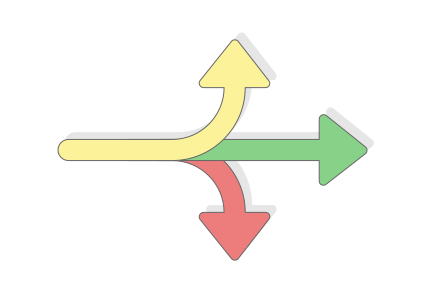
We can outline two major categories of strategies. Depending on how the wager changes after each spin, there are positive and negative progression systems. When using a positive progression system, players increase the stake after a win and decrease it after a loss.
The Martingale
 The Martingale betting system is one of the most widely used systems because of its simplicity, as there are no complicated equations to memorize. With this in mind, the Martingale might seem like a path to easy money, but players should remember that it involves significant risk for a limited potential profit.
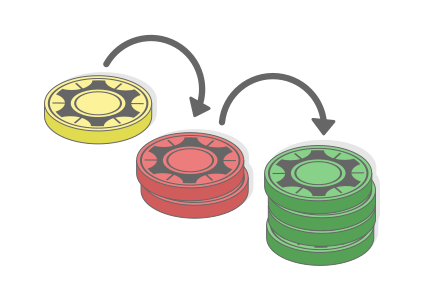
The idea is that players double their wagers after a loss and return to their original stake after a win. In this way, one win following several losses can leave players with a profit equal to the original bet. Here is a simple example.
It is important to note that players who want to follow the Martingale system are generally advised to use bets that pay even money. Although these bets offer the lowest payouts, they also have the highest chances of winning.
You start with $1 and lose. You then place $2 and lose again. In the third round, you lose $4. In the fourth round, you place $8 and win. Before the winning bet, you have lost $7 in total. An $8 winning bet covers those losses and leaves you with a net profit of $1. If you follow this strategy, you need to double the wager after every loss and reset it to its initial value after a win. This is an example of a negative progression system.
Unfortunately, applying this strategy may cause you to reach the table limits very quickly, preventing you from continuing to use it. Many people believe that long losing streaks are unlikely, but roulette spins produce random outcomes, so you should not rely on luck to end a losing streak.
If you are considering the Martingale betting system, keep in mind that it may not be suitable if your bankroll is limited because the amount wagered will quickly escalate after multiple losses in a row.
Moreover, casinos are familiar with these systems, which is one reason tables have minimum and maximum betting limits.
| Roulette Martingale Betting System | |||
|---|---|---|---|
| Bet Number | Bet Size | Spin Outcome | Net Winnings |
| #1 | 1 | LOSS | -1 |
| #2 | 2 | LOSS | -3 |
| #3 | 4 | LOSS | -7 |
| #4 | 8 | WIN | +1 |
| #5 | 1 | WIN | +2 |
| #6 | 1 | LOSS | +1 |
| #7 | 2 | LOSS | -1 |
| #8 | 4 | WIN | +3 |
The Grand Martingale
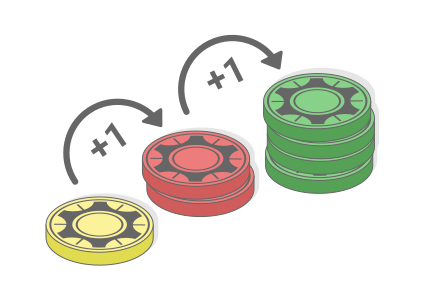 As a variation of the Martingale strategy, the logic behind the Grand Martingale is very similar. You double your bet and add one more unit after each loss. This is an even faster way to reach the table limits because the amount wagered increases more quickly after each loss.
For example, you start with $1. On the next spin, you place $3 (1 × 2 + 1 = 3), then you bet $7 (3 × 2 + 1 = 7), and so on. The advantage of this strategy is that after a winning spin, you can earn a greater profit than the initial bet. The strategy is designed for even-money outside bets.
For example, after losing bets of $1, $3, and $7, you need to place $15. If this even-money bet wins, you receive $30 in total, including your returned stake. This means that you have wagered $26 over the cycle and received $30, so your net profit is $4. Thus, the gain equals the initial bet plus one unit for each loss in the consecutive streak. As a more aggressive variation of the Martingale, it is also a negative progression system.
These systems may appeal to players who have larger bankrolls and are willing to take greater risks. Players should be cautious with the Grand Martingale because the chances of reaching the table limit or losing their entire bankroll are significantly higher.
| Roulette Grand Martingale Betting System | |||
|---|---|---|---|
| Bet Number | Bet Size | Spin Outcome | Net Winnings |
| #1 | 1 | LOSS | -1 |
| #2 | 3 | LOSS | -4 |
| #3 | 7 | LOSS | -11 |
| #4 | 15 | LOSS | -26 |
| #5 | 30 | WIN | +4 |
| #6 | 1 | LOSS | +3 |
| #7 | 3 | WIN | +6 |
| #8 | 1 | LOSS | +5 |
The Reverse Martingale
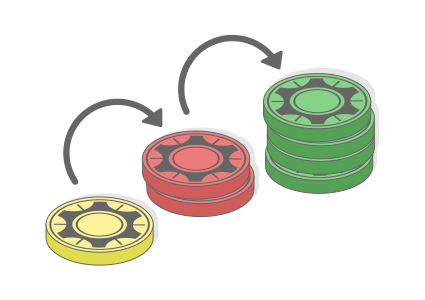 As the name suggests, the main idea of this strategy is the opposite of the Martingale system, so the bets move in the opposite direction. As the counterpart to the Martingale, the Reverse Martingale is a positive progression system.
You double your bet after every win and return to the initial amount after every loss. The system can be risky because one loss may erase the profit from a winning streak.
For instance, you bet $1 and win, earning a net profit of $1. You then place $2 and win again, bringing your accumulated profit to $3. Your next bet is $4. If it loses, that loss wipes out the $3 profit and one additional unit. Since each spin of the wheel produces a random outcome, it is impossible to predict when a winning streak will end. Therefore, this strategy is generally used for short betting cycles. One of the system’s biggest weaknesses is that one losing bet can wipe out the profit players have accumulated. In addition, although individual losing bets may not cost players as much as they would under the Martingale system, losses can still occur frequently. Players should also consider the possibility of depleting their bankroll through repeated losses.
| Roulette Reverse Martingale Betting System | |||
|---|---|---|---|
| Bet Number | Bet Size | Spin Outcome | Net Winnings |
| #1 | 1 | WIN | +1 |
| #2 | 2 | WIN | +3 |
| #3 | 4 | WIN | +7 |
| #4 | 8 | LOSS | -1 |
| #5 | 1 | LOSS | -2 |
| #6 | 1 | WIN | -1 |
| #7 | 2 | WIN | +1 |
| #8 | 4 | WIN | +5 |
The D’Alembert System
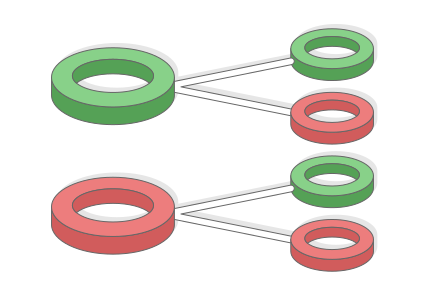 One of the most attractive aspects of this strategy is that stakes increase more gradually than they do with the Martingale, which is why many players favor it. The method is also known as a pyramid system, and the main idea is to decrease the bet by one unit after a win. After a loss, players increase the next bet by one unit. This makes the D’Alembert less aggressive than the Martingale system. It may be more appropriate for smaller bankrolls, and players are less likely to reach the maximum table limit as quickly as they would with the Martingale.
As with the roulette systems mentioned above, the D’Alembert method is designed for even-money bets. Before using the system, roulette players should choose a betting unit that does not exceed 1% of their funds.
A notable feature of the D’Alembert strategy is that when wins and losses occur at adjacent stake levels, each paired win and loss can produce a gain of one unit. For example, if a $5 bet loses and the following $6 bet wins, the net result is a profit of $1.
The biggest advantage of this betting system is that it is not as aggressive as the systems mentioned above, meaning the chances of reaching the table limits are lower. The system is also straightforward and relatively easy to understand, even for beginners.
The main disadvantage of the D’Alembert system is that it generally does not produce substantial profits, but lower-risk systems also tend to offer more limited returns. Another disadvantage is the decreasing stake after each win. During a long winning streak, players may reach the minimum table limit and be unable to continue reducing the wager.
Using the strategy at a French table with a single zero provides a lower standard house edge than playing at a double-zero table.
| Roulette D’Alembert Betting System | |||
|---|---|---|---|
| Bet Number | Bet Size | Spin Outcome | Net Winnings |
| #1 | 5 | WIN | +5 |
| #2 | 4 | LOSS | +1 |
| #3 | 5 | LOSS | -4 |
| #4 | 6 | WIN | +2 |
| #5 | 5 | WIN | +7 |
| #6 | 4 | LOSS | +3 |
| #7 | 5 | WIN | +8 |
| #8 | 4 | WIN | +12 |
The Reverse D’Alembert System
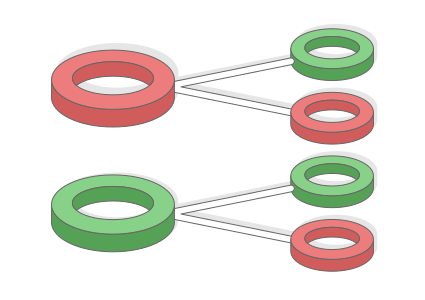 This is the positive progression counterpart of the regular D’Alembert system, meaning that the rules are reversed.
The Reverse D’Alembert, also known as the Contra D’Alembert, requires that players increase the initial bet by one unit after every win and decrease it by one unit after a loss.
This strategy relies on sequences of wins, but no one can predict when a winning streak will end. Moreover, with an equal number of consecutive wins and losses, you may be down by the number of losses. Players should therefore bear in mind that they need more wins than losses to earn a net profit when applying this strategy.
Still, the Reverse D’Alembert can be used by players with limited bankrolls or those who are more risk-averse. It increases stakes gradually after wins and reduces them after losses.
| Roulette Reverse D’Alembert Betting System | |||
|---|---|---|---|
| Bet Number | Bet Size | Spin Outcome | Net Winnings |
| #1 | 5 | WIN | +5 |
| #2 | 6 | LOSS | -1 |
| #3 | 5 | LOSS | -6 |
| #4 | 4 | WIN | -2 |
| #5 | 5 | WIN | +3 |
| #6 | 6 | LOSS | -3 |
| #7 | 5 | WIN | +2 |
| #8 | 6 | WIN | +8 |




The Labouchere System
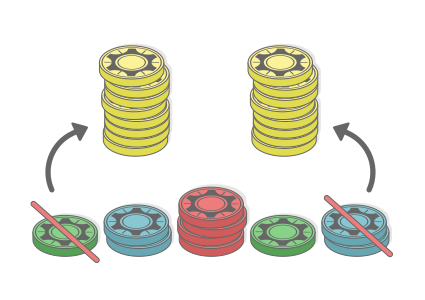 The name may be unfamiliar to casual players, but this system is popular among more experienced players. It is also known as a cancellation strategy, and it is one of the most widely used roulette systems because it gives players a structured way to pursue a predetermined win goal. However, it is also one of the more complicated strategies and is used only with even-money outside bets. Applying this method may require a pen and notebook because it involves several calculations.
The first thing players must do before using the betting system is set a win goal. They then write down a sequence of numbers that adds up to the value of that goal. For example, if your sequence is 1, 2, 3, the total value of the numbers is 6, which represents the profit you want to earn.
The amount of your bet is calculated by adding the first and last numbers in the sequence. With the sequence above, that would be 1 + 3 = 4, so the bet is $4. If you win, the first and last numbers in the sequence are canceled. You then continue with the remaining numbers. In this example, only the number 2 remains, so the next bet is $2. If the original sequence is 1, 2, 3, 4 and the first bet wins, you cancel 1 and 4. You are then left with 2 and 3, making the next bet $5. If that wager wins, the cycle ends, and you can begin another sequence.
Every time you lose a wager, you add the amount of that wager to the end of the sequence. Consider the sequence 1, 2, 3. After losing the first bet of $4, you add 4 to the end of the sequence. After one loss, the sequence becomes 1, 2, 3, 4. When you lose a wager, do not cross out any numbers. Instead, add the lost wager to the sequence.
Suppose you win the next wager. You cancel 1 and 4, leaving 2 and 3. Your next wager should be $5. If you lose it, you add 5 to the sequence because the amount of the lost bet becomes the next number. The sequence will then be 2, 3, 5.
No matter how long the sequence becomes, canceling all the numbers leaves you with a net gain equal to the sum of the numbers in the initial sequence. This indicates that you have reached the win goal set at the beginning of the betting session.
The Labouchere is a negative progression system that inexperienced players may find difficult because of its complexity. Many players are attracted to it because a sequence can potentially be completed with fewer winning bets than losing bets, as one win may cancel two numbers from the sequence. The problem is that the wheel has no memory, and you never know when a losing streak will end. It is a mistaken belief that it is impossible to lose the same outside bet twice in a row. This is known as the gambler’s fallacy, which has led many players to lose substantial amounts of money.
Another problem with the strategy is that after a long losing streak, players risk reaching the table’s maximum limit. This prevents them from continuing the sequence as planned and attempting to recover previous losses through the system.
| Roulette Labouchere Betting System | |||
|---|---|---|---|
| Bet Sequence | Bet Size | Spin Outcome | Net Winnings |
| 1-2-3 | 4 | LOSS | -4 |
| 1-2-3-4 | 5 | LOSS | -9 |
| 1-2-3-4-5 | 6 | LOSS | -15 |
| 1-2-3-4-5-6 | 7 | WIN | -8 |
| 2-3-4-5 | 7 | WIN | -1 |
| 3-4 | 7 | LOSS | -8 |
| 3-4-7 | 10 | WIN | +2 |
| 4 | 4 | WIN | +6 |
The Reverse Labouchere System
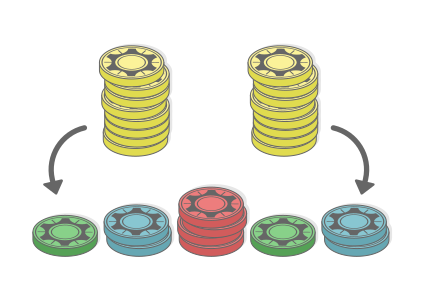 Like the regular version of the strategy, the Reverse Labouchere requires a sequence of numbers, and the first bet is the sum of the first and last numbers in that sequence. From that point onward, the rules differ. In the reverse version, players add the amount of the last bet to the sequence after a win. If a loss occurs, the first and last numbers in the sequence are canceled. When all the numbers in the sequence are crossed out, the result is a loss rather than a win.
| Roulette Reverse Labouchere Betting System | |||
|---|---|---|---|
| Bet Sequence | Bet Size | Spin Outcome | Net Winnings |
| 1-2-3 | 4 | WIN | +4 |
| 1-2-3-4 | 5 | WIN | +9 |
| 1-2-3-4-5 | 6 | WIN | +15 |
| 1-2-3-4-5-6 | 7 | LOSS | +8 |
| 2-3-4-5 | 7 | LOSS | +1 |
| 3-4 | 7 | WIN | +8 |
| 3-4-7 | 10 | WIN | +18 |
| 3-4-7-10 | 13 | LOSS | +5 |
The Fibonacci System
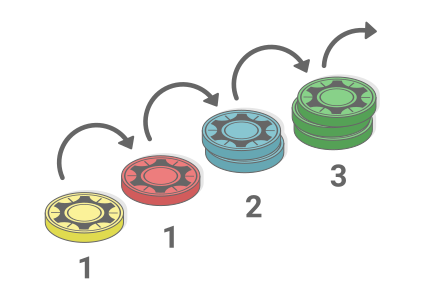 The Fibonacci system is used when placing even-money outside bets. The strategy uses negative progression because players increase the wager after each loss. The Fibonacci sequence starts with 0 and 1, and each subsequent number is the sum of the previous two. The sequence is as follows: 0, 1, 1, 2, 3, 5, 8, 13, etc.
When applying the strategy to roulette, 0 is ignored. Before using this method, you need to decide how much you will wager per unit. The amount is chosen by the player and should represent between 2% and 5% of the overall bankroll for the betting session.
Following the Fibonacci system means that your first bet should be one betting unit because the first usable number in the sequence is 1. For example, you start by placing $5. If you lose after the first spin, you move to the second unit in the sequence, which is also 1, so the second stake is again $5. For a two-unit wager, the stake would be $10. Every time you lose, you move forward in the sequence. On the other hand, when you win a bet, you move back two numbers in the sequence. For example, if you win after betting 34 units, the rules of the system require you to stake 13 units in the next round.
As with other negative progression systems, the main problem with the Fibonacci strategy is the risk of a long losing streak. In that case, you will continue moving forward in the sequence, and your stakes may become high enough to reach the table maximum. You therefore need to track your position in the sequence carefully. This may be difficult in a land-based casino because of the surrounding distractions. Players may find it easier to track the Fibonacci sequence when playing online.
| Roulette Fibonacci Betting System | |||
|---|---|---|---|
| Bet Sequence | Bet Size | Spin Outcome | Net Winnings |
| 0-1 | 1 | LOSS | -1 |
| 0-1-1 | 2 | LOSS | -3 |
| 0-1-1-2 | 3 | LOSS | -6 |
| 0-1-1-2-3 | 5 | LOSS | -11 |
| 0-1-1-2-3-5 | 8 | LOSS | -19 |
| 0-1-1-2-3-5-8 | 13 | WIN | -6 |
| 0-1-1-2-3 | 5 | WIN | -1 |
| 0-1-1 | 2 | WIN | +1 |
The Paroli System
 The Paroli strategy is often referred to as the counterpart of the Martingale betting system, and in addition to roulette, it can also be used in craps and baccarat. This is a positive progression system because players double the bet after a win and return it to the initial amount after a loss. Many players favor this system because of its simplicity. Its main purpose is not to recover previous losses but to maximize gains during a winning streak. Moreover, it discourages players from chasing losses because, after the third consecutive win, they return to their base stake. Another advantage of the Paroli system is that the limit placed on the progression may reduce the risk of depleting the bankroll.
This strategy is designed for even-money outside bets. The betting unit should represent between 2% and 5% of the overall budget for the betting session.
| Roulette Paroli Betting System | |||
|---|---|---|---|
| Bet Number | Bet Size | Spin Outcome | Net Winnings |
| #1 | 1 | LOSS | -1 |
| #2 | 1 | LOSS | -2 |
| #3 | 1 | WIN | -1 |
| #4 | 2 | WIN | +1 |
| #5 | 4 | WIN | +5 |
| #6 | 8 | LOSS | -3 |
| #7 | 1 | LOSS | -4 |
| #8 | 1 | WIN | -3 |
The 1-3-2-6 System
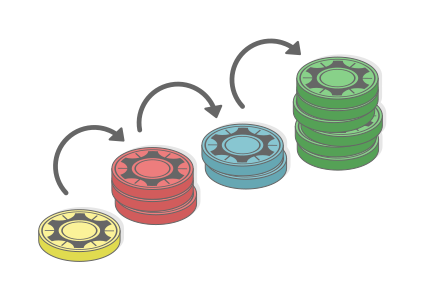 Like the Paroli strategy, this is a positive progression system. Because the stake resets after a loss, the progression does not involve the same rapid increases seen in negative systems such as the Martingale. It is also straightforward enough for beginners to understand. You place your wager on an even-money outside bet, determine your betting unit, and place your first stake. By doing so, you begin a sequence that follows the 1-3-2-6 pattern. If you win, you move to the next number in the sequence. For instance, if you place $10 on the first spin, your next bets should be $30, $20, and finally $60. If a loss occurs, you start the sequence again from the beginning.
One of the main advantages of this strategy is that it does not increase the bet after a loss. Moreover, it offers moderate bets based on the initial betting unit. The drawback is that the house edge remains in effect. No strategy eliminates the house edge, but European and French tables have more favorable odds than American tables, especially when special rules are available.
| Roulette 1-3-2-6 Betting System | |||
|---|---|---|---|
| Bet Sequence | Bet Size | Spin Outcome | Net Winnings |
| 1 | 10 | LOSS | -10 |
| 1 | 10 | WIN | 0 |
| 1-3 | 30 | LOSS | -30 |
| 1 | 10 | LOSS | -40 |
| 1 | 10 | WIN | -30 |
| 1-3 | 30 | WIN | 0 |
| 1-3-2 | 20 | WIN | +20 |
| 1-3-2-6 | 60 | WIN | +80 |
There are several approaches you can take at the roulette table. The purpose of these strategies is not to beat the wheel but to provide structure and help you manage your bankroll. Following a defined method may make it easier to track your wagers and maintain betting limits.
Biased Roulette Wheels
 Although single-zero roulette variants offer a lower house edge than double-zero games, casino players should remember that the house still holds the mathematical advantage. Even if players choose European Roulette, where the standard house edge is 2.70%, or French Roulette, where special rules can reduce the house edge, no betting system can eliminate the house edge.
In an attempt to earn a profit, some players use the betting systems described above during their roulette sessions, while others consider looking for defects in roulette wheels. Finding a biased roulette wheel was more likely in the past because modern technology and maintenance practices have made such defects less common.
In land-based casinos, management should ensure that the wheel is in proper working order so that the outcomes remain unpredictable. This includes checking that the wheel is level, all pockets have the same depth, and no area causes the ball to move differently. Such defects could make the ball behave more predictably, which attentive players might notice and attempt to exploit.
Of course, finding a biased roulette wheel is extremely difficult, and players would need to track a large number of spins to identify a meaningful pattern. If the scoreboard showing the previous 20 outcomes indicates that one number has appeared several times, this does not mean the wheel has a genuine bias. A specific number or group of numbers would need to appear unusually often over thousands of rounds before a player could reasonably suspect a bias.
Finding a roulette wheel with such a defect could work to a player’s advantage because it might help offset the house edge by indicating which number or group of numbers is more likely to appear.
Biased roulette wheels can develop for several reasons, most commonly through frequent use. An important point to remember is that some roulette wheels show pocket bias, while others cause the ball to favor entire sectors. The primary causes of bias include loose or raised frets, differences in pocket size, surface wear, or a deformed ball, among other defects.
In online roulette games, outcomes are controlled by a random number generator, which is designed to produce random results comparable to those of a properly functioning roulette wheel.
The Impact of the Dealer’s Signature
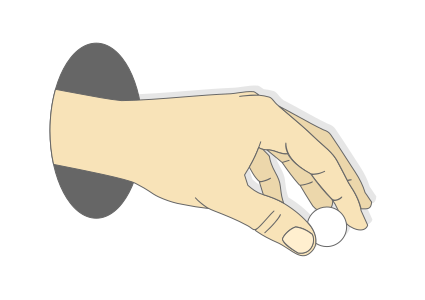 While trying to gain an advantage over the house, some roulette players closely observe how the dealer releases the ball. This is known as the dealer’s signature. The question of whether a dealer can land the ball in a preferred pocket is highly controversial. Some experts reject the idea entirely, while others accept it only to a limited extent.
The main reason many players doubt the dealer’s signature theory is that roulette wheels have obstacles known as diamonds or pins, which cause the small white ball to bounce. These obstacles make the ball change course, preventing the dealer from determining the pocket in which it will ultimately land.
Players should also remember that the ball bounces against the frets. This creates another obstacle for any dealer attempting to determine where the ball will land.
Identifying patterns in how a dealer releases the ball might seem easy, but even if you notice such patterns, the dealer may be unaware that he or she releases the ball in the same way during each round. Although some players believe this approach can help them reach their win goals, it may not be as effective as expected because roulette wheels are designed to produce random outcomes.
FAQ
Think of roulette strategies as your gaming GPS. They won’t guarantee a jackpot destination, but they can navigate you through your betting endeavors. While Lady Luck still reigns supreme, a well-picked strategy keeps your bets from going off-road.
Betting systems focus on providing a pattern to follow to ensure bankroll management, having no effect on the wheel. They can’t nudge the odds in your favor, but they’re great at pacing your play. Whether it’s Martingale or Fibonacci, the goal is to manage wins and losses in a structured way.
For a smoother ride, even-money outside bets are your best bet. They’re the cruise control of roulette betting, offering a balance of risk and reward. Think red or black, even or odd, high or low. These wagers are not that thrilling, but you’ll likely stick around longer.
Setting up your roulette bets using the Martingale system is like playing chicken with your bankroll. Double down after a loss, and you could either recover beautifully or crash spectacularly. It’s thrilling but watch out for table limits – they’re the real buzzkillers.
Enter D’Alembert – the cooler, more collected cousin of Martingale. While following similar principles, this system advises you to up your bet gradually after losses and decrease it after wins. It’s like easing into a hot bath, not as jarring as the Martingale but still keeping the bankroll increase at a nice rate.
Many consider positive betting systems to be less risky. If you want to implement this type of betting strategy, you can start with the Paroli system. It’s all about doubling down on wins, not losses. It’s like surfing a winning wave – just know when to paddle back to shore before it crashes.
In today’s high-tech casino world, finding a biased wheel is like finding a needle in a haystack. Casinos make sure to regularly check roulette wheel mechanics, while online roulette games rely on RNG technology to guarantee a random outcome on every spin. Online and modern casinos keep their wheels in check so we don’t recommend banking your whole game plan on finding biased wheels.
The idea of a dealer’s actions having any effect on the game of roulette is tantalizing. The truth is that roulette wheels and balls are designed to be random, meaning there is no way for the dealer to interfere with them. It’s fun to speculate, but don’t put your money on it.
Fibonacci is like a scenic route through your bets – it’s beautiful and mathematical, but it won’t necessarily get you there faster. It’s a less aggressive climb than Martingale, but remember, each spin is still a fresh start.
Your perfect strategy match depends on your bankroll, risk appetite, and what kind of game experience you’re after. If you want to experience more excitement, Martingale is the system for you. If you prefer a more chilled session, then we suggest trying D’Alembert. Experiment, but always have a budget plan.