
Baccarat House Edge and Odds
 | Updated:
 Learning the Odds of Winning in Baccarat
 Baccarat is a classic casino game with a simple set of rules, entertaining gameplay, and potentially rewarding outcomes. Like any game of chance, baccarat has a house edge that represents the casino’s mathematical advantage over players. There are three main betting options in baccarat, each with different odds of winning.
If you want to know which baccarat bet is best, you must first become familiar with the odds of each option. This information can help you determine which wager offers the most favorable potential return. Remember, however, that the casino will always maintain an edge over players. The sections below explain how this advantage is achieved by examining the odds and house edge of every main baccarat bet.

-
 Sign Up Bonus
Up to $3500
350% Bonus!9.7 -
Sign Up Bonus
Up to $500
400% Bonus!9.4 -
Sign Up Bonus
Up to $2000
200% Bonus!9.3










Baccarat House Edge
 Two of the most important factors every player should consider before playing a casino game are its house edge and odds. These figures can vary depending on the casino and the specific game variation. Baccarat is often played with high stakes, so understanding its house edge is especially important when the minimum bet is significantly higher than in many other table games. Players should take the time to become familiar with their chances of winning before betting substantial amounts of money. This is also why baccarat is a favorite game among many high rollers, as it suits their betting habits and playing style.
Baccarat is a casino game with a relatively low house edge. The most common rules offer a house edge of 1.06% on the Banker bet, 1.24% on the Player bet, and 14.36% on the Tie wager. However, players should always check the rules beforehand to ensure they have not been altered in the casino’s favor. On average, it is estimated that the Banker wins around 50.68% of non-tie bets, whereas the Player wins 49.32%. The difference between these percentages helps explain the Banker’s statistical advantage.
There is not much difference between these probabilities, so the Banker bet alone does not provide the casino with a sufficient built-in advantage. To maintain its edge, the casino typically collects a 5% commission on every winning Banker bet. This commission preserves the house advantage and prevents players from gaining a long-term mathematical edge.
Wagering Odds
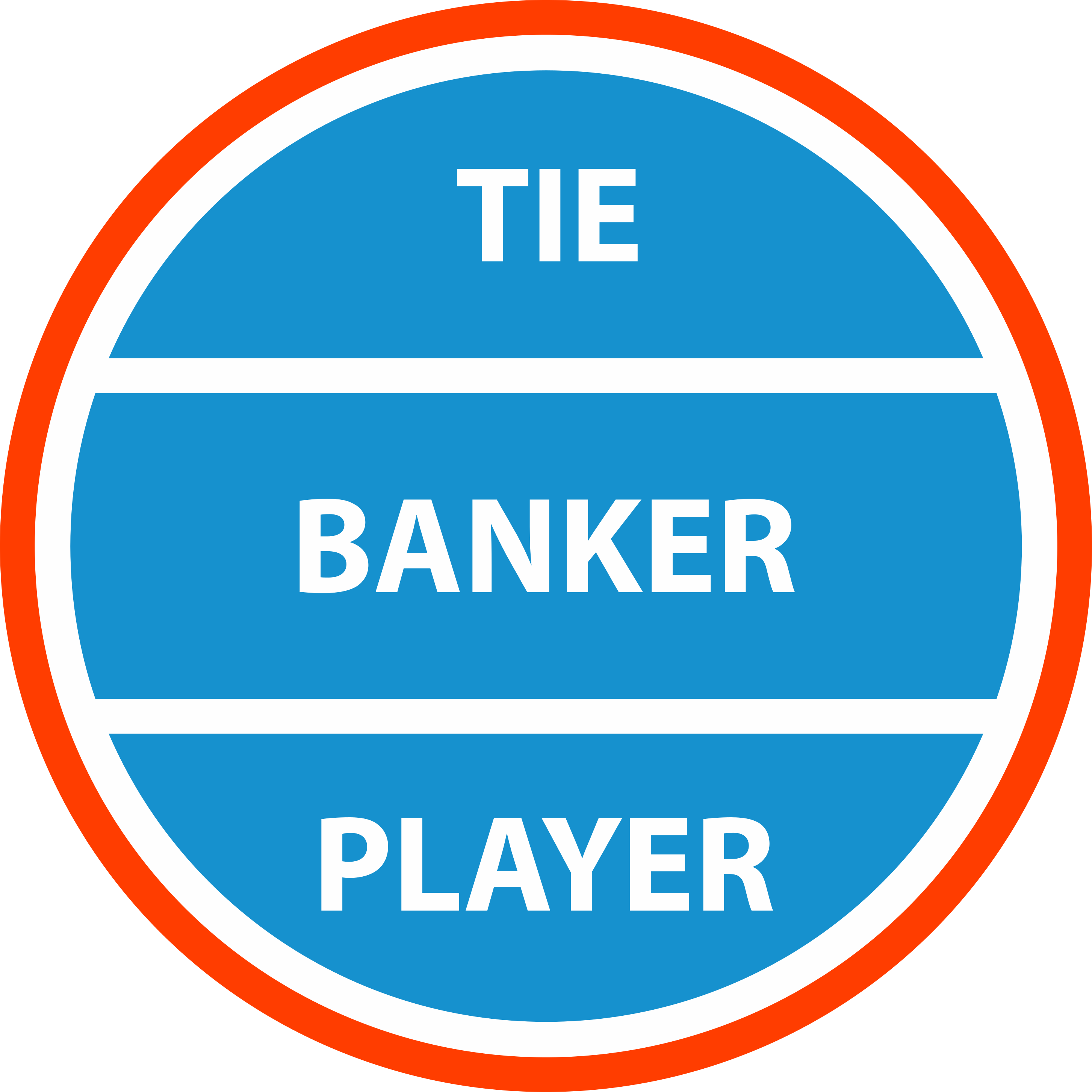
 The rules of baccarat are relatively easy to learn. One of the basic rules concerns the available types of bets. Players can choose among three options when placing their chips on the table. Each table has designated areas labeled Player, Banker, and Tie. These are the main wagers available during the game. Each one has different odds, so you should understand them before deciding where to place your money.
The odds differ significantly among the three bets. If players place a wager on the Player section, the house edge is estimated to be 1.24%. If they choose the Banker section, it is 1.06%. However, the Tie bet has a much higher house edge of 14.40%.
| Baccarat Wagering Odds and House Edge | |
|---|---|
| Bet Type | House Edge |
| Banker | 1.06% | Player | 1.24% |
| Tie | 14.40% |
The Bet with the Worst Odds
 The Tie bet is worth discussing because it has an exceptionally high house edge. The odds of this wager are clearly unfavorable to players, so it is generally best avoided. Although its 8-to-1 payout may be tempting, its odds are considerably worse than those of the other available bets.
The Bet with the Best Odds
 After comparing the odds, it is easy to identify the bet with the lowest house edge. Players seeking the most favorable odds should choose the Banker section, as its house edge is the lowest. Even with the 5% commission collected by the casino on winning Banker bets, this remains the best of the three main options.
The Banker bet has the lowest house edge because it is more likely to win. The Banker hand is completed last, giving it a slight advantage over the Player hand. In addition, the Banker’s drawing decision depends largely on the cards drawn to the Player side. Much like in blackjack, the hand that acts last has a statistical advantage.
The Banker hand always stands on a two-card total of 7, 8, or 9. Any other total triggers the drawing rules, and the Banker’s action depends on the cards drawn to the Player side. In this respect, baccarat resembles blackjack, where the house gains an advantage because the dealer acts after the player. In blackjack, the player can bust before the dealer acts. Baccarat players cannot bust, but the order of play still favors the Banker, resulting in more wins over the long term.



Relationship Between the House Edge and Payout Percentage
 Another reason it is essential to consider the house edge in baccarat is its relationship with the payout percentage. The house edge indicates how much players are expected to lose over time, while the payout percentage represents the proportion of wagers expected to be returned. Both figures can affect a player’s bankroll over an extended period of play.
It is worth remembering that baccarat is a game of chance, so individual outcomes cannot be predicted. Unlike games such as blackjack, it is impossible to apply a betting routine that guarantees a long-term profit.
Calculating House Edge for Baccarat Bets
 If you are seeking bets with a lower house edge, you should place your money on either Banker or Player, as these options have much lower house-edge percentages than the Tie wager.
Consider that the Player hand wins 49.32% of all non-tie bets, while the Banker hand wins 50.68%. When wagering 100 credits on Player, you can expect to lose 50.68 credits and win 49.32 credits on average. Subtracting 49.32 from 50.68 produces a difference of 1.36.
The odds for the Banker bet are calculated differently. Because the house is entitled to a 5% commission on every winning Banker bet, a stake of 100 credits returns 0.95 credits in winnings for every 1 credit wagered. If we take the expected win rate of 50.68% for the Banker bet and multiply it by 0.95, we get 48.15. Meanwhile, the losing probability for this bet is estimated to be 49.32% of all non-tie bets. Subtracting 48.15 from 49.32 produces a house edge of approximately 1.17%.
The Tie bet wins 9.55% of all bets. Dividing 100 by 9.55 gives 10.47, but a winning wager also returns the original stake. Subtracting 1 from 10.47 produces true odds of 9.47 to 1. Because the wager pays 9 to 1, the difference is 1.47. Dividing 1.47 by 10.47 produces a house advantage of approximately 14.4% for the Tie wager. Despite its high house edge, many players are tempted by the Tie bet’s high payout.
Important Things to Consider
 The house edge of a casino game is an important factor that players often overlook. Understanding the odds and probabilities can provide a useful indication of their chances of winning. In baccarat, the odds depend primarily on the type of bet you choose. However, other factors can also affect the house edge.
Another important consideration is whether the standard rules remain unchanged, as some casinos adjust them to make the game more attractive or increase the house edge. You should also check whether the selected game is a baccarat variation, as its odds may differ. Players should be aware that even a minor rule change can directly affect the house edge.
Punto Banco, often referred to simply as baccarat, is the most widespread version of the game and is available at many leading casinos. However, there are other popular variations, such as Chemin de Fer and Baccarat Banque, whose rules differ significantly from those of the classic game. Therefore, their odds and probabilities are not the same. Players should also bear in mind that when baccarat is played online, its odds and house edge may differ slightly depending on the version and rules.
The Role of the Deck
 Baccarat is a card game, so the number of decks used can affect the probabilities. The important question is how much the house edge changes depending on the number of decks. When the game is played with eight decks, the Player bet wins 44.62% of the time, the Banker wager wins 45.86%, and the Tie bet wins 9.52%.
Now consider a game played with a single deck. In this case, the Banker bet wins 45.96% of the time, the Player bet wins 44.68%, and the Tie bet wins 9.36%. There is little difference between the Player and Banker probabilities. However, the Tie bet is more noticeably affected by the number of decks used. These examples support the following conclusion: the fewer decks in use, the lower the probability of a Tie.
| Baccarat Payout Depending on the Number of Decks | |
|---|---|
| 8 Decks | |
| Banker | 45.86% | Player | 44.62% |
| Tie | 9.52% |
| 1 Deck | |
| Banker | 45.96% | Player | 44.68% |
| Tie | 9.36% |
| House Edge for Baccarat Bets According to Number of Decks | |||
|---|---|---|---|
| 8 Decks | 6 Decks | 1 Deck | |
| Banker | 1.06% | 1.06% | 1.01% |
| Player | 1.24% | 1.24% | 1.29% |
| Tie | 14.36% | 14.44% | 15.75% |
Conclusion
 Baccarat is one of the oldest casino games still played today. It has a relatively low house edge compared with many other casino classics, making it attractive to players worldwide. Its rules are also easy to learn, which makes it suitable for inexperienced players. To understand the game fully and make informed betting decisions, players should become familiar with the available bets and their respective house edges.