
Slot Machines Odds
 | Updated:
 An In-Depth Look at the Algorithms of Slot Games
 Slots are among the simplest casino games to learn, attracting millions of recreational players with the prospect of quick and lucrative payouts. These games are based entirely on chance, and players cannot influence the outcome of a reel spin. However, seasoned slot players understand the risks involved. Slots are among the most dynamic games you can play in online or land-based casinos. You could potentially hit a massive payout, but you could also lose money at a rapid pace.
Although each outcome is random, players can make better-informed decisions when choosing which slot to play. Several factors should be considered, including the slot’s house edge, average player return, payout structure, and volatility. When combined with good bankroll management, a proper understanding of these factors can help players choose games that suit their preferences and budgets. Because these concepts can be difficult for novices to grasp, this article explains how they work and why they matter.

-
 Sign Up Bonus
Up to $150
100% Bonus!9.7 -
Sign Up Bonus
Up to $100
100% Bonus!9.4 -
Sign Up Bonus
Up to $150
100% Bonus!9.3






Random Number Generators and House Edge in Online Slots
 In online slots, the outcome of each spin is determined by software known as a random number generator (RNG). The RNG uses complex algorithms to generate thousands of lengthy number sequences every second according to a predefined formula. Each sequence corresponds to specific stops on the reels. It follows that each spin’s outcome is random and depends on the number sequence generated at the moment a player presses the Spin button.
The sequence usually starts with what is known as a seed number. Subsequent numbers are generated from this seed according to the algorithm programmed into the RNG. These sequences can be extremely long, often consisting of more than 200,000 digits. Each following number in the sequence is used to generate another number, which then becomes a new seed. This process continues even when no one is playing the slot.
When the player presses the Spin button, the reels on the screen begin rotating, but the outcome has already been determined by the RNG. Whether you win or lose depends solely on the number sequence produced at the precise moment you press the button. Thousands of winning and losing combinations are generated every instant.
How does this relate to the house edge? Although individual outcomes are random, the RNG is programmed so that the slot returns a specific percentage of all wagers to players over time. This figure is known as the return to player percentage, or RTP.
Online Slots and Player Return Percentages
 The average return varies depending on the slot title and the software developer that supplied the game. Payout percentages typically range from 86% to 99.9%. Slots with higher coin denominations often have higher average payout percentages. Those with smaller coin denominations are typically at the lower end of the scale, so players should compare RTP percentages before placing their bets.
The house edge in slots, especially when multiple paylines are involved, is virtually impossible for the average player to calculate using formulas. The good news is that it is directly related to the average player return percentage, making it possible to estimate the casino’s built-in advantage without performing complex calculations.
Consider NetEnt’s Jack and the Beanstalk as an example. The average return to player percentage for this slot is 96.30%. You can calculate the house edge by subtracting the slot’s RTP from 100%. It follows that Jack and the Beanstalk’s house edge is 3.70%. This means the house retains an average of $3.70 for every $100 wagered on the slot over the long term.
At this point, you may be wondering, “Why play slots at all if the games are always tilted against me?” It is a reasonable question. Although accurate, the house edge and RTP figures of 3.70% and 96.30%, respectively, are theoretical averages realized only over extremely long periods of play. You cannot realistically expect to receive exactly $96.30 for every $100 you wager on Jack and the Beanstalk.
It can take hundreds or thousands of presses of the Spin button before the observed RTP and house edge begin to approach the percentages specified by the casino. The average player return is calculated over millions of spins on a given slot machine. If you collect a payout of $2.20 from an initial stake of $0.75, the payout includes your returned stake and $1.45 in net winnings. A single result says little about the game’s RTP. In general, the more spins included in a sample, the closer the observed return may come to the slot’s theoretical RTP.
Players should always check the average return of a slot before placing their bets. It generally makes sense to choose slots with higher RTP percentages and, consequently, lower house edges. Slots with average returns above 95% or 96% may offer better long-term value. However, a high return percentage does not necessarily mean that the slot will produce payouts frequently. This is where volatility, also known as variance, comes into play.
Difference Between Return Percentages and Hit Frequency
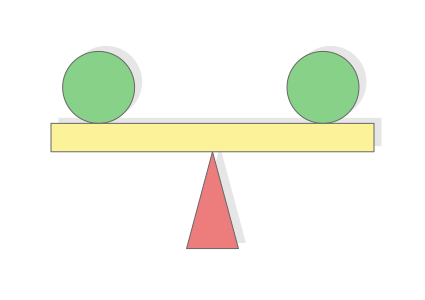 Slot novices sometimes assume that hit frequency is the same as return percentage, but the two concepts are entirely different. We can demonstrate the difference using two hypothetical slot games. The reel stops contain blank spaces as well as symbols, but both games pay only when the player lands three matching symbols on the single payline.
The odds are adjusted so that each game produces 10,000 possible symbol combinations. The table below shows how many winning combinations the two hypothetical single-line slots can produce, along with their respective payouts.
| Symbol Combination | Payout | Slot 1 Combination Hits per 10,000 Spins | Slot 2 Combination Hits per 10,000 Spins |
|---|---|---|---|
| 3 x bells | 800 to 1 | 1 | 1 |
| 3 x lucky 7s | 80 to 1 | 45 | 45 |
| 3 x cherries | 10 to 1 | 350 | 350 |
| 3 x lemons | 2 to 1 | 700 | 995 |
| No matches | No pay | 8,904 | 8,609 |
Based on this paytable, Slot 2 produces 1,391 winning combinations, compared with 1,096 for Slot 1. Slot 2 therefore has a hit frequency of 13.91%, whereas Slot 1 has a hit frequency of 10.96%. Both games have the same number of hits and the same payouts for combinations of three bells, lucky 7s, and cherries.
The lowest-paying combination, three lemons, appears 295 more times per 10,000 spins on Slot 2 than on Slot 1. This gives Slot 2 a higher hit frequency and theoretical return percentage. For every 10,000 credits played, both games pay 800 coins for bells, 3,600 coins for lucky 7s, and 3,500 coins for cherries. The overall return from these combinations is therefore 7,900 coins in both games. The difference comes from the lower-paying end of the paytable.
Slot 1 pays 1,400 coins for the lemon combinations, whereas Slot 2 returns 1,990 coins for the same combination. This discrepancy results in a theoretical return of 9,300 coins, or 93.00%, for Slot 1 and 9,890 coins, or 98.90%, for Slot 2. If the two games were placed next to each other on a casino floor, they would appear identical. They share the same winning symbols and payouts, making it impossible to tell from their appearance that Slot 2 has a higher hit frequency and greater theoretical return.
A slot manufacturer can design a game with the hit frequency of Slot 1 and the return percentage of Slot 2, or vice versa. The easiest way to achieve this is by changing the paytable. Assume that the two slots’ hit frequencies remain at 10.96% and 13.91%. The manufacturer then increases the payout for lucky 7s from 80 to 95 coins on Slot 1 and reduces it from 80 to 70 coins on Slot 2.
Slot 2’s hit frequency would still be higher, but Slot 1’s theoretical return would increase from 93% to 99.75%. Meanwhile, Slot 2’s long-term payout percentage would drop from 98.90% to 94.40%, even though it would still have a higher hit frequency than Slot 1. In short, a higher hit frequency does not necessarily mean a better return percentage. Hit frequency represents the percentage of spins that produce payouts, whereas RTP represents the percentage of wagered money returned to players over time.
Figuring Out the Odds of Slots
 Calculating the odds, or probability, of hitting the maximum payout on a classic, three-reel slot is relatively simple because there is typically a single combination of symbols that pays the jackpot. The calculation depends on the number of symbols, commonly referred to as “stops,” and the number of reels used by the game.
If there are three reels, each containing 16 different symbols, the odds of hitting the maximum payout can be represented as 1/16 x 1/16 x 1/16, which equals 1 in 4,096. The same method can be used to calculate the probability of landing any symbol combination on the three reels.
However, spin outcomes on more advanced video slots are determined by the RNGs described above. These slots typically have five reels, multiple paylines, and a much larger number of symbols. This makes calculating the odds of landing specific combinations extremely difficult. A five-reel slot with 32 symbols can produce more than 33 million combinations.
Low and High Volatility in Slots
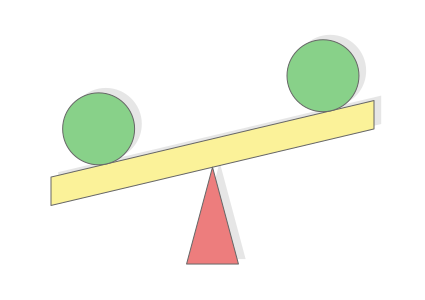 Before placing any real-money wagers, slot novices should understand what the terms volatility and variance mean. The terms are often used interchangeably because they refer to similar concepts. Volatility describes the inherent risk of a slot, including how frequently wins may occur and how large the payouts may be during a gaming session.
Thus, slots can be divided into two main categories: low-volatility slots and high-volatility slots. Higher-volatility games involve a greater degree of risk for players. They typically offer larger potential payouts, but winning combinations occur less frequently. When they do pay, however, the payouts can be substantial. These games may suit patient players with larger bankrolls that can withstand longer periods between wins.
Low-volatility slots carry less inherent risk. Players tend to land winning combinations more often, but the payouts are generally smaller. These more frequent wins can create steadier action and help players extend their gaming sessions. Low-volatility slots may suit players on a budget who primarily play for entertainment and want their bankrolls to last longer.
Unlike average player return, slot volatility is not always listed in the paytable because casinos and developers may not provide this information. Even so, the paytable can indicate whether a particular slot has high or low volatility. If a slot’s paytable offers a maximum payout of half a million coins, its volatility is probably medium to high. In general, more lucrative top payouts can indicate greater volatility.
You can also compare the payout for landing a four-of-a-kind combination, which contains four identical symbols, with the payout for a five-of-a-kind combination. If the difference between the two is five times or less, the slot’s volatility is probably low. If the highest-paying five-of-a-kind combination pays more than ten times the corresponding four-of-a-kind combination, the slot is more likely to have high volatility.
Example of High-Volatility Slot: Gems Bonanza
Gems Bonanza by Pragmatic Play is an example of a high-volatility slot. The game uses a colorful 8×8 grid and offers a maximum payout of up to 10,000 times the player’s stake.

Screenshot of Gems Bonanza
| Gems Bonanza Overview | |
|---|---|
| Title | Gems Bonanza |
| Developer | Pragmatic Play |
| Layout | 8 reels, 8 rows |
| Paylines | Cluster Pays |
| RTP | 96.51% |
| Volatility | High |
| Min/Max Bet | 0.20/100 |
| Release Date | October 29, 2020 |
Gems Bonanza is a cluster-pay video slot built around a grid of precious stones. Each spin can trigger a chain reaction of wins. Because of the game’s high volatility, payouts may occur less frequently, but they can be substantial. Its features include Gold Fever Progressive and several spin modifiers.
Gems Bonanza’s broad betting range accommodates different bankroll sizes. Its colorful graphics, cluster-pay system, and modifiers provide varied gameplay for players who prefer the greater risk and potential rewards of a high-volatility slot.
Example of a Low-Volatility Slot: Starburst
Starburst by NetEnt is a well-known low-volatility slot that was released in 2012. Its space-themed design spans 5 reels and 10 paylines. Winning combinations can pay in both directions, while the Starburst symbol can trigger up to three ReSpins. These features provide regular action without the extended gaps between wins commonly associated with higher-volatility games.

Screenshot of Starburst
| Starburst at a Glance | |
|---|---|
| Title | Starburst |
| Developer | NetEnt |
| Layout | 5 reels, 3 rows |
| Paylines | 10 |
| RTP | 96.09% |
| Volatility | Low |
| Min/Max Bet | 0.10/100 |
| Release Date | 2012 |
Starburst stands out for its simple gameplay and vibrant gem symbols. Its Both-Ways mechanic allows winning combinations to pay from either direction, while its low volatility produces more frequent, smaller wins. This makes the slot suitable for new players and those who prefer a steadier gaming experience.
FAQ
The outcome of each spin is determined by a Random Number Generator (RNG), ensuring each spin is completely independent and random. The RNG generates thousands of number sequences per second, making each spin’s outcome unpredictable and unrelated to previous or subsequent spins.
The house edge in slot machines is directly related to the Return to Player (RTP) percentage. It represents the casino’s average profit from a player’s bet. For example, a slot with an RTP of 96% has a house edge of 4%, meaning the casino expects to make an average profit of 4% over the long run.
Yes, choosing slots with higher RTPs can improve your chances of winning in the long run. Slots with an RTP of 95% or higher offer better potential returns to the player compared to titles that have lower RTP rates. Playing a slot with a higher RTP will reduce the house edge and will increase your chances of ending a session profitably.
Volatility refers to the risk and payout frequency of a slot, with high volatility offering larger but less frequent wins, and low volatility offering more frequent wins that are, however, significantly smaller in size. RTP, or Return to Player, indicates the average percentage of bets that are returned to players over time, regardless of volatility. Simply put, the volatility of a slot indicates the risk level, while the RTP shows what return you can expect in the long run.
While casinos don’t typically list a slot’s volatility, you can infer it by looking at the paytable. Slots with larger maximum payouts are likely to have high volatility, while those with smaller maximum payouts but more frequent winning combinations have low volatility. The difference in payouts for four-of-a-kind versus five-of-a-kind can also indicate volatility, with way too big of a difference indicating high volatility.
No, slots do not pay out more at certain times of the day. The RNG technology ensures that each spin is entirely random, making the odds of winning the same at any time. Player traffic may vary, but it does not influence the slot machine’s payout rates.
No, it is not possible to predict when a slot machine will hit a jackpot because of the randomness introduced by the RNG. Each spin is independent and has the same chance of winning the jackpot as any other spin, regardless of previous outcomes or how long the machine has been played.