
Fibonacci Casino System in Roulette
 | Updated:
 The Fibonacci System – Basics and Application in Roulette
 Many roulette enthusiasts seek different ways to improve their betting choices and manage their wagers. If you are looking for a way to limit your monetary losses, you are likely to encounter a betting system. Nowadays, you can find many betting systems that provide structured plans for placing wagers. Many of these systems can be applied to roulette under the right circumstances, although none can eliminate the game’s inherent risk.
Some players also adapt these systems to casino games such as blackjack and baccarat, adjusting the rules accordingly. One of the best-known examples is the Fibonacci betting system.
Based on a negative betting progression, the Fibonacci betting system requires players to increase their stake after a loss and decrease it after a win. Let’s examine the features that distinguish it from other betting systems and how it can be applied to roulette. Along with its potential benefits, we will also consider its shortcomings. After reviewing both, you can decide whether this betting system suits your gambling style and budget.

-
 Sign Up Bonus
Up to $100
100% Bonus!9.7 -
Sign Up Bonus
Up to $30000
100% Bonus!9.4 -
Sign Up Bonus
Up to $1000
200% Bonus!9.3



Brief History
 The origins of this betting system can be traced to a sequence described by the Italian mathematician Leonardo Pisano Bigollo, better known as Leonardo Fibonacci. He was one of the most renowned mathematicians of the medieval period. In 1202, he published the notable Book of Calculation (Liber Abaci), which gained widespread recognition in Europe. The book described the Fibonacci sequence of numbers that later became the basis of this betting system.
Basics of the Fibonacci Betting System
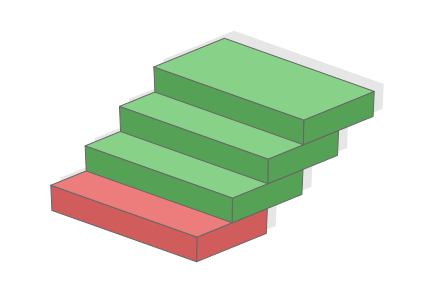 To understand the Fibonacci betting system, it is best to start with the Fibonacci sequence itself. This famous sequence begins with 1, and each subsequent number is the sum of the two preceding numbers. Following this pattern, the numbers in the sequence gradually increase. Similar patterns can also be found in nature. For a clearer understanding, consider the following numbers from the sequence:
- 1-1-2-3-5-8-13-21-34-55-89-144-233-377
The Fibonacci betting system uses a negative progression, which means increasing your stake after a loss and decreasing it after a win. The idea behind this type of system is that an eventual win may compensate for some previous losses and potentially produce a small profit. However, a long losing streak can cause bet sizes to rise considerably.
How to Apply the Fibonacci Betting System in Roulette
 When playing roulette games, the Fibonacci betting system is usually used for outside bets that pay even money. To apply it, you need to be familiar with the Fibonacci sequence introduced above. Each number in the sequence determines the size of the bet placed at that stage. To use the system smoothly while playing, it is helpful to memorize the sequence or keep it available for reference.
Since the size of a betting unit is not predetermined, you can set it according to your preferences and, most importantly, your bankroll. You should begin each betting cycle by placing one betting unit. If you lose, proceed to the next number in the sequence. Suppose one betting unit is $5 and your first two spins result in losses. Your third wager should be two betting units because the third number in the sequence is two. You would therefore place a $10 bet.
Continue following this pattern until you win. The longer the losing streak continues, the larger your bet becomes. If you lose five times in a row, for example, the progression requires your next wager to increase by five betting units. This is why you should be particularly careful when determining the value of one betting unit. If the amount is too large for your available bankroll, you may run out of funds before recovering your losses. Remember that one betting unit is the minimum wager used with this system.
So far, we have illustrated how the system works during a losing streak. Now, let’s consider what happens after a win. Whenever you win, calculate your next wager by moving back two numbers in the sequence. For instance, if you win after betting five units, your next bet should be two units. Follow this pattern after each win unless you have already made a profit. In that case, it is best to restart from the beginning of the sequence. You should also restart the sequence if your first bet wins.
| Roulette: The Fibonacci Betting System | |||
|---|---|---|---|
| Bet Sequence | Bet Size | Spin Outcome | Net Winnings |
| 0-1 | 1 | LOSS | -1 |
| 0-1-1 | 2 | LOSS | -3 |
| 0-1-1-2 | 3 | LOSS | -6 |
| 0-1-1-2-3 | 5 | LOSS | -11 |
| 0-1-1-2-3-5 | 8 | LOSS | -19 |
| 0-1-1-2-3-5-8 | 13 | WIN | -6 |
| 0-1-1-2-3 | 5 | WIN | -1 |
| 0-1-1 | 2 | WIN | +1 |
Pros & Cons of the Fibonacci Betting System
 It is important to weigh the pros and cons of the Fibonacci betting system before deciding whether to use it. One potential advantage is that the progression may produce short-term gains when outcomes are favorable. Following a structured betting pattern can also make roulette more engaging for some players. Although the system requires you to know the Fibonacci sequence, online players can keep the sequence open in another browser tab for reference.
The system also has several major drawbacks. Its progression is more complicated than some alternatives, which may make it unsuitable for inexperienced players. If you choose to use it, you should be especially cautious with your funds and consistently track your wins and losses. When using a negative progression betting system, it is essential to have good money management skills and to set both a loss limit and a win goal.
The Fibonacci Roulette System in Practice
The Fibonacci roulette system combines a mathematical sequence with a structured approach to wagering. However, it is not foolproof, and the random nature of roulette means that the progression cannot guarantee a profit.
- Potential for Short-Term Gains: The progression may produce gains during a favorable sequence of outcomes.
- Engaging Gameplay: Adds a structured betting approach to roulette play.
- Easy Access to the Sequence: Online players can keep the Fibonacci sequence open in another browser tab.
- Complex for Beginners: The progression may be difficult for players who are new to betting systems.
- Ongoing Bankroll Tracking: Requires players to monitor every win, loss, and wager.
- Risky During Losing Streaks: A prolonged run of losses can deplete available funds quickly.
Final Thoughts
 The Fibonacci betting system is one of the more interesting yet complicated strategies used in roulette. Its structured progression may make the game more engaging, but it cannot guarantee a profit. If your bankroll is limited, it may be best to avoid this system because the required wagers can grow substantially during a losing streak. If you experience several consecutive losses and lack the funds to continue, you may be unable to complete the progression and recover your losses. Take time to understand the system’s advantages and disadvantages before deciding whether it suits your budget and preferred style of play.
FAQ: Fibonacci Casino System in Roulette
The Fibonacci betting system is a negative progression strategy where players increase their bets after a loss and decrease them after a win, based on the Fibonacci sequence of numbers. Each number in the sequence is the sum of the two preceding ones, starting with 1. Here is an excerpt of the sequence: 1, 1, 2, 3, 5, 8, 13, 21, 34, 55.
In roulette, the Fibonacci system is typically applied to even-money outside bets. Players start with a single bet unit and size their bets according to the sequence. After a loss, move to the next number in the sequence for your bet; after a win, move back two numbers.
No betting system, including the Fibonacci, can guarantee consistent profits due to the random nature of roulette. While the system aims to recover losses over time, its effectiveness is limited by potential long losing streaks and table betting limits.
The main advantage of the Fibonacci system is its structured approach to betting, potentially helping to manage bankrolls more effectively. It offers a chance to recover losses systematically, and for some players, it enhances the enjoyment of the game by adding a mathematical concept.
The primary drawback is the risk of significant financial loss during extended losing streaks, as bet sizes increase rapidly. It’s also more complex than other betting strategies, potentially making it less suitable for inexperienced players or those without a substantial bankroll that allows them to continue following the progression.