
Baccarat Runs
 | Updated:
 Recognizing Winning Patterns for More Successful Baccarat Betting
 Baccarat is a card game that can provide players of all experience levels with a fun and rewarding gaming experience. While the game was once regarded as entertainment strictly for high rollers, its growing popularity led casinos to offer a range of betting limits suited to different budgets. Since the rules are straightforward, players should have little difficulty learning baccarat and enjoying their gaming sessions.
Although baccarat is not particularly complex, it is often viewed as operating on a near-50/50 principle, with many players comparing its outcomes to a coin toss. This means that the results of previous coups do not reliably predict the outcome of the next coup. Unfortunately, previous results provide little useful information to players who want to make informed betting decisions. Some players therefore track winning results in an attempt to identify trends and make better decisions that could help them prolong their baccarat sessions.

-
 Sign Up Bonus
Up to $100
100% Bonus!9.7 -
Sign Up Bonus
Up to $30000
100% Bonus!9.4 -
Sign Up Bonus
Up to $1000
200% Bonus!9.3






Objective and Basic Baccarat Rules
 Playing baccarat is not as demanding as some players might think. There are no complicated rules or moves you need to memorize before joining the baccarat table. This simplicity has made the game popular among different types of players, regardless of their preferred style of play.
Baccarat’s objective is easy to understand, as the winning hand is the one with a total closest to nine. Unlike blackjack, where exceeding 21 means you bust, you cannot bust in baccarat. When the total value of your cards exceeds nine, only the last digit counts. Thus, if you are dealt two 7s, for example, the total is 14, so your hand value is 4. Cards count according to their face value, except for tens, Jacks, Queens, and Kings, which are worth zero. Aces count as 1. When your first two cards total 9 in baccarat, the hand is called a natural.
If you place your chips on the area marked Tie, you are betting that the Banker and Player hands will have the same total at the end of the round. The remaining two betting options are Banker and Player. Players must decide whether to bet on the Banker, the Player, or a Tie. It is important to note that a winning Banker bet is subject to a house commission, which is commonly 5%.
Baccarat Runs
 As already stated, many players refrain from playing baccarat because they assume the game is complicated and requires considerable skill and knowledge. In fact, its rules are easy to grasp, and the underlying principle of the game is often described as close to 50/50. This is why many people draw a parallel between baccarat and flipping a coin.
Players aiming for bigger wins should remember that there is more to the game than previous results. Regardless of how many wins or losses the Player or Banker has recorded, those results do not determine which hand will win next. When we say that baccarat is often compared to flipping a coin, this analogy is used to illustrate individual outcomes within a single shoe.
One of the most important things baccarat players should remember is that the cards are shuffled, which means their exact order cannot be predicted. Any scorekeeping or pattern analysis should therefore be limited to a single shoe. This explains why baccarat players are advised not to focus on an isolated round but instead to observe specific sequences that occur within the shoe.



This is where the alternative scorekeeping method comes into use. When applying this method to baccarat, you should record Player and Banker wins in separate columns, resulting in an average of 32 columns. In the first column, you will notice that Bs and Ps alternate. You might wonder what the second column should look like. Since P can be expected to follow B about half the time, there should eventually be around 16 entries represented by Ps and Bs. If this does not happen, you should start a new column.
When examining the second row, you can expect to see 16 Player and Banker wins. In the third row, however, you will notice only eight Bs and Ps; consequently, you can expect to record just two wins across these eight rows. Another pattern you can anticipate seeing in each shoe is one run of five wins, two runs of four wins, and four runs of three wins.
With that in mind, let us return to the second row, where you should find 16 Bs and Ps. Turn the scorecard on its side and view the row as a column to get a clearer picture of the trends. Following this approach, baccarat players can anticipate eight singles, two pairs, one triple, and half a quadruple in the second row. The situation is the same in the third row.
We can now return to the sample of 232 shoes. Let us call a single entry in Row Two a singleton and two consecutive entries a double. The goal is to determine how long the runs in Row Two are. If everything discussed above holds true, you should anticipate that, half the time, the entry will form a PP or BB run. The remaining half will feature the start of a run comprising at least three Ps or Bs.
Looking at the distribution of Row Two entries, the number of two-entry sequences is 2,169. Although the anticipated number of singletons was 1,085, the actual number is 1,124. The number of doubletons is 537, compared with an expectation of 542.
The expected number of triples was 271, while the actual number is 274. Meanwhile, the expected number of consecutive Row Two entries was 136, while the actual number is 125.
In other words, Row Two behaves as expected. While players might anticipate that 50% of the entries will be singletons, 25% will be doubletons, and 12.5% will be triples, the final analysis shows an average of 4.8 singletons, 2.3 doubletons, and 1.2 triples per shoe.
Thus, there are 9.3 sets per shoe on average. In the shoes analyzed, there are no more than 12 singletons, six doubletons, or five triples per shoe.
The analysis also shows an average of approximately 17.9 runs per shoe, with no shoe containing fewer than nine runs. Aside from one shoe with 41 runs, none of the others exceeds 24.
Betting on Streaks
 Some players use a strategy known as following the shoe. This means placing bets on the side that won the previous round. The purpose of this betting system is to catch a winning streak and achieve as many consecutive wins as possible.
Many baccarat players believe there are numerous opportunities to catch a streak in which one side wins several hands in a row. Some players also use the Avant Dernier system during their baccarat sessions. This French term means “before last.” Players using this system bet on the same result as the second-to-last hand dealt in the game. For example, consider four consecutive hands with the results Player, Banker, Player, and Banker. Under the Avant Dernier method, you would bet on Player because that was the result of the second-to-last hand.
Although following the shoe or using Avant Dernier can be effective when a streak occurs, baccarat remains a game of chance, and no one can predict the results of upcoming rounds. If you are wondering how often a particular result can occur in consecutive baccarat hands, consult the table below. It can help you decide whether betting on streaks is suitable for you.
| Probability of Winning Streaks in Baccarat | |||
|---|---|---|---|
| Number of Runs | Banker | Player | Random |
| 0 | 0.49316293 | 0.50683707 | 0.5 |
| 1 | 0.24995325 | 0.24995325 | 0.25 |
| 2 | 0.12668557 | 0.12326768 | 0.125 |
| 3 | 0.06420894 | 0.06079105 | 0.0625 |
| 4 | 0.03254347 | 0.02997989 | 0.03125 |
| 5 | 0.01649424 | 0.01478497 | 0.015625 |
| 6 | 0.00835989 | 0.0072914 | 0.0078125 |
| 7 | 0.0042371 | 0.00359585 | 0.00390625 |
| 8 | 0.00214752 | 0.00177334 | 0.00195313 |
| 9 | 0.00108844 | 0.00087455 | 0.00097656 |
| 10 | 0.00055166 | 0.00043129 | 0.00048828 |
Runs vs Singletons
 As mentioned above, baccarat operates on a near-50/50 principle, so players can anticipate that the numbers of runs and singletons will be close. However, a shoe can sometimes deviate from this balance point before moving back toward equilibrium.
For baccarat players wondering what playing a singleton or a run means, this refers to betting on whether an entry will appear in Row Two. In practice, you are betting either in favor of a singleton or against it. The number of entries per shoe is 36, with an expected 18 singletons and 18 runs. If the ratio of runs to singletons is 3:1 or higher, your bet should favor a run. If the ratio is 1:3, however, you should bet that a singleton will appear instead of a run.
Let us assume the ratio is 3:10 and your bet on Player wins, resulting in an entry in the first row of the 14th column. You should now place a stake on Banker because the ratio will become 4:10, which is closer to the 50/50 split.
Betting Row Three
 The Basic Strategy states that betting on Row Three means assuming this row will remain empty. In other words, you anticipate that there will not be three or more consecutive Player or Banker wins. Players must place this bet three times. If they lose, they should then wager three units. Repeat this process twice, and if both sets of wagers are unsuccessful, stop playing for the current shoe.
Suppose you have placed three unsuccessful bets and decide to wager three units that there will be two runs, with the ratio now at 3:5. Wagering three units in this situation is risky because the ratio is below 1:2. If the ratio is 3:9, for example, wagering three units is a more favorable move. Players are advised to follow the Basic Strategy only when the ratio is 1:3 or lower.
Betting Row Four
 Each shoe is also expected to contain nine runs, three of which may reach the third row of the scorecard. Although their number is small, you can still wager for or against an entry in Row Four. However, you are advised to do so only when the ratio between runs in Row Three and runs in Row Four exceeds 6:1 or falls below 1:6.
Basic Baccarat Strategy
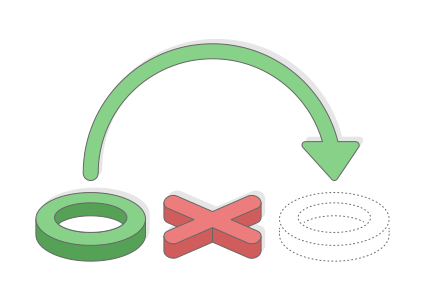 The Basic Strategy is straightforward and should be easy to follow. According to this strategy, players should stake one unit on two consecutive results not becoming three in a row. Moreover, if you have recorded three consecutive losses, you should wager three units on two in a row not becoming three in a row. If this bet loses, repeat the procedure once more. If you then accumulate four losses, stop playing and wait for the next shoe.
The strategy also states that you should place a bet each time there is an entry in the second row. If eight consecutive losses occur, stop playing and wait for the next shoe. If you win during steps 2 through 4, return to step 1.
Useful Tips for Playing Baccarat
 Baccarat is a popular casino game because of its low house edge. The house advantage for Banker and Player bets is 1.06% and 1.24%, respectively. One of the most important things to remember is that the house edge increases to around 14.4% when you bet on a Tie. This makes the Tie one of the least favorable standard baccarat wagers, so it is generally best to avoid it.
Many players believe that betting on the Banker is the best option, so they repeatedly place the same wager. The chance of the Banker hand winning is 45.85%, while the chance of the Player hand winning is 44.62%. In other words, both hands have roughly the same chance of winning. Nevertheless, baccarat is based on a near-50/50 principle, so betting exclusively on the Banker does not guarantee continuous wins.
Money management is another simple but important aspect of playing baccarat. Before you begin, set clear win and loss limits. Once you reach either limit, stop playing, regardless of how difficult it might be.