Baccarat Basic Betting Strategy
 | Updated:
 Improving Your Baccarat Sessions with Betting Strategies
 Baccarat is a classy casino game that was once played only by the wealthiest players, with baccarat tables often imposing high-stake limits back in the day. Nowadays, some players still mistakenly avoid the game, worrying that it is reserved for high rollers only. However, this could not be further from the truth, as baccarat tables now accommodate all kinds of players. That said, you should always be cautious when setting a budget for your baccarat sessions, as this is still a game of chance.
Another reason players avoid baccarat is the misconception that the game requires advanced decision-making or specific skills. On the contrary, baccarat is extremely easy to play, with all decisions beyond the bets you place being made automatically thanks to the rules of the game.

-
 Sign Up Bonus
Up to $3500
350% Bonus!9.7 -
Sign Up Bonus
Up to $500
400% Bonus!9.4 -
Sign Up Bonus
Up to $2000
200% Bonus!9.3



Even though baccarat rules are pretty straightforward and easy to master, that is not to say you should start playing before you get familiar with the game. Despite being a game of chance, baccarat still offers better odds on some bets than on others. Knowing your best betting option can improve your winning chances in the long run. Combine that knowledge with a correct betting pattern, and you can last longer and enjoy more exciting baccarat sessions.




The Basic Baccarat Strategy Explained
 Before players start mastering the basic baccarat strategy, they should take some time to understand the probabilities they will be up against in this game. This is a very player-friendly game that yields one of the lowest house edges in a casino, the only comparable game being the dice game of craps. In baccarat, you are fighting a long-term house edge of 1.06% for banker bets, 1.24% for player bets, and 14.36% for tie bets, but the latter should be off-limits for smart players.
Baccarat players who place player or banker bets enjoy an almost even-odds game. The banker bet has the highest chance of winning at 45.84%, whereas the player hand wins 44.61% of the time on average. The player and banker will tie on rare occasions, so the probability of a push between the two hands is only 9.54%. It follows you should never bet on ties – not only because your chances of winning with this wager are slim but also because you will be underpaid at reduced odds of 8 to 1. Note these figures are accurate when you are playing eight-deck baccarat.
The Premises of the Basic Strategy in Baccarat
<img src="https://casinogamespro.com/wp-content/uploads/2021/03/casinogamespro-baccarat-basic-strategy_premises.svg" alt="The Premises of the Basic Strategy in BaccaratNow, what is the point of applying a strategy if you are playing an almost break-even game? Well, the main premise this strategy rests upon is that it enables players to end more shoes in profit than in net losses.
The strategy stipulates that players should quit the game when they are ahead. It also ensures that those who experience a longer negative streak will be able to weather it out and break even at some point, provided they have a sufficient bankroll to play with. We are speaking about the long term, though, so do not expect amazing results right from the get-go.
Although winning player and banker hands appear to alternate most of the time, streaks do occur in baccarat, with longer sequences of the same consecutive result occasionally manifesting themselves. These sequences are rare, which is why it is safer to assume they will not happen during your stay at the baccarat table rather than assuming they will. It is better to play it safe and avoid exposing much of your bankroll to high risk while waiting for a rare streak to occur so you can capitalize on it.
Using a Player/Banker Score Card
 In order to use a basic betting strategy for baccarat, you must first decide on the size of your base betting unit. You also have to use a score card to keep track of the results for each side (player and banker). Most casinos will readily provide such cards at their baccarat tables and will also give you a two-colored pen so you can easily distinguish the player from the banker results on your score card. The colors are usually red and black or red and blue.
These charts contain alternating columns for player/banker hand results (like this PB-PB-PB-PB), so if the player wins on the first coup, you must fill in the number 1 in the first box of the first column marked as P. Provided the player hand wins again on the second coup, you enter the number 2 in the second box of your first player column.
Then the banker hand wins on the third coup, so you write the number 1 in the first box in the second column of the chart marked as B. This is the standard method of tracking the score of player/banker hands in baccarat when the chart is kept vertically.
So, if the banker wins on the first hand, you write a B in the first box of the first column. Then the player hand wins, and you mark it with a P in the first box of the second column. If the banker wins again, you write B in the first box of the third column and continue in the same manner, advancing across your card the deeper you go into the shoe.
Boxes checked in the first row are called singletons. Two consecutive singletons are referred to as a chop, while columns with entries in the second row are called runs, although runs can be longer than two entries. So, if, for example, the player hand wins three times in succession, we say this run has a length of three. Ideally, you want to leave a bit of space in each box so that you can also enter the amount you have wagered on each hand. Ties can be marked with a small dash or an x, depending on your preferences.
The Gist of the Strategy
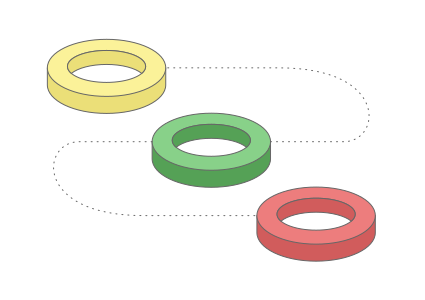 The basic strategy for baccarat rests on several premises; the first is that you wager one base betting unit after a run of two identical results, which is to say you are wagering that this outcome will not occur for a third consecutive time.
The second premise of the strategy is that you must increase your wager to three base betting units after you experience a streak of three consecutive losing bets. In this instance, you are wagering that a run of two identical results will not become a sequence of three identical results. Either way, you must start over with your next bet and wager one unit again.
The gist of this strategy is that you must place a wager each time you mark a box in the second row of your score card. In case you happen to experience three consecutive losses, bet three base units. If you lose a fourth time, you must start afresh, i.e., you must wager one unit again. Eight consecutive losing bets serve as an indicator for you to stop wagering until the callman reshuffles and a new shoe starts.
The Basic Baccarat Strategy in Action
 As you have probably noticed, this strategy is built upon the idea of specific sequences of outcomes occurring within a baccarat shoe. These outcome sequences are written within each column of your strategy card, which contains around 32 sequence columns per shoe on average.
Each of these columns corresponds to a sequence of identical outcomes, with the first row of the card containing 32 alternating player/banker outcomes. Since the chances of a banker or a player hand occurring are almost equal, you should expect to get 16 single player and banker results on the second row of the card. This is so because you start a new column every time one of the two outcomes fails to happen twice in a row.
Respectively, the third row of the card will consist of 8 single player and banker results, the fourth row will have 4 alternating player/banker results, and so on. You progress downward and reach the sixth row where you end up with 0.5; correspondingly, a sequence of six winning player or banker hands will occur only once every two shoes. Respectively, seven identical results in a row will happen once every four shoes, eight identical consecutive results will occur once every eight shoes, and so on. Long runs of fifteen identical results in a row will happen once in a blue moon (once every 1,024 times).
What this shows is that, on average, you should expect to get a relatively equal number of single and longer runs. To get a better idea of how the strategy works, you can turn your card upright, the way it was originally intended to be used. You will see there are 16 player/banker results, 8 of which are singles and the other 8 are consecutive identical results.



The strategy was tested in 232 real-life shoes, where a single entry was regarded as a singleton and two consecutive identical results were regarded as a double. As you know, the strategy requires you to wager that two consecutive identical results will not turn into a third identical result. When you lose three such bets, you are supposed to wager three base betting units on the next coup. If you lose two such sequences, you are supposed to stop playing.
When you apply the basic strategy, you will lose when there is a run of three or more consecutive banker or player hands. If this happens four consecutive times before a double occurs, you will lose a total of six units. The test with the 232 baccarat shoes registered an average of around 18 sets of two consecutive identical results per shoe.
Therefore, the average number of sets of three consecutive identical results was roughly half of this, or around 9 per shoe. The basic baccarat strategy enables players to limit their losses per shoe to only twelve base betting units if they stop wagering after they suffer four runs of three identical results twice in the shoe, which corresponds to a run of eight or longer. The tests registered only four successive rows with three identical results in 5 out of the 232 shoes played.
What Are the Odds of Going Through Several Winning Shoes in a Session?
 Players using this strategy are recommended to quit the baccarat tables whenever they generate a net profit, i.e., when they succeed in winning more shoes than they have lost during the session. Baccarat experts have established that players will win an average of five-and-a-half out of every ten shoes they play.
The probability of winning all ten shoes is quite small at 0.25%, whereas the likelihood of winning none of the ten shoes is even more minuscule at 0.03%. Meanwhile, players can expect to win as much as 60% of the shoes a little over half of the time. It is essential for you to stop playing when you are ahead, as otherwise you risk getting wiped out due to variance, a statement every experienced baccarat player will readily back.
Why Should Baccarat Players Use This Strategy?
 If you are wondering why you should use the basic baccarat strategy instead of relying on hunches, there are several reasons to do so. First of all, it helps you keep your betting action in check, which in turn may save you money because you will sit out some hands instead of betting on each coup as many baccarat players do.
We should not forget baccarat is an exceptionally fast-paced game, even more so than similar card games like blackjack, because almost no playing decisions are made by baccarat players, for whom the primary question is only how much to wager on the next coup. Slowing down the game may therefore give rise to vehement protests from fellow players.
With this baccarat strategy, you will be making fewer bets per shoe (around fifteen, in fact) and sitting out the rest of the coups. This way, you will not be making as many mistakes as you normally would when fatigue takes its toll on you, which, on its own, will have a positive effect on your overall performance.
Another peculiarity of the strategy is that it produces positive long-term results that are based on the shoes you play, rather than on the number of hands you play. Computer simulations have established that you will win more than half of the shoes you play and lose around 40% of them, while the rest will result in ties. The bottom line is you will always end up winning more in the long run than you will lose when applying this strategy.
Mistakes Winning Baccarat Players Would Never Make
 No baccarat strategy can help you become a successful player if you lack knowledge of the game, self-control, and adequate bankroll management. For starters, you should not play baccarat, let alone incorporate a strategy, if you have not mastered the rules of the game first. The drawing tableau for baccarat may be a bit daunting at first, but you should do your best to memorize it before you head to the casino.
Some casual players might argue that baccarat dealers are already well-versed in the game’s rules and would therefore rely on the dealers to make the correct drawing decisions, sum up the hands’ totals, and pay out in accordance with the results. This line of reasoning is incorrect because no dealer, no matter how experienced, is fully immune to making mistakes. And each of these mistakes may end up costing you money. So, before you start practicing the strategy outlined above, you must learn the rules of the game to a T.
In this guide, we have mentioned on multiple occasions that the tie is a bad bet, but it bears repeating since less disciplined gamblers would inevitably place it in an attempt to make their sessions more exciting. Well, you should abstain from doing that unless “exciting” and “losing” are one and the same thing to you. The tie bet is a sheer waste of money since the player and banker sides push roughly every nine-and-a-half times, whereas the payout for winning ties is significantly reduced to 8 to 1. This corresponds to a house edge of 14.36%, which is to say you stand absolutely no chance when overdoing it with this terrible bet.
Last but not least, a winning baccarat player would always abide by the rule of quitting the game when they are ahead, something we stressed on several occasions when outlining the above strategy. To be honest, you should consider yourself a winner even if you are lucky enough only to break even. So, the bottom line is you should muster up the strength to call it quits on profit, no matter how small, rather than pushing it and risking losing it all.