Soft Hands in Blackjack
 | Updated:
 Playing Soft Hands the Correct Way
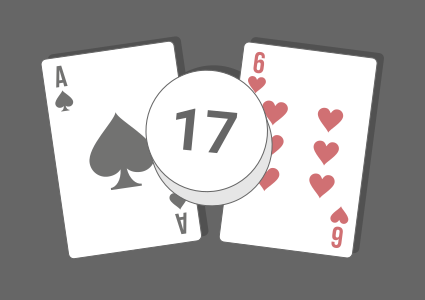 Although blackjack rules are fairly straightforward, there are a few details you should understand before you start playing the game. Most cards carry the value shown on them, while several cards have specific values assigned to them. All face cards (Jack, Queen, and King) are worth 10, making them highly desirable because they can help you form a natural blackjack. Another special card in blackjack is the ace, which can change its value depending on your total.
In this article, we will focus on hands containing an ace that can be counted as either 1 or 11, also known as soft hands. It is crucial to recognize soft hands and learn the optimal decisions for different ace combinations. Keep reading as we cover everything you need to know about this type of blackjack hand.

-
 Sign Up Bonus
Up to $500
400% Bonus!9.7 -
Sign Up Bonus
Up to $3500
350% Bonus!9.4 -
Sign Up Bonus
Up to $3000
300% Bonus!9.3



What Are Soft Hands?
 In brief, soft hands contain an ace that can be counted as 11 without pushing the total above 21. They are beneficial because their total can be adjusted when necessary. The ace is the most flexible card in the deck because it can be counted as either 1 or 11. This flexibility allows you to adjust your hand’s total and avoid an immediate bust.
When you have a soft hand, taking one additional card cannot push your total above 21 because the ace can be counted as 1 if necessary. For instance, suppose you have a soft 15 consisting of an ace and a four, and you draw an eight. Your total would be 23 if the ace remained valued at 11.
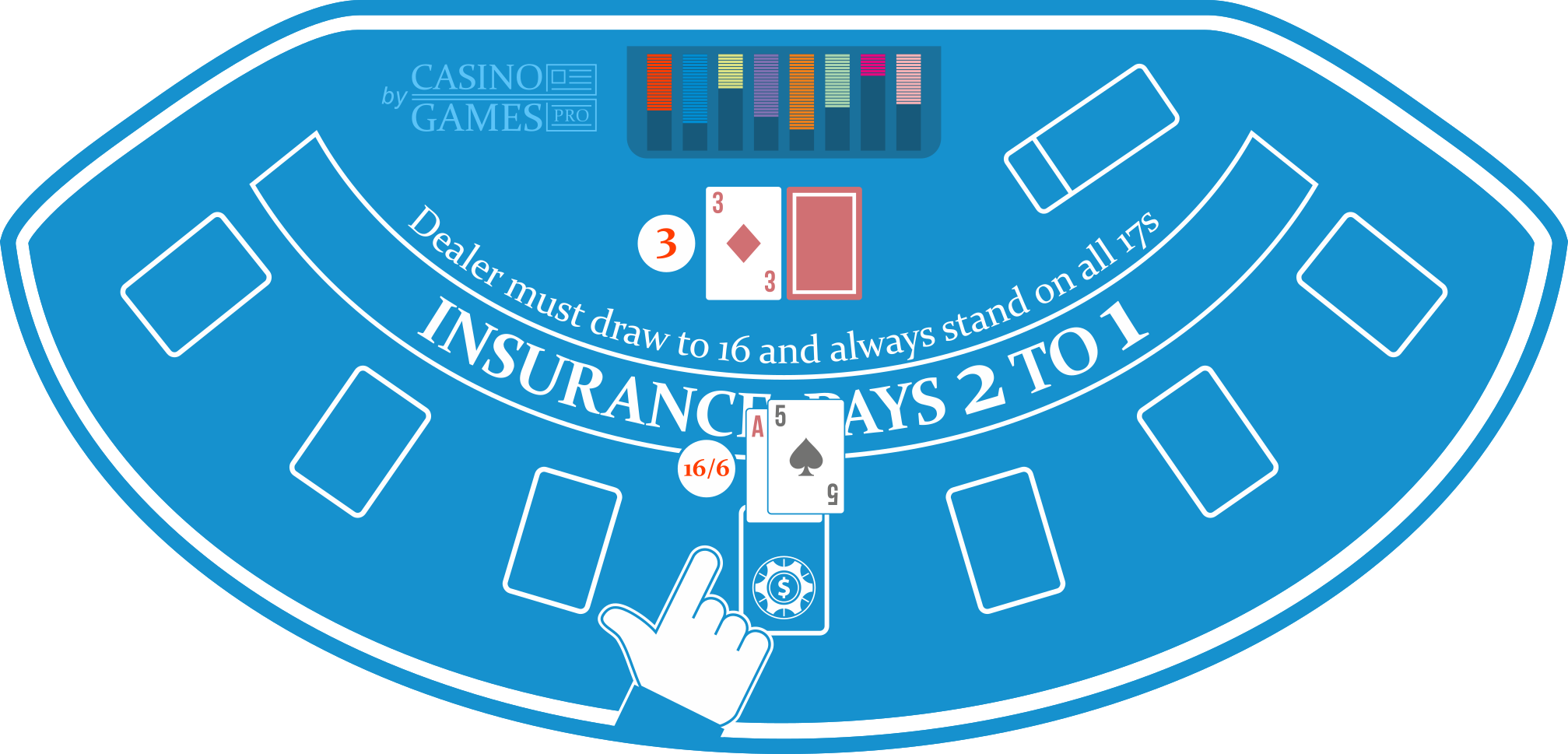
For example, if you have an ace and a three, the dealer may refer to your hand as 4 or 14 because the ace can be counted either way. It is important to note that a soft hand can contain two or more cards. In other words, soft hands are not limited to two-card combinations. If you hold 3-5-Ace, you have a soft 19.
Strategy for Playing Soft Hands
 Since blackjack is a skill-based game, it allows you to apply strategy and reduce the house edge. Soft hands are no different from other card combinations in the game. They also require a proper approach and a solid strategy. Knowing how to play them correctly can help you make better decisions in every game.
Let’s look at some of the soft hands you may encounter during the game and how to play them successfully. To make the best possible decision, you should always consider the dealer’s up card and the applicable table rules.
Whenever you receive a soft hand, you can choose among three options: hit, stand, or double down. The first situation we will consider is receiving an ace and a two as your first two cards, forming a soft 13. In this case, it is recommended to hit unless the dealer’s up card is a five or six, in which case it is best to double down.
Suppose you receive a soft 14, 15, or 16 and the dealer is waiting for your decision. The strategy for these three hands is the same. If the dealer has a four, five, or six, your best option is to double down. If the dealer’s up card is anything else, you should simply hit.
Playing Soft 18: Stand or Double Down?
Another scenario worth discussing is when you have a soft 18, consisting of an ace and a seven. In this situation, you should carefully consider the dealer’s up card because your best move depends on it. If you have a soft 18 and the dealer is showing a two, seven, or eight, you should stand.
If the dealer’s up card is between three and six, you should take a different approach. In this situation, your best move is to double down because the dealer has a relatively weak up card. Doubling down allows you to increase your wager when the circumstances are more favorable.
In general, you should double down when the strategy recommends it based on the strength of your hand and the dealer’s up card. These opportunities do not occur with every hand, so it is important to recognize them.
In the remaining cases, when the dealer has a nine, a ten, or an ace, it is recommended to hit. At first glance, hitting with a soft 18 may seem inappropriate because many players consider 18 a fairly strong total. However, it may not be enough when the dealer has a strong up card. Since the ace can change from 11 to 1, you can take another card without immediately busting. A soft 18 is a tricky combination, so choosing the correct move is particularly important.
Dealing with Soft 19 and 20: Your Best Bet
Last but not least, consider situations in which you have either a soft 19 or a soft 20 hand. These are among the strongest hands you can receive in blackjack and are difficult to improve. With either hand, you are in a favorable position. Depending on the dealer’s up card, the number of decks used, and whether the dealer hits or stands on soft 17, you may need to stand or double down.
If you play multi-deck blackjack in which the dealer stands on soft 17, you should stand regardless of the dealer’s up card. If you play multi-deck blackjack in which the dealer must hit on soft 17 and you hold a soft 19, it is better to double down against a dealer’s 6.
If your soft 19 consists of more than two cards and the rules permit doubling down, you should double against a dealer’s 6. However, some casinos only allow players to double down on their first two cards. If your soft 19 consists of three or more cards and doubling down is not an option, your best move is to stand.
| Strategy for Soft Hands | |||||||||||
|---|---|---|---|---|---|---|---|---|---|---|---|
| Your Hand | The Dealer’s Up Card | ||||||||||
| 2 | 3 | 4 | 5 | 6 | 7 | 8 | 9 | 10 | Ace | ||
| A-2 | H | H | H | D | D | H | H | H | H | H | |
| A-3 | H | H | D | D | D | H | H | H | H | H | |
| A-4 | H | H | D | D | D | H | H | H | H | H | |
| A-5 | H | H | D | D | D | H | H | H | H | H | |
| A-6 | H | D | D | D | D | H | H | H | H | H | |
| A-7 | S | D | D | D | D | S | S | H | H | H | |
| A-8 | S | S | S | S | S | S | S | S | S | S | |
| A-9 | S | S | S | S | S | S | S | S | S | S | |
Conclusion
 Soft hands in blackjack are important combinations that every player should understand. Because the ace can be counted as either 1 or 11, drawing one additional card to a soft hand cannot cause an immediate bust. Understanding how to play soft hands correctly can help you make better decisions and enjoy the game more. Although mastering the strategy may take some time, regular practice will help you apply it more consistently.
FAQ: Playing Soft Hands in Blackjack Correctly
A soft hand in blackjack includes an ace counted as either 1 or 11, depending on what’s best for your hand. It’s called “soft” because you can add more cards without the risk of busting (going over 21), giving you more flexibility in your play.
Soft hands are great because they give you a safety net, helping you to avoid going above the total of 21. With an ace acting as 11 or 1, you can hit (take another card) without worrying about busting right away. This means you can try to improve your hand to get closer to 21 with less risk.
Not always. While hitting is a good option for soft hands like 13 to 17, when you have soft 18, 19, or 20, you might want to stand or double down, depending on the dealer’s up card. It’s all about maximizing your chances based on what the dealer shows.
Consider doubling down on soft hands (especially soft 17 or lower) when the dealer’s up card is weak (like a 4, 5, or 6). By betting more on your soft hand when the dealer is likely to lose, you can potentially double your winnings.
In most cases, it’s better to hit or double down on a soft 17 because you have a chance to improve your hand without busting. However, if the game rules or a particular situation suggest that standing is the smarter choice (like in specific blackjack variations or strategic scenarios), you should trust your judgment.