
Surrender in Blackjack
 | Updated:
 What Is Surrender in Blackjack and Why Should You Use It?
 Using basic strategy when you play blackjack can lower the house edge and improve your chances of winning in the long run. That said, even when you know the optimal move for every hand and the dealer’s up-card, you are not guaranteed to win every time. Because luck also plays a major role in blackjack, you may sometimes be dealt a hand with extremely slim chances of success.
Luckily for players, some blackjack variations offer a feature known as surrender, which allows you to minimize your long-term losses. There are two variations of this feature, early and late surrender, with the former giving players a greater advantage. If you want to learn more about this blackjack option and how to use it to reduce long-term losses, keep reading.

-
 Sign Up Bonus
Up to $3500
350% Bonus!9.7 -
Sign Up Bonus
Up to $500
400% Bonus!9.4 -
Sign Up Bonus
Up to $30000
100% Bonus!9.3



Overview
 The surrender option in blackjack gives you the chance to forfeit your hand, lose half of your original bet, and keep the rest when basic strategy recommends this move. In general, you can surrender immediately after receiving your first two cards, provided that you haven’t taken any other action, such as hitting or standing.
Whether surrender is available depends on the table rules, not solely on the dealer’s up-card. From a strategy standpoint, surrender is most relevant when the dealer has a strong up-card, such as a 10-valued card or an ace. Unlike other moves in the game, surrender has no universal hand gesture. To indicate it, simply turn to the dealer and clearly announce your intention. Bear in mind that not all blackjack variations offer the surrender option. To find out whether it is available at a given table, ask the dealer.
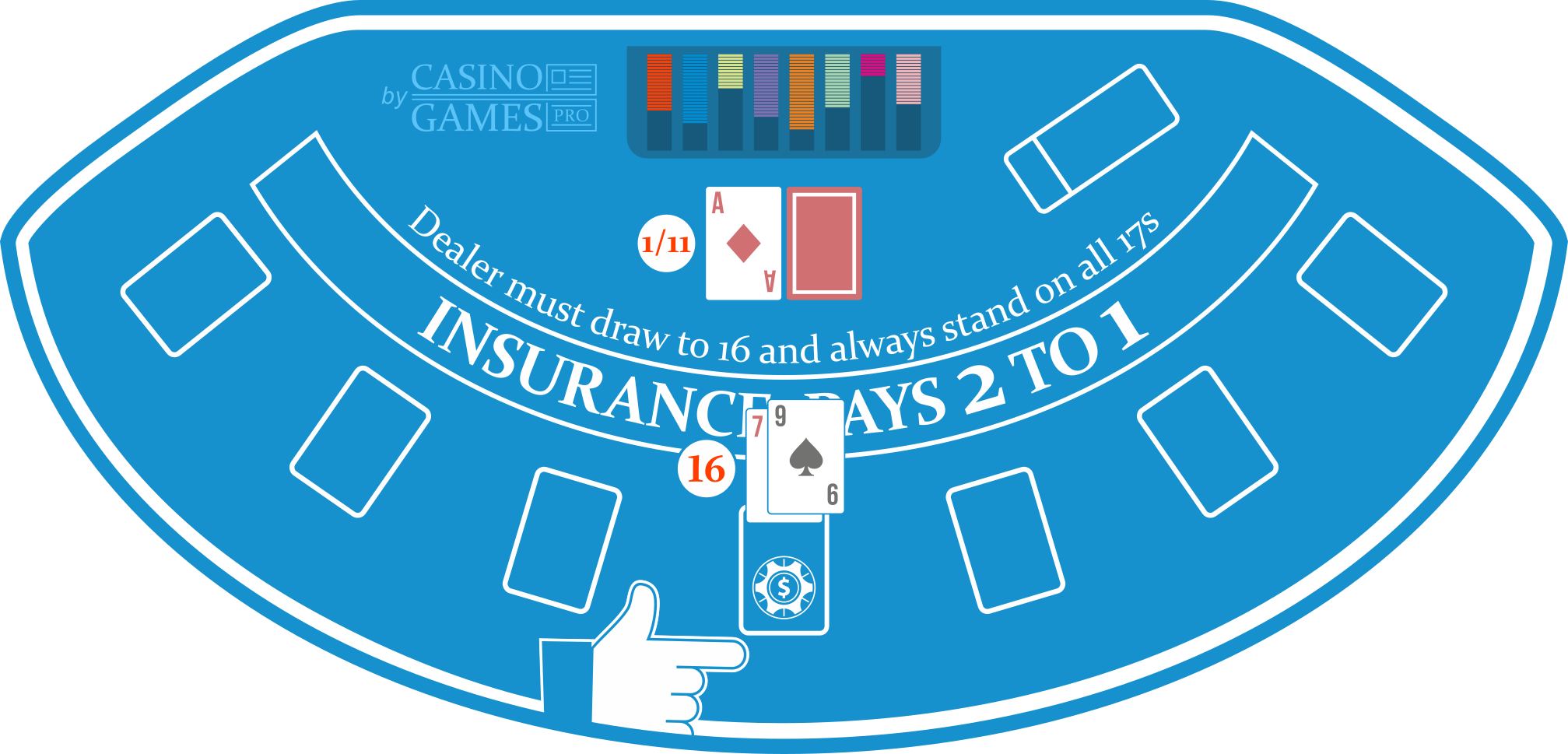
Once you announce your intention to surrender, your cards are removed, and the dealer collects half of your original bet. You keep the rest of your wager but forfeit the opportunity to play out the hand. Although it may seem odd to give up half of your bet without playing the hand, this move can be beneficial in certain situations. When you have almost no realistic chance of winning, it may be wiser to recover some of your money than to risk losing it all. In general, there are two types of surrender you can use.
Early Surrender
 The first surrender option offered in some blackjack games is called early surrender. It allows you to forfeit the current hand before the dealer checks for blackjack. Unfortunately, not many casinos offer this move because it can be very advantageous for players when used correctly. Calculations show that the early-surrender rule reduces the house edge by about 0.63% in six-deck games where the dealer stands on soft 17. If you find a blackjack variation that features early surrender, you need to know when to use this move.
If the dealer’s up-card is an ace and you have a hard total of twelve, thirteen, fourteen, fifteen, sixteen, or seventeen, it is best to surrender. If the dealer’s up-card is a ten and you have a hard total of fourteen, fifteen, or sixteen, surrender is also recommended. If the dealer’s up-card is an ace and your hand is a pair of 3s, 6s, 7s, or 8s, surrender is your best choice.
Late Surrender
 The main difference between early and late surrender is that you can make the latter move only after the dealer has checked for blackjack. Of the two options, late surrender is more widespread and can be found in many variations of the game. This is not surprising, considering that the late-surrender rule has only a small impact on the house edge, reducing it by about 0.1%. Because multi-deck blackjack variations are the most common, we will discuss when it is best to surrender according to total-dependent strategy.
If you play a variation in which the dealer stands on soft 17, you are advised to surrender when you hold a hard 15 and the dealer shows a ten. In a game where the dealer hits on soft 17, surrender is also recommended with a hard 15 against a ten or an ace. Surrendering is the optimal move if the dealer’s up-card is an ace and you hold a hard 17 or a pair of 8s. With a hard 16 against the dealer’s 9, 10, or ace, it is better to surrender regardless of whether the dealer stands or hits on soft 17.
When It’s Best to Surrender
 As already mentioned, at some point during the game, you might find yourself in a very unfavorable situation in which you are almost certain to lose the hand. When the applicable basic strategy recommends surrendering, you can give up your current hand and keep half of your original bet.
This move can be beneficial only if you use it when it is genuinely appropriate. Some players take an overly conservative approach and surrender whenever their odds appear slightly unfavorable. As a result, they may lose more over the long term by unnecessarily forfeiting half of their bets.
You should not use the surrender option merely because the dealer shows a strong up-card. Your exact total, hand composition, the dealer’s up-card, and the table rules all affect the correct decision. Follow the appropriate basic-strategy chart instead of surrendering whenever the dealer appears to have an advantage.
Further Thoughts
 It is worth mentioning that the rules regarding the surrender option can vary depending on the blackjack version and the casino. Therefore, it is always a good idea to double-check whether this move is available before joining a particular game. If you have decided to use a basic strategy that includes the surrender option but sit at a table that doesn’t offer this move, you won’t be able to implement your plan correctly.
In general, if the surrender option is permitted, the house edge decreases. Although this may seem like a very small reduction at first glance, remember that the overall house edge reflects the combined effects of every rule. If you have the chance to make the game slightly more favorable, you should take advantage of it.
Conclusion
 In some blackjack variations, one of the moves you can make during the game is to surrender. In general, you should use this option when the applicable basic strategy recommends it. By choosing to surrender, you give up your current hand and half of your initial bet while keeping the rest of your wager. This move can be beneficial if you become familiar with the situations in which it is the best choice.
FAQ: Surrender in Blackjack
Surrender in blackjack allows you to forfeit half of your bet and fold your hand early when the odds are against you. It is recommended when you’re dealt a weak hand against the dealer’s strong upcard. You should opt for surrender when your chances of winning are less than 50% as this way, you will be at least able to save half of your stake.
Early surrender is allowed before the dealer checks for blackjack, significantly reducing the house edge. Late surrender is possible only after the dealer peeks under their hole card, which makes it less advantageous but still useful. Early surrender is generally more advantageous for the player as it leads to a greater house-edge reduction.
Surrender is advisable when facing a strong dealer’s upcard, like an ace or a ten, while holding a weak starting hand that’s unlikely to win. For instance, players should surrender a hard 16 against a dealer showing a 9, 10, or ace. It’s a tactical move to minimize losses in unfavorable scenarios.
The surrender option isn’t universally offered because it can significantly lower the house edge, especially with early surrender. Casinos may limit or exclude this option to maintain a greater advantage over players. Always check the table rules or ask the dealer if surrender is allowed before you start playing.
Incorporating the surrender option into your blackjack strategy can effectively reduce the house edge, making the game slightly more favorable for players. By wisely choosing to surrender in certain situations, you minimize potential losses over time.