
Blackjack Odds & Probabilities
 | Updated:
 Odds and Probabilities: Can Players Outsmart Casinos?
 Blackjack is a skill-based card game, which makes it extremely attractive to those who know how to make the optimal move on every hand. Playing with the correct strategy allows you to reduce the house edge and improve your odds of winning in the long term. However, optimal play requires extensive knowledge of this classic casino game and how each card can affect the outcome of a betting round.
Nowadays, thanks to the work of countless blackjack aficionados, mathematicians, and casino experts who have analyzed the game, useful information is readily available in numerous books and online. To help you better understand blackjack gameplay, we have provided detailed information on blackjack odds and probabilities, covering what you need to know to make more informed decisions while playing the game of 21.

-
 Sign Up Bonus
Up to $3500
350% Bonus!9.7 -
Sign Up Bonus
Up to $500
400% Bonus!9.4 -
Sign Up Bonus
Up to $30000
100% Bonus!9.3





Blackjack Odds and Probabilities
 The odds of a particular casino game are usually expressed as a ratio between the number of times a given event occurs and the number of times it does not occur. For example, the odds in favor of drawing the Ace of Hearts in single-deck blackjack are 1 to 51 because there is only one Ace of Hearts in a standard deck of 52 playing cards. Odds are also commonly presented as odds against an event. In this case, the odds against drawing the Ace of Hearts are 51 to 1.
If you are a casino fan, you most likely have a basic understanding of what the terms “true odds” and “casino odds” mean. True odds represent the actual odds of winning a bet. However, casinos do not typically pay according to the true odds, which gives the house its built-in advantage. Casino odds represent the payout for every $1 wagered.
Many people use odds and probabilities as synonyms, but the two terms describe different concepts. Probability is the likelihood of a given event occurring among all possible outcomes. Consider the probability of drawing the Ace of Hearts in single-deck blackjack. To calculate it, divide the number of ways the event can occur by the total number of possible outcomes.
Since a standard deck consists of 52 cards and contains only one Ace of Hearts, the probability of drawing it is 1 ÷ 52 = 0.0192. Multiply this number by 100 to express it as a percentage: 0.0192 × 100 = 1.92%. Probability is always a number between 0 and 1. If an event has a probability of 0, it will never occur. If it has a probability of 1, it is certain to occur.
Comparing the Odds: Blackjack Variations
Instead of leaving you to work through blackjack odds calculators, we have simplified the process. The following table compares the listed payouts and house edges of several popular blackjack variations. This information can help you evaluate blackjack games more carefully.
Here is how different blackjack versions compare in terms of payouts and house advantage:
| Blackjack Variations Odds Table | ||
|---|---|---|
| Blackjack Variation | Odds | House Edge |
| American/Classic Blackjack | 3:2 | 0.61% |
| European Blackjack | 3:2 | 0.39% |
| Switch Blackjack | 1:1 | 0.58% |
| Face Up 21 | 1:1 | 0.85% |
| Free Bet | 3:2 | 1% |
| Online Video Blackjack | 1:1 or 3:2 | 0.5% and 2% |
| Online Live Dealer Blackjack | 3:2 | 0.49% and 0.72% |
Blackjack: A Unique Skill-Based Game
 Odds are used to compare players’ chances of winning a particular hand with their chances of losing it, taking several factors into account. Players should remember that even a small rule change can significantly affect the game. Every adjustment influences their chances of winning, so it is important to understand which variations offer the most beneficial conditions.
By becoming familiar with the odds of the game, players can improve their ability to make informed decisions in different situations. Understanding how the cards and rules affect the possible outcomes provides valuable context for each decision.
In blackjack, the odds can shift in favor of the player or the dealer with every card drawn from the deck, and optimal strategy is built around these changes. Blackjack players should take the time to develop their skills and learn as much as possible about the game. Playing decisions should not be controlled by instinct but by factors such as the dealer’s up-card, the number of decks in use, and the rules dictating the dealer’s play. This is one of the most important differences between games based entirely on chance and those in which skill affects the outcome.
Mastering Tricky Blackjack Hands
Some blackjack hands can challenge even experienced players. How you handle these difficult situations can have a significant effect on the outcome. Understanding the odds can help you approach the following hands with greater confidence:
- Tough Spot: When You Have 16
A hard 16 is one of the most difficult hands to play. Basic strategy suggests hitting against a dealer’s 7 or 8 and surrendering against a 9 or 10. The risk of busting when you hit is high, but the decision should be based on the dealer’s up-card.
- Stuck with 15 Against a Dealer’s 10
Facing a dealer’s 10 with a total of 15 is difficult because the odds narrowly favor the dealer. Hitting gives you a 22% chance of winning, slightly lower than the 23% chance if you stand. The narrow difference illustrates how close this decision can be.
- The Difficult 12 Against a Dealer’s 4
This hand presents a close decision. With the dealer showing a 4, there is a 40% chance that the dealer will bust. Standing means you will lose 60% of the time. If you hit, you have a 58% chance of losing and a 2% chance of pushing. According to basic strategy, you should stand in this situation.
- Dealing with Low Pairs
The following guidelines apply to low pairs:
- Pair of 4s? Split against a dealer’s 5 or 6.
- Pair of 5s? Do not split. Instead, consider doubling down if the dealer shows 2 through 9.
- Pairs of 2s, 3s, or 6s? Split against a dealer’s 2 through 6. Also split 2s and 3s against a dealer’s 7. Otherwise, do not split. If you do not split, hit pairs of 2s, 3s, and 4s, and double with a pair of 5s against a dealer’s 2 through 9. With 6s against a dealer’s 7 or higher, hit; against a 6 or lower, split.
- When You Have 12 and the Dealer Shows 3
Basic strategy suggests hitting a total of 12 against a dealer’s 3. The odds are close, so this decision should be based on strategy rather than instinct.
Blackjack is a game of probabilities, and understanding them can help you make more informed decisions.
The Effect of Card Removal in Blackjack
 As noted above, every card that leaves the deck provides valuable information about the remaining cards and the player’s odds. Card-counting systems are based on this principle. Decks rich in high-value cards shift the odds in favor of the player. Conversely, decks in which low-value cards outnumber high-value cards work in favor of the house.
The removal of a card worth 10 decreases the players’ chances of winning by 0.51%. Similarly, the removal of an ace reduces their chances of winning by 0.59%. Removing a nine leads to a 0.15% decrease in the players’ chances of winning. In summary, the removal of a nine, ten, or ace decreases your chances of winning. On the other hand, the removal of cards valued from 2 through 6 works in your favor.
Blackjack Odds & Probabilities of Busting
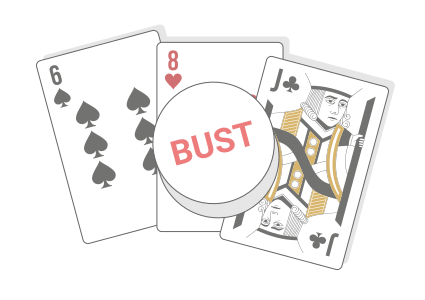 One of the most important things players need to understand before playing is the probability of going bust. Since the main objective of the game is to reach 21 without exceeding it, it is essential to know when it is best to avoid hitting. Although players should follow basic strategy to make the best possible moves, they should also understand their mathematical chances of losing.
The following chart illustrates the probability of going bust when a player chooses to hit. It considers only the total value of the player’s hand and uses that value to calculate the likelihood of busting. This information can help players better understand the risk associated with taking another card.
| Blackjack Odds of Busting if Player Chooses to Hit | |
|---|---|
| Player’s Hand | Probability of Busting |
| 21 | 100.00% |
| 20 | 92.00% |
| 19 | 85.00% |
| 18 | 77.00% |
| 17 | 69.00% |
| 16 | 62.00% |
| 15 | 58.00% |
| 14 | 56.00% |
| 13 | 39.00% |
| 12 | 31.00% |
| 11 or less | 0.00% |
Dealer’s Bust Probability
The dealer’s probability of busting depends on the up-card and whether the house rules require the dealer to stand or hit on soft 17. Understanding these probabilities can help players recognize when the dealer is more likely to exceed 21.
The following table shows the probability of the dealer busting under each soft 17 rule:
| Dealer’s Odds Table | ||
|---|---|---|
| Dealer’s Card | Probability: Stand on 17 | Probability: Hit on 17 |
| Ace | 17% | 20% |
| 2 | 35% | 36% |
| 3 | 37% | 38% |
| 4 | 40% | 40% |
| 5 | 42% | 42% |
| 6 | 42% | 44% |
| 7 | 26% | 26% |
| 8 | 24% | 24% |
| 9 | 23% | 23% |
| 10 | 23% | 23% |
Frequency of the First Two Cards
 At the beginning of every game, players are dealt two cards that determine the value of their hand. Since a standard pack consists of 52 cards, 13 ranks, and 4 suits, it is possible to calculate the likelihood of receiving a particular combination. These calculations give players a general idea of how often they might form a natural blackjack, a soft hand, or another hand category.
A natural blackjack, consisting of an ace and a ten, occurs 4.8% of the time. It is the most desirable starting hand, so it should not be surprising that it is relatively difficult to receive. The second-best combination is a hard-standing hand because its total value is usually high enough to compete with the dealer’s hand. The following chart shows the likelihood of receiving each type of combination.
| First Two-Cards Frequency Chart | |
|---|---|
| Two-Card Combination | Frequency in Percentage |
| Natural Blackjack | 4.80% |
| Hard Standing (17-20) | 30.00% |
| Decision Hands (1-16) | 38.70% |
| No Bust | 26.50% |
| Total | 100.00% |

Blackjack House Edge
 Every casino game, including blackjack, has a built-in house advantage. The house edge is a dynamic measurement because it depends on factors such as the number of decks and the specific rule set. Blackjack is known for having a relatively low house edge of around 1%, which can be reduced further when players apply strategy correctly. In general, casino games that require skill and knowledge have some of the lowest house edges because players’ decisions can affect the outcomes.
Blackjack is one of the most popular casino games and has numerous variations. Each version gives players different chances of winning because some variations offer more favorable rules and odds than others. For instance, the house edge of the popular version Super Fun 21 is 0.94%, whereas in Blackjack Switch it is only 0.17%.
House Edge of Multi-Deck Blackjack
 In blackjack, the number of decks used plays a crucial role because it directly influences the odds of winning. In the past, the game was mainly played with a single pack of cards, but nowadays, such games are extremely difficult to find. Players should therefore familiarize themselves with the house edge of each variation because it can significantly affect their chances of winning. The number of decks is also important for card counters because a game played with eight decks makes it much harder to track the cards. It is worth noting that the more decks used, the higher the house edge becomes. For instance, a blackjack game following standard rules will have a house edge of about 0.42% when played with two decks. However, if the game involves eight decks, the house advantage will increase to about 0.70%.
Conclusion
 One reason blackjack is so popular is that it offers players relatively favorable odds, with a house edge of less than 1% under certain conditions. Because many of its probabilities can be calculated, players can determine the likelihood of receiving specific card combinations. Blackjack requires a considerable amount of skill, and players can use a reliable strategy to make more informed decisions throughout the game. It is also important to recognize the situations in which increasing the size of a bet may provide an opportunity to maximize potential winnings.
FAQ: Understanding Blackjack Odds & Probabilities
Odds in blackjack tell you the chance of winning or losing a hand. For example, the odds of getting an Ace of Hearts from a single deck are 1 in 51. Understanding odds helps you better gauge your chances during the game.
Knowing the odds helps you make smarter decisions. For instance, if you’re aware of the odds of busting with a certain hand, you might choose to stand instead of taking another card. It’s all about making smart decisions.
Odds reflect the chances of an event happening to it not happening. Probabilities, on the other hand, indicate the likelihood of an event occurring. Both concepts help you understand your chances of winning or losing a hand.
Yes, blackjack odds change with each card dealt. For example, if high-value cards are drawn, the remaining deck becomes less favorable for the player. This dynamic nature of blackjack is why strategies like card counting can be effective.
Different rules can significantly impact the house edge. For instance, the house edge increases if the dealer hits soft 17. Understanding how these rules affect the odds can help you choose games that offer better chances of winning.