
Spanish Blackjack
 | Updated:
 Spanish Blackjack: The Game Where 21 Always Wins
 Among the many blackjack variations is Spanish 21, also known as Spanish Blackjack. Despite its name, the game first appeared in Nevada, which is still home to some of the biggest brick-and-mortar casinos in the US. Spanish Blackjack is easy to learn because its basic gameplay follows that of classic blackjack. However, several distinctive features make Spanish Blackjack an interesting variation to explore.
Spanish Blackjack is available at numerous land-based casinos, and several versions of the game can also be found online. Although it is similar to classic blackjack, Spanish 21 offers special payouts for certain combinations totaling 21. Read the rest of this guide to learn more about the rules and payouts. In addition to explaining the game’s rules in detail, we will present an optimal strategy that can help you play Spanish Blackjack with the lowest possible house edge.

-
 Sign Up Bonus
Up to $3500
350% Bonus!9.7 -
Sign Up Bonus
Up to $500
400% Bonus!9.4 -
Sign Up Bonus
Up to $30000
100% Bonus!9.3







Spanish Blackjack Rules
 Because Spanish Blackjack is a variation of the classic game, its basic gameplay remains the same. The main rules and card values are also unchanged. Your aim is to beat the dealer, who is your only opponent. Although other players will probably be sitting at the table, your goal is to form a hand with a higher total than the dealer without exceeding 21. If your total exceeds 21, you automatically go bust and lose your bet. Most cards are worth their face value, while queens, kings, and jacks count as 10. Aces can count as either 1 or 11, depending on the hand.
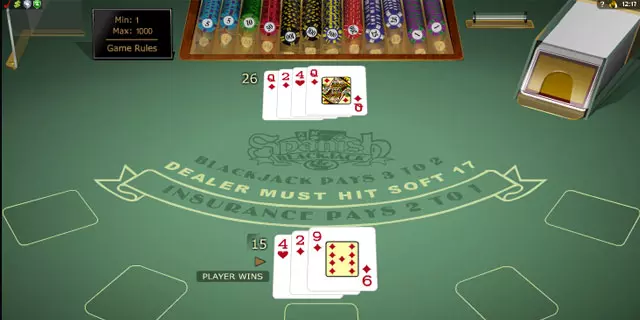
Screenshot of Spanish Blackjack
These are the basic rules every player should understand. Now, let’s examine the changes introduced in Spanish Blackjack. Unlike the classic game, this version uses six or eight decks, each containing 48 cards instead of 52 because all four 10s are removed from each deck. This rule benefits the casino and puts players at a disadvantage because their chances improve when the deck is rich in 10-value cards.
To offset the missing 10s and make the game more appealing, Spanish Blackjack includes more liberal rules and features. Under one such rule, whenever you receive a hand totaling 21, you win automatically, regardless of the dealer’s hand. The other rules of Spanish Blackjack include the following:
- You may double down on any two initial cards, regardless of their suits or values.
- After splitting a pair, you may hit or double down, including after splitting aces.
- You may surrender after doubling down. In this situation, you forfeit your original bet but keep your double-down wager.
- You can also use late surrender, meaning that you give up half of your initial bet and keep the rest. You may make this move only if the dealer does not have blackjack.
- You may resplit aces.
- If you have blackjack and the dealer has the same combination, you win rather than tie.
- The dealer is required to hit on soft 17.
- This variation is a hole-card game, so the dealer peeks for blackjack.
Spanish Blackjack Payouts
 To compensate for the missing 10s, this variation features the Super Bonus Rule, which provides different bonus payouts depending on the cards you receive. These bonuses create additional opportunities for enhanced payouts. The available bonus payouts include the following:
- A five-card hand totaling 21 pays 3:2.
- A six-card hand totaling 21 pays 2:1.
- A seven-card hand totaling 21 pays 3:1.
- A 6-7-8 or 7-7-7 of mixed suits totaling 21 pays 3:2.
- If either of the above combinations is suited, it pays 2:1. If all the cards are spades, the payout is 3:1.
- If you receive three 7s of the same suit when the dealer’s up card is also a 7, the payout is 50:1.
These bonus payouts do not apply if you have already doubled down or split a pair.
Some Spanish Blackjack variations feature an additional side bet called “Match the Dealer.” Players bet on whether either of their first two cards will have the same rank as the dealer’s up card. If the rank matches but the suit does not, the side bet pays 4:1. If both the rank and suit match, the payout rises to 9:1. However, new players should avoid “Match the Dealer” side bets because they increase the house edge.
Spanish Blackjack House Edge
 The removal of all 10s plays a crucial role because it significantly increases the house edge. However, several additional rules are designed to work in the players’ favor. As with other blackjack variations, the house edge in Spanish Blackjack depends largely on factors such as the dealer’s required actions and the number of decks in play.
Keep in mind that the house edge is usually calculated under the assumption that players use basic strategy. If the dealer hits on soft 17 and the game uses eight decks, the house edge is 0.80%. However, if the dealer is required to stand on soft 17, the house edge drops to a more favorable 0.38%.
Optimal Strategy for Playing Spanish Blackjack
 Because Spanish Blackjack uses fewer cards and includes several rule variations, the game requires a specific strategy. The most important factor when choosing the optimal strategy is whether the dealer hits or stands on soft 17. Below are some general rules that apply regardless of the variation you choose:
- Always hit when you have a hard total of 4 through 8.
- With a hard 9, hit unless the dealer’s up card is a 6, in which case you should double down.
- If your hand totals 12, 13, or 14, hit.
- Stand on hard totals of 18 through 21.
- If you have suited 7s and the dealer shows a 7, hit.
- Do not split paired 4s, 5s, or 10s.
- If you have a pair of 8s and the dealer’s up card is an ace, surrender. Otherwise, split.
- If you have paired aces, your best move is to split them.
If you have a hand without an ace that totals 16, your decision depends on the dealer’s up card. If the dealer’s exposed card is a 5 or 6, it is best to stand. If the dealer shows a 7 through 10, you should hit. Surrender only if the dealer’s up card is an ace.
Online, you can find Spanish Blackjack basic strategy charts showing the optimal move in every possible situation. Some recommended plays depend on the number of cards in your hand. Learning the strategy may take some time, but using it can help you make more informed decisions.
Spanish Blackjack Strategy Chart
Rules:
- Played with 48-card decks (10s removed).
- Player blackjack (pontoon) beats dealer blackjack.
- Player 21 beats dealer 21.
- Double on any number of cards.
- Redouble once.
- Surrender after doubling down.
- 5-card 21 pays 3:2, 6-card 21 pays 2:1, and 7+-card 21 pays 3:1.
- Special payouts for 6/7/8 and 7/7/7 combinations.
- 8 decks; dealer hits soft 17 and peeks for blackjack.
- Double after splitting; resplit up to 4 hands; draw to split aces.
- Surrender allowed.
| Strategy When Player Has Not Doubled | |||||||||||
|---|---|---|---|---|---|---|---|---|---|---|---|
| Your Hand | The Dealer’s Up Card | ||||||||||
| 2 | 3 | 4 | 5 | 6 | 7 | 8 | 9 | 10 | A | ||
| 5-7 | H | H | H | H | D | H | H | H | H | H | |
| 8 | H | H | H | D | D | H | H | H | H | H | |
| 9 | H | D3 | D | D | D | H | H | H | H | H | |
| 10 | D4 | D4 | D | D | D | D4 | D4 | H | H | H | |
| 11 | D3 | D4 | D4 | D4 | D4 | D4 | D4 | D3 | D2 | D2 | |
| 12 | H | H | H | H | H | H | H | H | H | H | |
| 13 | H | H | H | H | S3* | H | H | H | H | H | |
| 14 | H | H | S3* | S4* | S5* | H | H | H | H | H | |
| 15 | S3* | S4* | S5 | S5 | S | H | H | H | H | H | |
| 16 | S5 | S5 | S5 | S | S | H | H | H | H | R | |
| 17 | S | S | S | S | S | S | S5 | S5 | S5 | R | |
| 18+ | S | S | S | S | S | S | S | S | S | S | |
| A,2-A,6 | H | H | D | D | D | H | H | H | H | H | |
| A,7 | S3 | S3 | D3 | D4 | D5 | S5 | S3 | H | H | H | |
| A,8-A,9 | S | S | S | S | S | S | S | S | S5 | S5 | |
| Strategy Chart with Pair | |||||||||||
|---|---|---|---|---|---|---|---|---|---|---|---|
| Pair | The Dealer’s Up Card | ||||||||||
| 2 | 3 | 4 | 5 | 6 | 7 | 8 | 9 | 10 | A | ||
| 2,2 | P | P | P | P | P | P | H | H | H | H | |
| 3,3 | P | P | P | P | P | P | H | H | H | H | |
| 4,4 | H | H | H | D | D | H | H | H | H | H | |
| 5,5 | D | D | D | D | D | D | D | H | H | H | |
| 6,6 | H | H | P | P | P | H | H | H | H | H | |
| 7,7 | P | P | P | P | P | P* | H | H | H | H | |
| 8,8 | P | P | P | P | P | P | P | P | P | R | |
| 9,9 | S | P | P | P | P | S | P | P | S | S | |
| 10,10 | S | S | S | S | S | S | S | S | S | S | |
| A,A | P | P | P | P | P | P | P | P | P | P | |
Legend:
- H: Hit (Twist)
- S: Stand (Stick)
- D: Double if possible; otherwise, hit
- D#: Double if your hand has # or fewer cards; otherwise, hit
- S#: Stand if your hand has # or fewer cards; otherwise, hit
- S*: Stand unless a 6/7/8 or 7/7/7 bonus is possible
- P: Split (Pair)
- P*: Split unless you have suited 7s and a bonus is possible
- R: Surrender if possible; otherwise, hit
| Strategy When Player Has Doubled | |||||||||||
|---|---|---|---|---|---|---|---|---|---|---|---|
| Your Hand | The Dealer’s Up Card | ||||||||||
| 2 | 3 | 4 | 5 | 6 | 7 | 8 | 9 | 10 | A | ||
| 7 | D | D | D | D | D | D | R | R | R | R | |
| 8 | D | D | D | D | D | D | D | D | R | R | |
| 9 | D | D | D | D | D | D | D | D | D | D | |
| 10 | D | D | D | D | D | D | D | D | D | D | |
| 11 | D | D | D | D | D | D | D | D | D | D | |
| 12 | S | S | S | S | S | D | D | R | R | R | |
| 13-16 | S | S | S | S | S | S | R | R | R | R | |
| 17 | S | S | S | S | S | S | S | S | S | R | |
| 18+ | S | S | S | S | S | S | S | S | S | S | |
| A,2-A,6 | D | D | D | D | D | D | D | D | D | D | |
| A,7 | S | S | D | D | D | S | S | S | S | S | |
| A,8+ | S | S | S | S | S | S | S | S | S | S | |
Legend:
- S: Stand
- D: Double
- R: Surrender
Conclusion
 Spanish Blackjack is a popular variation enjoyed by players around the world. Its bonus payouts and player-friendly rules make it an appealing alternative to classic blackjack. This variation is available at many brick-and-mortar casinos and online. Before playing, make sure you understand all of its rules, payouts, and strategic differences.
FAQ: Spanish Blackjack for Beginners
Spanish Blackjack, or Spanish 21, spices things up by removing all the tens from the deck, making it a bit trickier to win as tens are pretty handy in blackjack. But don’t worry, it balances out with some cool rules that can work in your favor, like always winning with a 21, even if the dealer has a 21 too!
Yes, you can! In Spanish Blackjack, you’re allowed to double down on any two cards you get, which means you can double your bet if you think your hand is strong. Plus, you can even double down after splitting pairs, giving you more chances to win big.
As already mentioned, Spanish Blackjack introduces some fun twists like the player’s blackjack always winning the game. If you hit blackjack (an ace and a face card), you win, even if the dealer also has blackjack. That’s a cool rule that you don’t find in regular variations of the card game, making Spanish Blackjack a bit more exciting.
Most certainly. Spanish Blackjack throws in some awesome bonus payouts for specific 21 combinations, like getting paid 3:2 for a five-card 21. These bonuses give you a chance to win more than the usual payouts, especially if you manage to land specific card combos.
Knowing when to hit or stand can be a bit tricky with the extra rules. Generally, you’ll want to hit when your hand is between 4 and 8, and stand on hard totals of 18 to 21. For everything in between, it’s good to check a basic strategy chart for Spanish Blackjack, which will guide you based on your hand and the dealer’s up card.