Doubling Down in Blackjack
 | Updated:
 Doubling Down: A Key Blackjack Move for Strategic Play
 One reason for blackjack’s popularity among casino players is the ability to influence the game by using the correct strategy. Because it often offers an extremely low house edge, blackjack requires players to make the optimal move on every hand to reduce the casino’s advantage as much as possible. Implementing a blackjack strategy requires a good understanding of all the basic moves and the situations in which to use each one.
Depending on whether you stand, hit, split, or double down, you can completely change how each betting round unfolds. Doubling down is one of blackjack’s basic moves and can reward players with increased returns when used correctly. While basic blackjack strategy can help you learn when it is advisable to double down, we suggest starting with this article, which provides detailed information about this fundamental move and how to execute it properly.

-
 Sign Up Bonus
Up to $3500
350% Bonus!9.7 -
Sign Up Bonus
Up to $500
400% Bonus!9.4 -
Sign Up Bonus
Up to $2000
200% Bonus!9.3






Overview
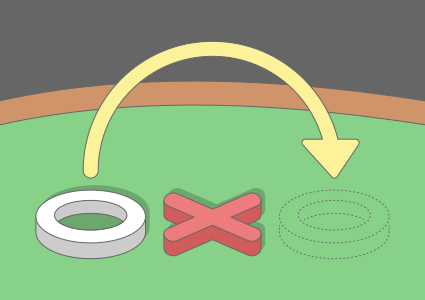
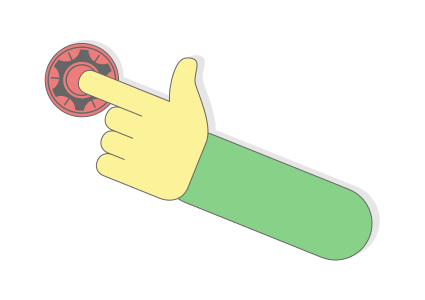
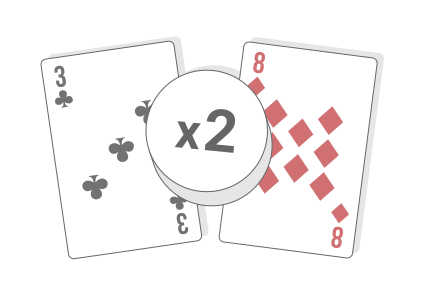
 Doubling down is one of the most exciting moves you can make in the game. This option allows you to double your original wager, giving you the opportunity to win more money when you hold a better hand than the dealer. To indicate this move, you must place the additional bet next to your initial wager, outside the designated betting area, and point to the amount with one finger. After you have been dealt your first two cards, you will receive only one additional card. The permitted size of the additional bet varies from one casino to another.
Some games allow you to stake only half of your initial bet, whereas others require you to match it in full. Although the required amount is not fixed, the additional wager cannot exceed the original bet. The rules for this move can vary depending on the casino and the particular version of the game. Some casinos allow players to double down on any two cards, while others impose certain restrictions. It is therefore essential to check the rules in advance so that you are prepared for the situations that may arise.
Doubling Down for Less
 Some casinos allow patrons to double down for less than their original wagers. Although this may sound appealing because it reduces the amount at risk, basic-strategy blackjack players generally avoid this option. After all, when you double down, you want to maximize your potential winnings.
Let us assume that you are dealt a hard 11. If you are familiar with basic strategy, you know that the optimal move in this situation is to double down when the dealer’s upcard is a ten. Your original wager is $50, but the casino allows you to double down for less. Regardless of the amount you choose, you will receive only one additional card after doubling down. From a mathematical perspective, you are expected to win 54% of the time. If you double down for the full amount, you will have a total of $100 in action. Over 100 hands, 54 wins at $100 equal $5,400. On the other hand, losing 46% of the time would result in total losses of 46 x $100 = $4,600, leaving a net profit of $800.
If you have a hard 11, hitting may also be an option. In that case, your chances of winning are slightly higher, at approximately 56%. If your bet is $50, you could win 56 x $50 = $2,800, while your losses could amount to 44 x $50 = $2,200. This would result in net winnings of $600 ($2,800 – $2,200). In this example, hitting produces a larger net result than doubling down for less, without increasing your stake. However, doubling down for the full amount of your wager produces a greater long-term return.
When to Double Down
 Doubling down can be a beneficial move, but only if you know when it is appropriate to use it. Although you cannot predict whether a particular hand will win or lose, you can make more informed decisions by applying basic strategy. This playing system provides valuable information about the situations in which it is best to make a particular move, including doubling down.
You should decide whether to double down by considering the dealer’s upcard and your hand total. It is usually advisable to make this move when the dealer is in a weak position. When the dealer has low cards, you have a good chance of winning, so it is important to make the most of the situation. For example, if you have a soft 13 through 18 and the dealer’s upcard is 3, 4, 5, or 6, it is best to double down. If doubling down is not allowed, basic strategy advises players to hit on soft 13 through 17. However, if you have a soft 18, it is better to stand and preserve the stronger total.
- Hard 9 against 3 through 6
- Hard 10 and 11 against low cards
It is essential to become familiar with all the situations in which it is best to double down. Doing so can improve your long-term results and help offset losses.
| Strategy for Doubling Down in Blackjack | ||||||||||
|---|---|---|---|---|---|---|---|---|---|---|
| Player’s Total | Dealer’s Upcard | |||||||||
| 2 | 3 | 4 | 5 | 6 | 7 | 8 | 9 | 10 | Ace | |
| 8 | H | H | H | D | D | H | H | H | H | H |
| 9 | H | D | D | D | D | H | H | H | H | H |
| 10 | D | D | D | D | D | D | H | H | H | H |
| 11 | D | D | D | D | D | D | D | H | H | H |
| A-2 | H | H | H | D | D | H | H | H | H | H |
| A-3 | H | H | D | D | D | H | H | H | H | H |
| A-4 | H | H | D | D | D | H | H | H | H | H |
| A-5 | H | H | D | D | D | H | H | H | H | H |
| A-6 | H | D | D | D | D | H | H | H | H | H |
| A-7 | S | D | D | D | D | S | S | H | H | H |
Doubling Down on a Pair of 5s
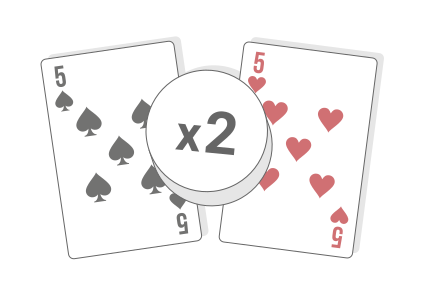 When players receive two cards of the same rank, they may be able to split them to form two new hands. Whether splitting is advisable depends on the rank of the cards and the dealer’s upcard. One important exception occurs when you receive a pair of 5s and the dealer’s upcard is 2 through 9. In this case, you should double down instead of splitting.
Although two 5s form a strong starting total of 10, separating them does not create two strong hands. Splitting such a pair can leave you with two hands that have relatively low chances of winning. Doubling down instead allows you to take advantage of the favorable starting total. It is important to make the most of such situations when they arise.
Rule Variations of Doubling Down
 As already mentioned, the rules for doubling down depend on the particular version of the game and the casino. Every rule change, even a seemingly insignificant one, can affect the house edge. You should therefore review when doubling down is permitted and when it is prohibited, as these rules can influence your chances of making a profit.
For instance, if doubling down is allowed after splitting, the house edge is reduced by approximately 0.13%. If you are permitted to double down only on 10s and 11s in a six-deck game, the rule favors the casino by increasing the house edge by 0.61%. In the same situation with two decks instead of six, the house edge increases by approximately 0.26%.
Conclusion
 Blackjack combines strategic decisions with chance, so player choices can significantly affect the outcome of each hand. Applying a reliable strategy can reduce the house edge, but strategic play never guarantees a 100 percent success rate. Doubling down increases both your potential return and the amount at risk, so it should be used only when basic strategy and the table rules support the move.