
Strategy for Blackjack
 | Updated:
 Blackjack Strategy: The Gateway to More Successful Play
 Unlike most casino games, blackjack involves both luck and skill. While there is no way to predict the result of a blackjack hand, the player’s decisions can significantly affect the outcome. By learning the optimal move for each hand, you can play more effectively and realize the game’s full theoretical RTP. Strategic play does not guarantee a win on any hand, but it can reduce the house edge and improve your chances of winning.
You can find numerous blackjack strategies, especially online, but many blackjack experts consider basic strategy the system that provides the optimal move for each hand. In this article, we will review basic strategy and the charts that make it easier to apply.

-
 Sign Up Bonus
Up to $3500
350% Bonus!9.7 -
Sign Up Bonus
Up to $500
400% Bonus!9.4 -
Sign Up Bonus
Up to $30000
100% Bonus!9.3






Basic Strategy Overview
 One of the most popular approaches to blackjack is basic strategy. Countless players use it because it has proven highly effective. It serves as a guide that suggests the most efficient move in a particular situation, taking into account the dealer’s up card and the player’s hand. To apply basic strategy correctly, it is essential to be familiar with the fundamental rules of the game. Many players are unfamiliar with fundamental terms such as soft and hard hands, which prevents them from understanding the game properly.
The history of basic strategy can be traced back to 1952, when a group of soldiers decided to play blackjack while stationed at the U.S. Army barracks in Aberdeen, Maryland. Roger Baldwin, one of the soldiers, proposed that if the dealer followed clear, fixed rules, it would be possible to calculate the probabilities of winning and losing in every situation.
His idea was developed with the help of three other men: Army Sergeant Wilbert Cantey, Herbert Maisel, and James McDermott. In 1957, the four men, who became known as the Four Horsemen of Aberdeen, published a book called Playing Blackjack To Win. Interestingly, the four men never used basic strategy to play blackjack. Later, Ed Thorp tested the strategy and confirmed its accuracy. He developed it further and laid the foundation for the first card-counting system, the Ten Count System. He published his work in a book called Beat the Dealer.
Basic strategy can significantly decrease the house edge. It relies on the probabilities of different combinations of cards appearing on the table, taking into account the number of decks included in the game, the player’s cards, and the dealer’s up card. Basic strategy compares how different actions affect your chances of winning and suggests the best option for the current situation. Millions of computer simulations have been run to test basic strategy and verify its effectiveness.
Reading Basic Strategy Charts
Blackjack is often played with six or eight decks, creating countless possible combinations. Online, blackjack enthusiasts can find several strategy charts adjusted to the specific rules of a given blackjack variation and the number of decks it uses.
At first glance, basic strategy charts might look overwhelming. However, they are not difficult to read. Information about the dealer’s up card is located at the top of the chart, while the player’s hand is shown vertically on the left. Different moves are indicated by different colors and letters.
Usually, “S” indicates that the player should stand, “H” means hit, and “D” means double down. “DH” stands for double down or hit if doubling is not allowed, while “SP” or simply “P” means split. “DS” suggests that the player should double down or stand if doubling is not allowed. However, you do not need to memorize these abbreviations because blackjack basic strategy charts feature a legend at the bottom.
Rule Variations Affecting Basic Strategy Moves
If you often find yourself wondering whether you should hit, stand, split, or double down, it is time to consult a basic strategy chart.
Although the objective of the game remains the same, several rule variations can influence your decisions and affect the size of the house edge.
Some of the most common variations include the number of decks, whether the dealer hits or stands on soft 17, rules for doubling and resplitting, surrender availability, whether the dealer peeks, and the payout for blackjack. You can find online strategy engines that help you adapt basic strategy to the specific rules of the game.
If you play a single-deck game in which the dealer hits on soft 17, your hand is soft 13, and the dealer’s up card is 4, you should double down if allowed; otherwise, hit. If you play a 4- to 8-deck variation in which the dealer stands on soft 17, your hand is soft 13, and the dealer’s exposed card is 4, you should hit.
Consider another example. You are playing single-deck blackjack, and the dealer is allowed to hit on soft 17. You are dealt soft 18, and the dealer’s up card is 2. In this case, you should stand. In multideck variations, you should double down if allowed; otherwise, stand.
When to Split Pairs
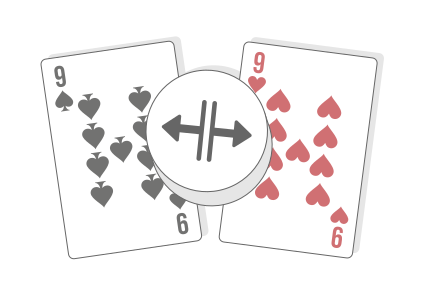 Receiving two matching cards is a situation that will eventually occur during the game. In such cases, many players act impulsively and follow the popular belief that pairs should always be split, regardless of the cards they contain. However, this is not always the best choice. In some situations, it is better to keep the pair intact.
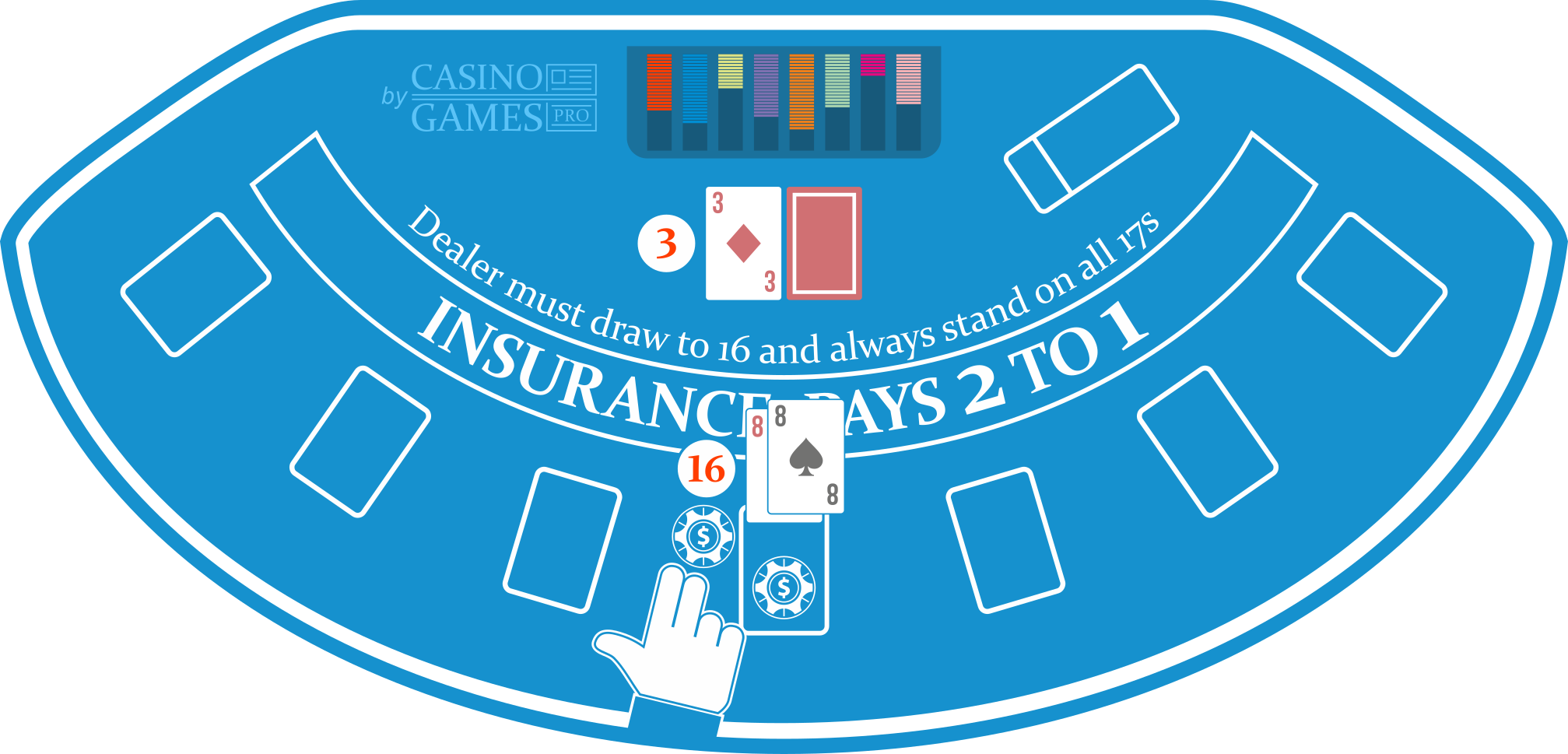
Without a reliable strategy, players are more likely to make costly decisions over time. Let’s examine the possible pairs and determine the recommended move for each, taking into account the player’s hand and the dealer’s up card.
Let’s start with a pair of 8s or Aces. According to the strategy shown below, players should split these pairs regardless of the dealer’s up card. Splitting them gives players the opportunity to start two separate hands.
Players should never split a pair of 5s, regardless of the dealer’s up card. Instead, they should double down when the chart recommends it and hit in the remaining situations. The same general rule applies to a pair of 10s: players should avoid splitting and stand instead, regardless of the dealer’s up card. Splitting a total of 20 would usually place the player in a less favorable position.
With a pair of 2s or 3s, the chart below recommends splitting when the dealer’s up card is 2 through 6. Players should split a pair of 4s only when the dealer’s up card is 5 or 6. A pair of 6s should be split against a dealer’s 2 through 6, while a pair of 7s should be split against a 2 through 7.
When the dealer’s up card falls outside these splitting ranges, players should follow the hit or stand recommendation in the chart. With a pair of 9s, players should split against 2 through 6, 8, or 9, but stand against 7, 10, or Ace.
| Strategy for Splitting Pairs in 4 to 8-Deck Blackjack When the Dealer Stands on 17 | |||||||||||
|---|---|---|---|---|---|---|---|---|---|---|---|
| Pairs in Player’s Hand | The up card of the dealer | ||||||||||
| 2 | 3 | 4 | 5 | 6 | 7 | 8 | 9 | 10 | Ace | ||
| A-A | SP | SP | SP | SP | SP | SP | SP | SP | SP | SP | |
| 2-2 | SP | SP | SP | SP | SP | SP | H | H | H | H | |
| 3-3 | SP | SP | SP | SP | SP | SP | H | H | H | H | |
| 4-4 | H | H | H | SP | SP | H | H | H | H | H | |
| 5-5 | D | D | D | D | D | D | H | H | H | H | |
| 6-6 | SP | SP | SP | SP | SP | H | H | H | H | H | |
| 7-7 | SP | SP | SP | SP | SP | SP | H | H | H | H | |
| 8-8 | SP | SP | SP | SP | SP | SP | SP | SP | SP | SP | |
| 9-9 | SP | SP | SP | SP | SP | S | SP | SP | S | S | |
| 10-10 | S | S | S | S | S | S | S | S | S | S | |
When to Double Down
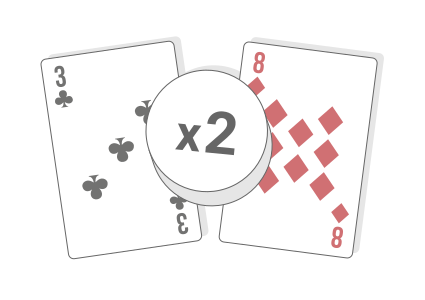 In general, doubling down is recommended when the dealer is in an unfavorable position and the player has a strong chance of improving the hand. This move doubles the initial bet, so it also increases the amount at risk. Doubling down can be beneficial, but only when it is used properly.
In some casinos, it is possible to bet less than the original wager when doubling down. However, such a move is generally less favorable to the player, so it is best to follow the recommended strategy. The chart below includes several situations in which doubling down may be the best move:
- If the player holds hard 9 and the dealer’s up card is 3 through 6
- If the player holds a suitable soft hand and the dealer shows a weak up card, as indicated in the chart
- If the player is dealt hard 10 or 11 and the dealer’s up card falls within the recommended range
Doubling down is recommended in these situations because the dealer is in a weaker position and the player has an opportunity to increase the wager. For the remaining combinations, players should follow the chart and either hit or stand.
| Strategy for Doubling Down in Blackjack | ||||||||||
|---|---|---|---|---|---|---|---|---|---|---|
| Player’s Total | The up card of the dealer | |||||||||
| 2 | 3 | 4 | 5 | 6 | 7 | 8 | 9 | 10 | Ace | |
| 8 | H | H | H | D | D | H | H | H | H | H |
| 9 | H | D | D | D | D | H | H | H | H | H |
| 10 | D | D | D | D | D | D | H | H | H | H |
| 11 | D | D | D | D | D | D | D | H | H | H |
| A-2 | H | H | H | D | D | H | H | H | H | H |
| A-3 | H | H | D | D | D | H | H | H | H | H |
| A-4 | H | H | D | D | D | H | H | H | H | H |
| A-5 | H | H | D | D | D | H | H | H | H | H |
| A-6 | H | D | D | D | D | H | H | H | H | H |
| A-7 | S | D | D | D | D | S | S | H | H | H |



When to Surrender
 This move can be beneficial, but only if players know when to use it. In general, it is best to surrender only in the specific situations recommended by basic strategy. By surrendering, players retain half of a bet that they might otherwise lose. Whether surrender is advisable depends on the number of decks in the game and the specific rules.
In a multideck blackjack game in which the dealer stands on soft 17, players are advised to surrender when the dealer’s up card is 10 and their hand is hard 15. The same applies to single-deck blackjack variations. If you are dealt hard 16 and the dealer’s up card is 9, 10, or Ace, surrender is the optimal decision in multideck variations. You should also surrender if the dealer’s up card is an Ace and your hand is hard 17.
Surrender is not available at every casino or blackjack table, so always check the rules before playing.
There are two types of surrender: early and late. Early surrender allows players to give up their hand before the dealer checks for blackjack. Early surrender is the more advantageous option, which is why few casinos offer it. Late surrender allows players to give up their hand after the dealer has checked for blackjack. This move costs half of the original stake.
Composition-Dependent Strategy
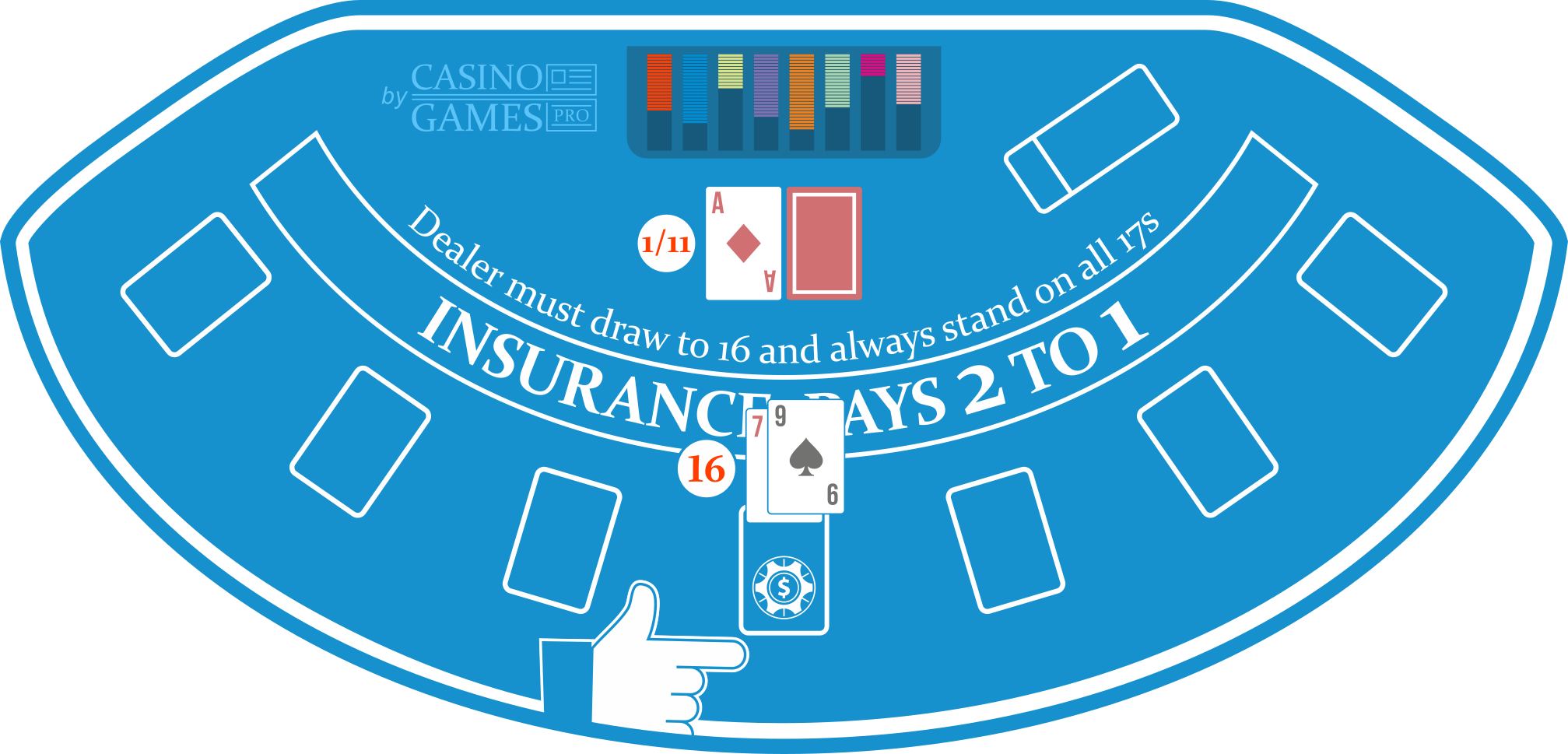
Most basic strategy charts are based on the player’s total and the dealer’s up card. In other words, basic strategy does not consider the individual cards that make up the player’s hand. However, hand composition can sometimes affect the recommended action in a particular situation.
For example, if your hand totals hard 12, basic strategy recommends standing when the dealer’s up card is 4 through 6 because of the risk of drawing a 10-value card and going bust. Composition-dependent strategy takes into account the individual cards that make up your hand. According to this strategy, you should stand if your hard 12 consists of 9 and 3, 8 and 4, or 7 and 5. If your hand consists of 10 and 2, composition-dependent strategy advises you to hit or double down if allowed. The reasoning is that the chance of drawing another 10-value card is lower because you already hold one.
Other Popular Blackjack Tips
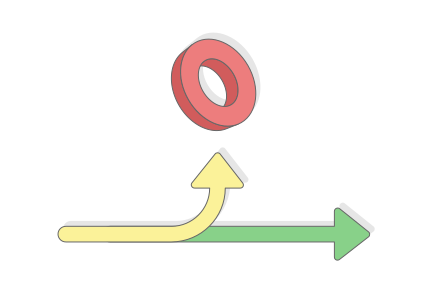 Another popular strategy is card counting. This approach is more advanced and is generally used by experienced players who already know basic strategy thoroughly. Card counting allows blackjack players to track the cards that have been dealt and estimate the ratio of high-value to low-value cards remaining. When applied alongside basic strategy, card counting can help players make more informed decisions based on the likely composition of the remaining cards.
Card-counting systems can help players make better betting and playing decisions by providing a general idea of the cards left in the deck. Over the years, many card-counting systems have been developed to help players improve their decision-making. They operate on the same basic principle by assigning point values to cards to make the counting process more efficient. Some of the best-known card-counting systems include the Hi-Lo System, Wong Halves System, Zen Count System, and Omega II System.
Valuable Tips
To play blackjack more consistently and enjoy the game, players should learn a reliable strategy. Basic strategy, combined with an accurately applied card-counting system, can help players make more informed decisions and reduce the house edge. The average winning hand in blackjack is 18.5, which means that players can win without reaching 21.
Because blackjack players compete against the dealer, they should always consider the dealer’s up card. Every decision should be based on the total value of the player’s hand and the dealer’s up card. Players who take the time to learn basic strategy can make better-informed choices and play more consistently.
Conclusion
 Blackjack is a game of skill and luck that gives players the opportunity to improve their performance by following an effective strategy. This opportunity should not be overlooked, as few other casino games allow player decisions to influence the outcome to the same extent. Basic strategy does not guarantee that players will win every hand, but it helps them make better decisions and reduce the house edge. By learning when to hit, stand, split, double down, or surrender, players can approach each hand more effectively.
FAQ for Blackjack Strategy Page
Mastering basic strategy is vital for all blackjack players. It shows you the optimal moves based on your hand and the dealer’s up card, significantly decreasing the house edge and improving your odds of winning.
While basic strategy sharpens your game, it does not guarantee you will always beat the dealer. What it does is minimize your losses and improve your odds, but remember that blackjack remains a blend of chance and skill.
Rule tweaks – like the number of decks or the dealer hitting soft 17 – have an impact both on the house edge and correct strategy. Adjust your strategy with these in mind, using online strategy engines to tailor an optimal game plan.
Splitting pairs can be a boon or a bane. Always split Aces and 8s and never split 10s and 5s in an attempt to form two stronger hands. For other pairs, the dealer’s up card dictates the recommended splitting moves.
Yes, card counting, when combined with basic strategy, significantly increases your chances of winning. It enables you to make better betting and playing decisions by tracking the ratio of high to low cards, nudging the odds in your favor.