
Multi-Hand Blackjack
 | Updated:
  Blackjack is a casino game suitable for both beginners and seasoned players, with plenty of variations to suit different playing styles. Experienced blackjack players who prefer a faster pace may appreciate variants that allow them to play multiple hands at once. This format lets them play more hands within the time they have set aside for their casino sessions.
While multi-hand blackjack tables offer a limited number of seats in land-based casinos, playing online gives you access to numerous multi-hand variations that you can enjoy instantly. The rules are generally based on the standard blackjack rules, but you should be aware of the specific features included in some online versions. To learn more, read our Multi-Hand Blackjack review below.

-
 Sign Up Bonus
Up to $500
400% Bonus!9.7 -
Sign Up Bonus
Up to $3500
350% Bonus!9.4 -
Sign Up Bonus
Up to $3000
300% Bonus!9.3



Overview
 The main difference between classic blackjack and Multi-Hand Blackjack is that the latter lets you play more than one hand simultaneously. In most cases, you can play up to five hands at once. Each hand is separate and requires an individual decision. Because the hands are treated independently, their outcomes can differ. For instance, if you play four hands at once, you might win three and lose one, or vice versa. If one hand exceeds twenty-one, that hand is removed from play, and you continue with the remaining hands.
The betting limits at each table are usually slightly different from those in other blackjack games. Because you must place a separate bet on each hand, table minimums may be lower for players’ convenience. In general, this version is suitable for active players who want a faster and more challenging blackjack experience.
In most games, you can double down on each hand, giving you an opportunity to increase the potential payout on favorable hands. However, placing multiple wagers at once can deplete your bankroll much faster if you lose. Moreover, card counters cannot apply their systems online with the same success as they can in a brick-and-mortar casino. Card counting is generally ineffective online because of the game’s digital nature and frequent shuffling.
Rules
 The basic rules of this variation remain the same as those of the original game. You compete against the dealer, and your main goal is to get a hand worth more than the dealer’s without exceeding twenty-one. All cards are worth their numerical value, except for Queens, Kings, and Jacks, which are worth ten points each. An Ace can be worth either one or eleven points, depending on which value benefits the hand. This online version is played with two decks of cards that are shuffled before the beginning of every game.
At the beginning of the game, you must decide how many hands you want to play. You must then place a bet on each hand, although the bet amounts do not have to be the same. You play your hands from right to left and must make a decision for each one. In this version, you cannot surrender because the option is unavailable.
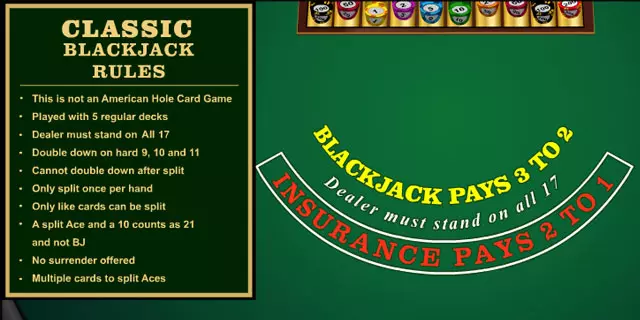
Screenshot of Classic Blackjack Rules
You must choose whether to hit, stand, double down, take insurance, or split when you have a pair. Your choice should be based on your first two cards and the dealer’s up card. You may split and re-split up to three times. The only exception is a pair of Aces, which can be split only once.
You can double down on any two initial cards unless they are an Ace and a 10-valued card, which constitute blackjack. This is the highest-value winning combination available in the game. It is also possible to double down after splitting a pair. Insurance can be taken, as usual, when the dealer is showing an Ace. The house edge of this version is approximately 0.39%.
In this game, the dealer must stand when their total is seventeen or more, regardless of whether the hand is soft or hard. If the dealer has a total of sixteen or less, they must hit. The rules require the dealer to draw cards until reaching a total of at least seventeen. If the dealer does not go bust, your hand is compared with the dealer’s hand. A blackjack pays 3/2, and a winning insurance bet also pays 3/2.
Multi-Hand Blackjack: An Easy Step-by-Step Guide
Playing multiple hands at once increases the pace of the game and requires you to make a separate decision for every hand. Here is how the format works:
- The Setup: Multi-Hand Blackjack lets you play up to five hands simultaneously. Each hand functions as a separate blackjack game with its own wager and outcome.
- Independent Hands, Independent Outcomes: Treat each hand separately. You may win one hand while losing another during the same round.
- The Bet: Table minimums may be lower because you are placing a separate wager on every hand. Remember that playing more hands means risking more money per round, so manage your stakes carefully.
- Doubling Down: You can double down on each eligible hand, increasing your original wager for the chance of a larger payout. This move can increase your return, but it also raises the amount at risk.
- The Challenge for Card Counters: Card counting is generally ineffective when playing online because frequent digital shuffling prevents players from reliably tracking previously dealt cards.
- The Moves: Decide whether to hit, stand, double down, or split. Surrender is unavailable, so each decision must be made using the remaining options.
- Play Carefully: Playing more hands gives you more opportunities to win, but it also increases your exposure to losses. Balance the number of hands and bet sizes with your available bankroll.
Strategy and Useful Tips
 If you decide to try this variation, you should learn a suitable strategy before playing. Without a reliable plan, you could lose four or five bets in a single round. Multi-Hand Blackjack can be very fast-paced, and impulsive decisions may lead to substantial losses. A consistent strategy can help you make more informed decisions. Because all hands are played separately, apply the appropriate strategy to each hand based on its cards and the dealer’s up card.
Strategy decisions can vary depending on the table rules. Pairs of Aces or 8s are generally played by splitting them, while pairs of 10s are usually played by standing. Pairs of 5s are generally treated as a total of ten rather than split. Consult the strategy chart below for the recommended decisions under the listed Microgaming rules.
Multi-Hand Blackjack by Microgaming: Strategy Chart
Rules:
- 5 Decks
- Dealer Stands on Soft 17
- Dealer Does Not Peek for Blackjack
- Double on Hard 9-11, No Double After Split (No DAS)
- Hit Split Aces
| Strategy Chart | |||||||||||
|---|---|---|---|---|---|---|---|---|---|---|---|
| Your Hand | The Dealer’s Up Card | ||||||||||
| 2 | 3 | 4 | 5 | 6 | 7 | 8 | 9 | 10 | A | ||
| 5-7 | H | H | H | H | H | H | H | H | H | H | |
| 8 | H | H | H | H | H | H | H | H | H | H | |
| 9 | H | D | D | D | D | H | H | H | H | H | |
| 10 | D | D | D | D | D | D | D | D | H | H | |
| 11 | D | D | D | D | D | D | D | D | H | H | |
| 12 | H | H | S | S | S | H | H | H | H | H | |
| 13-16 | S | S | S | S | S | H | H | H | H | H | |
| 17+ | S | S | S | S | S | S | S | S | S | S | |
| A,2-A,6 | H | H | H | H | H | H | H | H | H | H | |
| A,7 | S | S | S | S | S | S | S | H | H | H | |
| A,8-A,9 | S | S | S | S | S | S | S | S | S | S | |
| 2,2; 3,3 | H | H | P | P | P | P | H | H | H | H | |
| 4,4 | H | H | H | H | H | H | H | H | H | H | |
| 5,5 | D | D | D | D | D | D | D | D | H | H | |
| 6,6 | H | P | P | P | P | H | H | H | H | H | |
| 7,7 | P | P | P | P | P | P | H | H | H | H | |
| 8,8 | P | P | P | P | P | P | P | P | H | H | |
| 9,9 | P | P | P | P | P | S | P | P | S | S | |
| 10,10 | S | S | S | S | S | S | S | S | S | S | |
| A,A | P | P | P | P | P | P | P | P | P | P | |
Legend:
- H: Hit
- H*: Hit with 2 Cards, Stand with 3+ Cards
- S: Stand
- D: Double if Possible, Otherwise Hit
- P: Split (Pair)
Multi-Hand Blackjack: Essential Tips for Winning
- Understand the Basics: As in classic blackjack, your aim is to beat the dealer without exceeding 21. Numbered cards retain their face value, Kings, Queens, and Jacks are worth ten points, and Aces can count as either one or eleven.
- Choose Your Hands: Decide how many hands you want to play at the start. You can use different bet sizes for each hand, depending on your preferences and bankroll.
- Bet Wisely: More hands mean more action, but they also increase the total amount at risk. Set appropriate wager sizes and manage your bankroll carefully.
- Know the Available Moves: Decide whether to hit, stand, double down, or split. Surrender is unavailable, so every decision matters.
- Splitting and Doubling Down: You can split up to three times, except for Aces, which can be split only once. You can also double down on eligible initial hands and after a split.
- Insurance: Although insurance is available when the dealer shows an Ace, it is generally unfavorable to the player and is usually best avoided.
- Dealer’s Rules: The dealer stands on 17 or higher and hits on 16 or lower. This applies to both soft and hard totals.
- Blackjack and Insurance Payouts: A blackjack pays 3/2. If you take insurance and the wager wins, it also pays 3/2.
- Use a Strategy: Avoid making impulsive decisions. A consistent strategy is particularly important because the game’s fast pace can lead to rapid losses.
- Key Decisions:
- Playing a Total of 11: Check the applicable table rules and strategy chart before deciding whether to double down.
- Split Aces and 8s: These pairs are generally played by splitting them.
- Stand on 10s: A pair of 10s gives you a total of 20 and is generally played by standing.
- Playing 5s: Treat a pair of 5s as a total of 10 and follow the strategy chart based on the dealer’s up card.
Conclusion
 Multi-Hand Blackjack is an exciting variation that requires both skill and luck. Because each hand is independent, you should apply the appropriate strategy to each one rather than treating all hands as a group. You may also choose different wager sizes for individual hands, depending on your approach and bankroll. Remember that you are not required to play five hands at once; always choose a number of hands that you feel comfortable managing.
FAQ: Multi-Hand Blackjack
The primary distinction of Multi-Hand Blackjack lies in the ability to play multiple hands simultaneously, typically up to five. This feature allows players to engage in more action per round and strategize independently for each hand, potentially winning several times within the same game or mitigating losses.
In Multi-Hand Blackjack, table minimums are often adjusted to accommodate the playing of multiple hands by reducing the minimum bet per hand. This adjustment aims to make it more accessible for players to manage their bankrolls while engaging in the heightened action of playing several hands at once.
Card counting in online Multi-Hand Blackjack is challenging and largely ineffective due to the virtual nature of the game, where decks are shuffled before each hand. This environment makes it impossible to track cards the same way you would in a physical casino, diminishing the advantage card counting might offer.
Effective strategies for Multi-Hand Blackjack include doubling down on a total of eleven and splitting pairs of Aces or 8s for enhanced winning chances. Conversely, it’s advised to stand on pairs of 10s and carefully consider your moves with pairs of 5s. Diversifying strategies across hands can also help in identifying what works best for your gameplay.
Generally, the insurance bet is considered disadvantageous for the player due to its high house edge. It’s recommended to avoid this bet in Multi-Hand Blackjack, as it does not offer favorable odds and can get you further away from your overall strategy and potential winnings over time.