
Strategy for Craps
 | Updated:
 Comprehensive Overview of Craps Strategies
 Craps is a dynamic table game played with two dice. It has attained classic status and attracts players worldwide. Despite its immense popularity, craps is often considered one of the most confusing games on the casino floor. At first glance, it seems simple because it is based on chance, and players cannot affect the outcome of the dice rolls. However, there is much more to craps than merely tossing a pair of dice.
The sheer number of betting options in the game is enough to overwhelm any novice. In addition, the jargon and etiquette players are expected to follow at the table often leave newcomers feeling as though they have entered a foreign country where everyone speaks an unfamiliar language.

-
 Sign Up Bonus
Up to $3500
350% Bonus!9.7 -
Sign Up Bonus
Up to $500
400% Bonus!9.4 -
Sign Up Bonus
Up to $2000
200% Bonus!9.3



Craps can indeed be intimidating. Although it is a negative-expectation game, players can make more informed decisions and manage their losses by understanding how the game works. Knowing the available bet types and their odds, managing one’s bankroll carefully, setting win goals and loss limits, and following a disciplined strategy can improve the overall playing experience. If you would like to learn more about the strategies that can help you approach craps more responsibly, as well as the mistakes to avoid, the following article covers these topics in detail.



Know Your Bets
Some inexperienced players join a game before learning the rules and available betting options. The consequences can be costly. Craps offers an impressive number of wagers, and if you do not understand how they work, when they are accepted, and what their payouts are, you could quickly deplete your bankroll.
More importantly, the house edge fluctuates significantly depending on the type of bet placed. With Pass Line, Don’t Pass, Come, and Don’t Come bets, the house edge is relatively low, ranging from 1.36% to 1.41%. The Odds portion of these bets carries no house edge, although the original flat bet retains its standard casino advantage.
These bets generally offer players some of the best odds and value at the craps table. By contrast, the Big Red bet is one of the least favorable wagers because its house edge reaches 16.67%. Placing such a bet significantly increases the casino’s statistical advantage.
This is only one example of a poor-value craps bet. Several other bet types have a house edge exceeding 10%. Novices should familiarize themselves with all available wagers, their payouts, and their respective house edges. This knowledge will enable them to make more informed decisions during each betting session.
Adopt Combination Betting
 Some craps players combine several types of bets with relatively low house edges. While this approach covers more potential outcomes, it also increases the total amount at risk. One option is to combine a Pass Line bet with a Come bet, as both follow similar rules.
A Come bet has its own come-out roll after the table point has been established. It wins on 7 or 11 and loses on 2, 3, or 12 on that first roll. If another number becomes the Come point, that number must be rolled again before a 7 for the bet to win. A comparable approach can be used with Don’t Pass and Don’t Come bets, which generally perform better when a 7 appears before the relevant point number.
Another combination consists of a Don’t Pass bet, a Don’t Come bet, and a Field bet. The Field covers 2, 3, 4, 9, 10, 11, and 12 for one roll, while the Don’t Pass and Don’t Come bets follow their respective rules. The result of the combination depends on the roll, the status of each bet, and the Field payout schedule used at the table.
Follow the 3% Rule
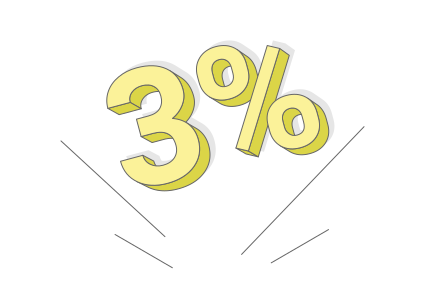 This approach again comes down to choosing bets carefully, as it encourages players to give the casino only a small statistical advantage. As the name indicates, players following this rule avoid bets with a house edge exceeding 3%. The higher the edge, the less frequently a given bet should be used.
Under this approach, Pass Line and Come bets, also known as right betting, and Don’t Pass and Don’t Come bets, known as wrong betting, can be used regularly because their house edges range from 1.36% to 1.41%. Their overall house edge can be reduced further by taking or laying Odds.
The recommended frequency for Place bets on 6 and 8 is 50%. Under this system, Lay bets on 4 or 10 and Field bets where 2 and 12 pay 3 to 1 are used less frequently. Buy bets, other Lay bets, Big 6, Big 8, Big Red, Any Craps, Yo-leven, and other proposition bets are generally avoided. Proposition bets may offer impressive payouts, but many also carry a substantial casino advantage.
Darby’s Field Bet
 Craps is played at a fast pace, which can cause many inexperienced players to steer clear of it. Nevertheless, it remains a popular casino game, and players are constantly looking for strategies that can help them structure their betting sessions. Darby’s Field Bet, also known as the Cross Iron Strategy, is one approach craps players use to cover multiple numbers on the table.
Players can apply this strategy whether they prefer to play craps at a land-based or virtual casino.
There are several important factors to consider when making combination bets in craps. First, the total house edge of a combination depends on the amounts wagered and the casino advantage attached to each individual bet. Combining wagers does not remove the house edge or guarantee a profitable result.
The outcome of a Field bet is determined immediately because it is a one-roll craps bet. The payouts are not the same for all winning numbers. Under the payout schedule described here, 12 pays 3:1, while 2 pays 2:1. The remaining winning numbers pay even money. Place bets, on the other hand, pay according to the number selected.
If you examine the numbers these wagers cover, you will notice that Darby’s Field Bet covers every total except 7. However, this strategy is not a fail-safe way to win at craps. A 7 causes the Field and active Place bets to lose, and players must stake different amounts on the Place and Field wagers.
With the stated bet sizes and payout schedule, this strategy can produce a combined house edge of around 1.14%, which is lower than the edge on some individual Place bets. However, the strategy still exposes multiple wagers to the same roll and does not guarantee a profit.
If you are still wondering whether this strategy suits your requirements and playing style, you should also consider the size of your bankroll. No betting system works equally well for all players. This one requires a larger bankroll than strategies based solely on Pass Line or Don’t Pass bets because several wagers are active simultaneously.
Craps Hedge Betting and the Logic Behind It
 Hedge bets are intended to protect one wager with another. Unlike Darby’s Field Bet, which combines several wagers to cover more totals, hedge bets are placed to compensate for the weaknesses of other wagers.
The numbers known as craps are 2, 3, and 12. To cover these totals, players can make an Any Craps bet, which pays 7:1 when it wins. The Pass Line bet is a multi-roll wager that loses if 2, 3, or 12 is thrown on the come-out roll and wins if 7 or 11 appears. If any other point number is thrown, play continues until either the point or a 7 appears.
One widespread hedge involves protecting a $5 Pass Line bet with a $1 Any Craps bet. If 7 or 11 is thrown on the come-out roll, the Pass Line bet wins $5, while the Any Craps bet loses $1, producing a net profit of $4. If the Any Craps bet wins, it returns a $7 profit, while the $5 Pass Line bet loses, producing a net profit of $2.
Hedge betting does not guarantee consistent wins because these are not the only possible outcomes. If 4, 5, 6, 8, 9, or 10 establishes a point, the Any Craps bet loses, while the Pass Line bet remains active until either the point number or a 7 is rolled.
With this in mind, the expected return from playing the Pass Line alone is generally better than the expected return from combining it with a high-edge hedge wager.
Another way to apply the hedge-bet method is to make a Hard 6 or Hard 8 bet to protect a flat Don’t Pass bet. However, many players avoid this approach because it requires risking more money and adds a wager with a comparatively high house edge.
Can You Really Control the Dice in Craps?
 Dice control is another method some players attempt at the craps table. It is also known as dice setting and concerns how the dice are arranged and thrown in an effort to influence the results. Players who use this technique generally hope to reduce the frequency of 7s, as 7 is the most common total and can cause several bets to lose.
If players could consistently reduce the frequency of 7s, the odds would theoretically shift in their favor over the long term. However, many craps players question the effectiveness of this method because consistently throwing the dice to produce or avoid particular totals is extremely difficult. In theory, players might benefit from this dice-rolling technique, but in practice, producing reliable and repeatable results is highly unlikely. One reason is that casinos typically require the dice to hit the back wall of the table on every valid throw.
Players interested in dice setting often focus on delaying the appearance of 7. The 3-V set is one of the most widely used arrangements. With this set, the 3 faces should point upward, and the pips should meet to form a V. The intention is to arrange 6s and 8s around the dice while reducing the likelihood of certain 7 combinations.
The release is also crucial, but the difficulty stems from the need to follow house rules, hit the back wall of the table, and maintain a smooth, consistent throw. Players attempting the technique generally try to release the dice without excessive force.
Avoid Negative Betting Progressions
 Some inexperienced craps players assume that following a progressive betting system will tip the scales in their favor. This could not be further from the truth. First, following a system is primarily a form of bankroll management and does nothing to affect the outcome of the dice rolls. Craps is a game of chance. Second, even if players win with a given system for a while, an unfavorable streak can cause them to lose money over the long term.
If you insist on following a betting system, consider avoiding those based on negative betting progressions. The Martingale is the best-known example. It requires players to double their stakes after each loss and return to their base betting unit after a win. The idea is that increasing the stake after each loss will eventually allow one win to recover the previous losses.
At first glance, this may sound logical. However, aggressively increasing your stakes after every loss has many disadvantages, especially in a fast-paced game like craps, where money can change hands quickly.
Players who follow systems such as the Martingale risk large sums to win relatively small amounts. They may also reach the table limit before securing the win needed to recover a losing streak. No one is “overdue” to win, and there is no way to determine with certainty when a losing streak will end. Players also risk exhausting their bankrolls before a recovery occurs.
Determine Your Bankroll Size and Base Betting Unit
 Because players cannot influence the outcome of random dice rolls, adequate money management is essential for controlling risk at the craps table. There are several aspects of proper bankroll management. The first step is to determine the size of your overall bankroll. The amount you take to the craps table or deposit into your online casino account is entirely up to you. Most importantly, you should never play with money you cannot afford to lose. Evaluate your expenses carefully to determine how much, if anything, you can comfortably set aside for gambling.
If you are planning several betting sessions during the month, the next step is to divide your overall bankroll into smaller portions, one for each session. For example, if you have a bankroll of $500 and plan two betting sessions, you will have $250 for each. Keeping your gambling budget separate from money reserved for essential expenses can also reduce the temptation to continue playing after depleting your session bankroll.
Once you have determined the overall size of your craps bankroll, consider choosing a base betting unit, which is the amount you place at risk per wager or roll. A suitable base unit should allow you to participate without exposing too much of your session bankroll at once. Because craps is played at a rapid pace, some bankroll strategies recommend using a base unit equal to approximately 1% of the session bankroll. With a bankroll of $250, for example, the base unit would be about $2.50. This approach can limit exposure but cannot eliminate the risk of losing.
You should also consider the table minimum when choosing a base betting unit. At some tables, it may be impossible to wager as little as $2.00 or $2.50. Online casinos may offer different craps variations and betting limits for both higher-stakes and more risk-averse players.




Increase Bets After the Point Is Established
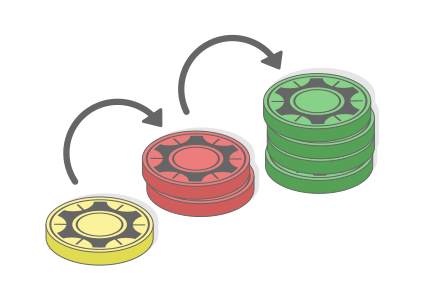 Some seasoned craps players recommend that novices treat each Pass Line and Come bet as an individual wager. If a wager wins, the next bet in that sequence is increased. If it wins again, the player increases the following wager once more. Other bets remain small and are increased only after they produce a win.
Some players may consider this approach too aggressive because it requires a favorable run to generate a meaningful profit. For this reason, players betting on the Pass Line with two Come numbers may choose to raise their stakes only after the shooter establishes a point. Once this happens, subsequent wagers may be increased and backed with double Odds. For example, if you start with a $5 bet, your next Pass Line wager could be $10 while your Come bets remain $5 each. If the Come bets win before the Pass Line bet, you could follow them with $10 Come bets so that they match the Pass Line wager.
If the point is repeated and the active bets win, the player may follow up with $15 Come and Pass Line bets. This is a positive progression because stakes increase after wins rather than losses. However, a 7 can still cause multiple active wagers to lose, so the approach requires clear limits and careful bankroll management.
The Floor and Ceiling Strategy
 The Floor and Ceiling strategy concerns knowing when to quit, regardless of whether you are on a winning run or experiencing a prolonged losing streak. This disciplined approach involves setting both a loss limit and a win goal.
Setting these limits can protect profits and reduce the risk of returning all previous winnings to the house. Win goals and loss limits should be based on the player’s individual bankroll. As one example, some craps players set a win goal equal to 30% of their starting session bankroll. If you join the table with $250, you might consider quitting when you are approximately $75 ahead. Less-experienced players should avoid chasing increasingly large wins, as doing so can expose their entire bankroll to further losses.
The same principle applies to losses. Some players choose to end the session after losing approximately 30% of their initial bankroll. Recovering losses may require risking even more money, and there is no way to know how long a favorable or unfavorable streak will last.
The Guarantee and Excess Principle
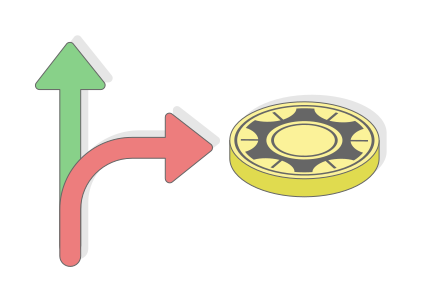 The Guarantee and Excess approach is another bankroll-management method used by some craps players. It is based on setting aside a portion of accumulated winnings and continuing to play only with the remaining profit.
This is how it works: once you reach your win limit, you set aside your original bankroll and a portion of your profit. You then use only enough chips from the remaining profit to complete another betting cycle. The chips you set aside function as your guarantee and should not be returned to play.
The chips used for the next betting cycle are your excess. Even if you lose the excess, the money set aside will remain protected. If the excess produces further winnings, you can add part of the new profit to the guarantee and continue with the remaining excess. This method can help preserve winnings, but only if you consistently avoid placing the protected chips back into play.
The Gambler’s Fallacy
 Some craps players fall prey to the so-called “Gambler’s Fallacy,” the false and unfounded belief that previous dice rolls affect the outcome of future throws. For instance, if one roll produces an Ace-Deuce, the craps term for a total of 3, and the next produces a Boxcar, or 12, a player might bet on 12 the next time the shooter rolls a 3.
However, there is no guarantee that 12 will appear on the next roll. This is a fallacy because independent dice rolls do not follow a predictable sequence. The dice have no memory, and each valid roll is independent of previous outcomes. Past results have no influence on the throws that follow, and disciplined craps players should avoid making decisions based on perceived patterns.
Craps Strategy for Risk-Averse Players
 Some craps betting strategies require players to risk larger amounts or keep several wagers active at once. Risk-averse players and those with smaller bankrolls can instead focus on lower-edge bets and limit the number of active wagers.
The first option to consider is sticking to Pass Line or Don’t Pass bets with Odds. Depending on the amount taken or laid as Odds, the combined house edge can fall below 1%. However, some players may find this approach less varied than strategies involving multiple bets.
Players with limited bankrolls may choose to skip the Odds bet and place only a Pass Line wager. Although Odds are among the most favorable options available in craps, players should not risk more than they can comfortably afford simply to place them.
Another approach is to place a bet on 6 or 8, or on both numbers simultaneously. These totals are rolled more frequently than most others because five dice combinations produce each of them. In addition, the house edge on Place bets on 6 or 8 is approximately 1.52%, which is comparatively low.
Players who do not mind having multiple bets active at once may consider following a Pass Line bet with a Place bet on 6, 8, or both. This method covers several frequently rolled totals while keeping the casino advantage relatively low. However, adding wagers also increases the total amount at risk on each roll.
Conclusion
 If you want to play craps for real money, you can compare the online casinos reviewed on our website. Before choosing an operator, review the available information about game fairness, security, betting limits, and the rules of each craps variation.
Online casino bonuses, customer support availability, and withdrawal terms can vary between operators. Always read the relevant terms and conditions, set a firm gambling budget, and remember that no craps strategy can guarantee a profit.