
Dice Combinations
 | Updated:
The Many Combinations Dice Can Form
 Casino games can have either a relatively low or high house edge. Craps stands out because it offers both. This unique game features some of the best bets you can make in a casino, while some of the more advanced proposition bets give the house a formidable edge of nearly 17%.
Another distinctive trait of craps is that it allows players to bet that something will not happen rather than backing the outcome they believe is most likely to occur. Examples include Don’t Come and Don’t Pass bets.
These features make this simple game of chance unique and appealing to millions of gamblers around the world.

-
 Sign Up Bonus
Up to $100
100% Bonus!9.7 -
Sign Up Bonus
Up to $30000
100% Bonus!9.4 -
Sign Up Bonus
Up to $1000
200% Bonus!9.3



As simple as craps may seem, you should take the time to learn all the possible dice combinations, along with their odds and probabilities, before risking any money on the game.
The purpose of this part of the guide is to introduce you to all dice combinations in craps and help you distinguish between true odds and casino odds. By the end, you will understand whether dice control is effective at reducing the house edge and be able to calculate your average expected losses at the craps tables.


Possible Dice Combinations in Craps
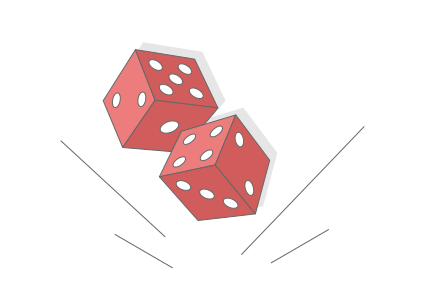 As explained previously in this guide, craps is a game of chance played with two six-sided dice. Each side has a different number of pips representing a numerical value from 1 through 6. Each toss of the two dice can produce one of 11 possible totals, namely 2 through 12.
When two dice are in play, there are 36 possible dice combinations because each die has six sides (6 x 6 = 36). Take a closer look at the table below to see whether you can identify a pattern.
| Dice Total | Number of Ways to Throw Total | Possible Combinations |
|---|---|---|
| 2 | 1 | 1-1 |
| 3 | 2 | 1-2, 2-1 |
| 4 | 3 | 1-3, 3-1, 2-2 |
| 5 | 4 | 1-4, 4-1, 2-3, 3-2 |
| 6 | 5 | 1-5, 5-1, 3-3, 2-4, 4-2 |
| 7 | 6 | 1-6, 6-1, 2-5, 5-2, 3-4, 4-3 |
| 8 | 5 | 2-6, 6-2, 5-3, 3-5, 4-4 |
| 9 | 4 | 3-6, 6-3, 4-5, 5-4 |
| 10 | 3 | 4-6, 6-4, 5-5 |
| 11 | 2 | 5-6, 6-5 |
| 12 | 1 | 6-6 |
You have probably noticed that the column showing the possible combinations is diamond-shaped. This shape makes it clear that a total of 7 has the highest number of possible combinations, which means it also has the greatest probability of being rolled.
As many as six combinations result in a 7. This is one reason many seasoned craps players favor the Pass Line, where a come-out roll wins when a 7 or 11 is tossed. These totals provide eight possible winning combinations: six for a roll of 7 and two for a roll of 11.
Do not be intimidated by the chart. There is an easy way to learn the combinations by heart. All you need to do is use 7 as a starting point and divide the remaining outcomes into pairs. You can pair rolls of 6 and 8 because both totals have five possible combinations.
Next is the pair of 5 and 9, with each total having four possible combinations. Rolls of 4 and 10 form the next pair, with three combinations each. Then come 3 and 11, each of which has two possible combinations.
Rolls of 2 and 12 are the easiest to memorize because there is only one possible dice combination for each total. Learning these combinations is essential because it will help you better understand the odds and probabilities in craps. We cover this subject in the next section.
Understanding the Odds and Probabilities of Craps Bets
 This is the part many gamblers struggle with. Craps, like all other games of chance, is based on independent trials. In other words, the odds of the dice rolls remain constant and are not influenced by previous outcomes. This is one of the most important aspects of the game for craps players to understand. Yet some people will bet on a particular dice outcome simply because they have not seen it occur for a while.
It is important to distinguish between odds and probabilities. Although related, the two terms do not mean the same thing, as many gamblers mistakenly assume. Probability is the likelihood of an independent outcome occurring and is usually expressed as either a proper fraction or a percentage.
To calculate the probability of rolling a particular total, you must know how many dice combinations produce it and the total number of possible combinations. For instance, the probability of rolling a 7 on the come-out roll is the highest at 16.67%. We can also say that the probability is 6 in 36 because six winning combinations exist out of 36 possible combinations. This is called theoretical probability.
Odds, on the other hand, show the ratio between winning and losing outcomes and are usually expressed as fractions. For example, if you make a Snake Eyes bet, which is a wager on a single roll of 2, the odds of winning are 1 to 35. There is only one winning combination for this roll, while the remaining 35 combinations result in a loss. This corresponds to a theoretical probability of 2.78% because 1/36 = 0.02777 x 100 = 2.78%. Consult the table below to see the probabilities of rolling all two-dice totals in craps.
| Two-Dice Total | Probability as a Fraction | Probability of Rolling the Total as a Percentage |
|---|---|---|
| 2 | 1/36 | 2.78% |
| 3 | 2/36 | 5.55% |
| 4 | 3/36 | 8.33% |
| 5 | 4/36 | 11.11% |
| 6 | 5/36 | 13.89% |
| 7 | 6/36 | 16.67% |
| 8 | 5/36 | 13.89% |
| 9 | 4/36 | 11.11% |
| 10 | 3/36 | 8.33% |
| 11 | 2/36 | 5.55% |
| 12 | 1/36 | 2.78% |
The Difference Between True Odds and Casino Odds
 It is essential to understand that there is a distinction between true odds and casino odds. The discrepancy between the two gives the house its edge, which can eventually reduce the bankrolls of imprudent gamblers to nothing.
If you spend an hour or so in a casino, you are likely to hear losing players complain that the games are rigged as they leave the venue with empty pockets. These players are correct to a certain extent. The games are designed to favor the casino, but not because the house resorts to cheating. The casino can make money through the mathematical advantage built into its games.
Another Example
 The main reason gamblers lose in the long term is the discrepancy between true odds and the payout odds offered by the house. The following example demonstrates how the house edge in craps works. Suppose you decide to make 36 consecutive Snake Eyes bets, wagering one dollar on each. The mathematically correct odds for this bet are 35 to 1. In other words, 35 of the possible combinations result in a loss, while only one combination (1-1) produces a win.
Now take a quick look at the layout of the craps table. The payout for a one-roll Snake Eyes bet on 2 is 30 to 1 instead of the true odds of 35 to 1. The same applies to a roll of 12, which also has a single winning combination (6-6). Craps payouts are lower than the corresponding true odds, allowing the house to generate consistent profits from its tables over the long term.
Suppose you wager one dollar on Snake Eyes 36 times in a row and the results match the theoretical probabilities exactly, meaning that one of those 36 trials is a winner. While this is unlikely to happen over such a short session, the more you play, the closer your average results tend to get to the mathematical expectations for the game.
Players can calculate the house edge for any available craps bet if they know its true odds, payout, and probability. Let’s demonstrate how this works for the Any 7 bet. This wager wins on a roll of 7, regardless of which of the six combinations occurs. The payout for a winning Any 7 bet is 4 to 1, and its probability of winning is 6 out of 36.



The calculation is as follows: (6/36) x 4 – (30/36) = 0.6667 – 0.8333 = -0.1667, or -16.67%. The figures in the first set of brackets represent the probability of winning an Any 7 bet, which is then multiplied by the casino payout of four units per unit wagered. You then subtract the probability of losing, represented by 30 losing combinations out of 36 possible combinations. The result is a house edge of 16.67% for the Any 7 bet.
As you can see, you will lose an average of $16.67 for every $100 wagered on the Any 7 bet. If you are still struggling to understand this concept, we suggest returning to the Craps House Edge article in this guide for further explanations, along with the true and casino odds of all available craps bets.
Distinguishing Between “To” and “For” Odds
 Many casual gamblers become so engrossed in the action that they pay little attention to anything else, including the information displayed on the table layout. If you carefully inspect craps layouts, you may notice unusual wording in the proposition bets section at some tables.
In some casinos, the layout states that an Any 7 bet pays 5 units “for” 1 unit wagered instead of the usual payout of 4 “to” 1. The same applies to proposition bets such as the Hard 6 and Hard 10, which pay 10 units for each unit wagered instead of the usual 9 to 1. Some gamblers may misread this phrasing and assume that winning proposition bets offer enhanced odds. However, the actual returns are the same.
The “for” payout includes your initial stake. In contrast, the term “to” separates your net profit from your original bet. With an Any 7 bet, for example, you receive four units in net profit plus your original stake of one unit, for a total return of five units.
Understanding the wording of these payouts is important. It can lead inexperienced craps players to believe they are receiving higher payouts on wagers with some of the steepest house edges when, in reality, they are being paid at standard casino odds. Regardless of the phrasing used, proposition bets carry a substantial house edge and should be approached with caution.
Figuring Out Your Expected Loss in Craps
 This section continues the discussion of true odds. You may be wondering why you need to learn how to calculate your expected losses rather than your expected hourly profits. The reason is that craps is a negative-expectation game. Due to the house edge, your expected value over the long term will always be negative, meaning you will lose money to the casino over time.
Learning to calculate your expected loss allows you to estimate the rate at which you may lose money per hour. This rate depends on your level of action, the types of bets you make, and their house edges. The formula is simple: multiply the number of rounds played per hour by the amount wagered, the house edge, and the number of hours you intend to play.
Suppose you play at a slow pace and go through 160 rolls, wagering $5 on Any 7 for one hour. The calculation is 160 x $5 x 0.1667 x 1 = approximately $133.33. This is your average expected loss with Any 7 wagers over a sufficiently large number of independent trials. In the short term, you might lose much more or far less within an hour. The longer you play, however, the closer your average results are likely to get to the expected loss.
Can Dice Control Influence the Probability of Rolling Certain Combinations?
 Some craps players attempt to influence roll outcomes through an advanced technique known as dice setting or dice control. The basic idea is that a player can skew the odds in their favor by tossing the dice in a specific manner. To achieve this, the shooter attempts to release the dice at a particular angle to produce the desired outcome.
The toss should involve as few hand movements as possible so the dice do not tumble excessively before hitting the back wall of the craps table. The dice must also be picked up in a particular way. The shooter’s wrist remains locked during the toss, meaning there is no twisting motion when the dice are thrown. This technique requires considerable practice, but the key question is whether it can actually influence the outcome of a roll.
Renowned gambling author Stanford Wong is among the proponents of this technique and wrote extensively about it in his book Wong on Craps. Author Christopher Pawlicki also covered the subject in his 2002 book Get the Edge at Craps: How to Control the Dice. Some mathematicians and gambling experts believe the technique either does not work or cannot be executed successfully in a casino environment.
Others give dice control some credence, arguing that it might work if the dice do not hit the back wall of the craps table. However, most casinos require the dice to hit the back wall for a roll to be considered valid. Overall, most members of the advantage-play community remain skeptical about overcoming the house edge in craps through dice control.