
How to Play Baccarat
 | Updated:
 Mastering the Baccarat Rules and Gameplay
 If you are interested in baccarat but know nothing about its rules or gameplay, you can learn the essentials by the end of this article. The reason so many players enjoy the card game is its simplicity, which allows newcomers to grasp the rules after watching just a few rounds. Nevertheless, there are several features of the game that you should understand before playing baccarat.
 4.3
4.3Depending on whether you play at a land-based casino or an online venue, the baccarat table may look different. Playing at a brick-and-mortar casino can also be slightly different, as virtual baccarat tables have more compact designs and involve fewer people. While baccarat is a luck-based game, you should learn bankroll management to help manage your betting sessions. In this article, we cover the basics of the game and provide tips that can make your baccarat experience more enjoyable.

-
 Sign Up Bonus
Up to $3500
350% Bonus!9.7 -
Sign Up Bonus
Up to $500
400% Bonus!9.4 -
Sign Up Bonus
Up to $30000
100% Bonus!9.3










Table Layout & Bet Types
In many land-based casinos, baccarat tables can be found in a separate area designed to provide players with privacy or alongside other table games on the casino floor. They can be easily distinguished by their hourglass-like shape. Each table has a middle area where two dealers manage the wagers while the caller directs the gameplay. The caller is responsible for dealing the cards, whereas the dealers manage the bets on their respective sides of the table.
The caller also collects the commission on winning Banker wagers. As the caller carefully follows the action, it is their job to announce whether there is a hit or a stand. The caller also announces the winner of each round.
In addition to the caller, a full-size baccarat table has two house dealers, one on each side. They assist the players on their respective sides by handling their bets. As in other casino table games, baccarat dealers are relieved by other croupiers at regular intervals.
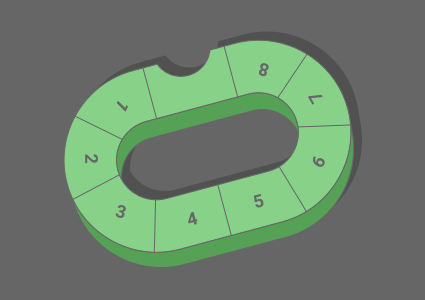
Baccarat tables vary depending on the version of the game and the casino offering it. Seating capacity also differs from one table to another, but most full-size baccarat tables accommodate up to 14 players. The seat numbers may run to 15 because the number 13 is omitted, as it is considered unlucky. Once seated, players will find an area in front of them for placing bets, divided into three sections.
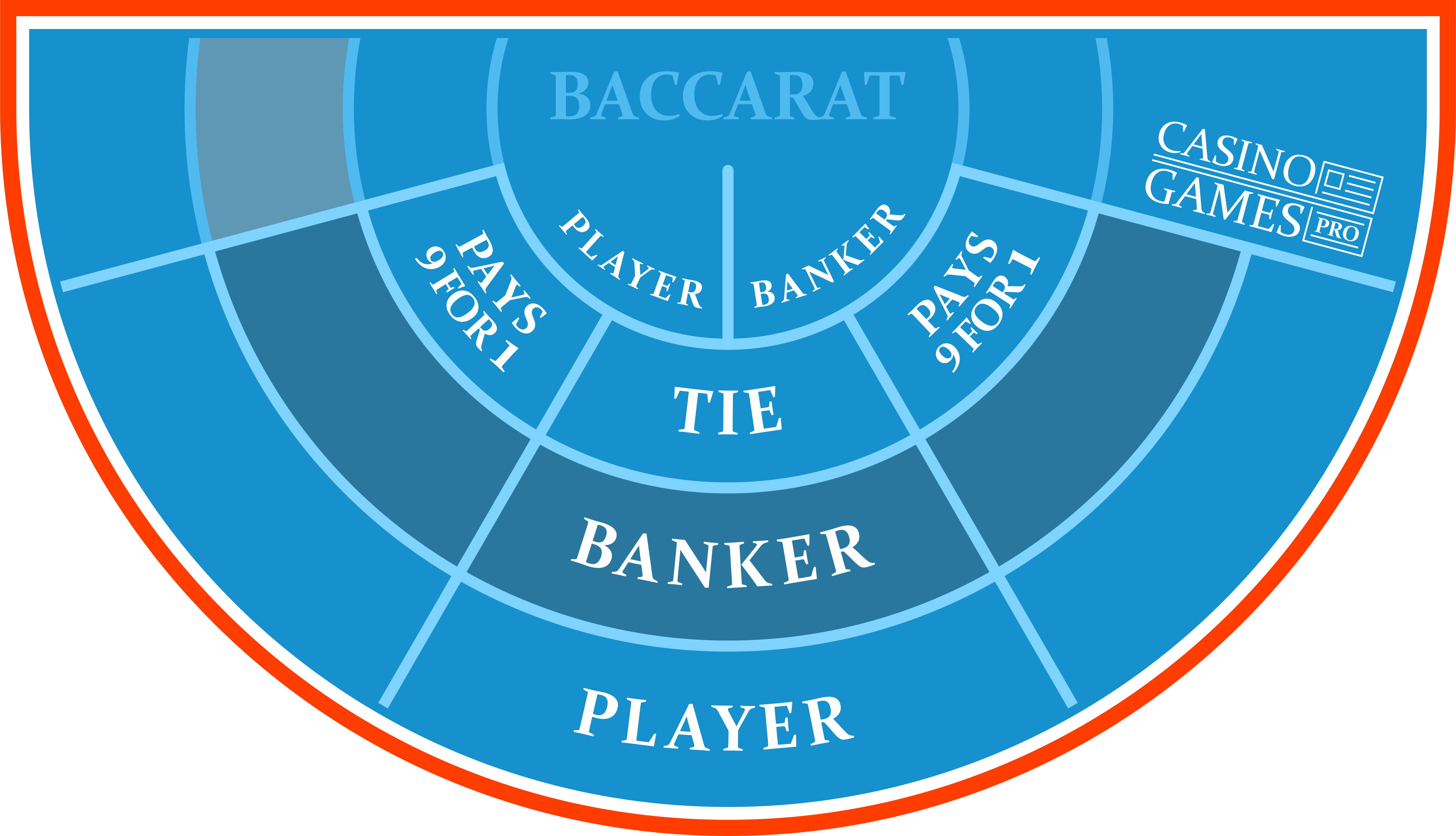
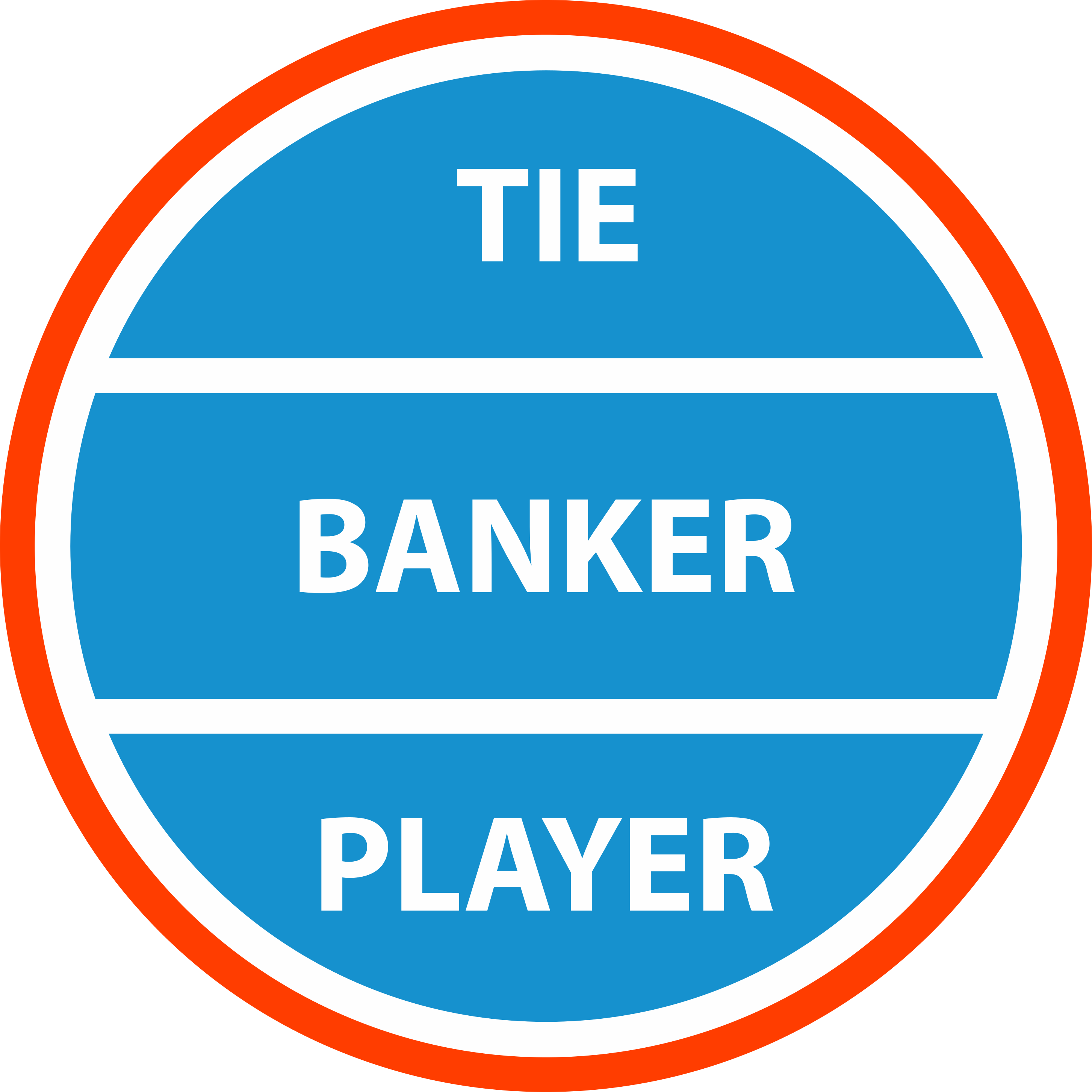
There are three available betting options: “Player,” “Banker,” and “Tie.” Each bet has a different house edge and therefore offers different odds. Besides operating the game and managing the bets, the dealers are responsible for keeping track of the commission each player needs to pay. Commission boxes are usually located at the center of the baccarat table for this purpose.
The commissions are handled by the caller, and every player who wins after wagering on “Banker” owes the house a commission of 5%. Player wagers pay even money, while winning Banker wagers are subject to the aforementioned commission.
The Fundamentals
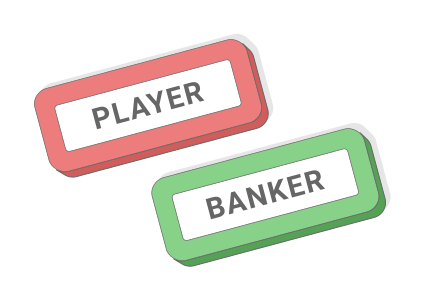 Baccarat is a card game with rules that are relatively easy to understand, making it suitable for different types of players. It can be played with six or eight decks, which are placed in a box called a shoe. The drawing rules are automatic, meaning that the dealer operates the game without needing to consult the players. In brief, players choose one of the three available betting options and then wait for the Player and Banker hands to be dealt. The highest possible total in baccarat is 9, so the winning hand is the one closest to this number.
The cards in the decks are shuffled together, and a cut card is placed before the seventh-to-last card in the shoe. This is known as cutting the deck, and drawing the cut card indicates the shoe’s final coup, or round of play. The dealer then burns the first face-up card and discards as many cards as the value of the burned card.
For every coup, the dealer deals two face-up cards to each side of the table, starting with the Player hand. If either hand reaches a total of 8 or 9, the coup ends, and the caller announces the result. If neither side has reached that total, the drawing rules determine whether the dealer should draw a third card for the Player hand. Depending on the value of that card, the drawing rules are applied again to determine whether the Banker hand should receive a third card.
Some variations of baccarat allow players to handle the cards instead of the dealer. In Chemin de Fer, one of the players is designated as the banker and deals the cards. The remaining players at the table are the “punters” playing against the banker.
In each round, a different player may become the banker, with the position shifting counterclockwise. Once bets are placed, the banker deals four cards face down, two for themselves and two for the punters. The player with the highest wager, or the first eligible player, acts as a representative of the punters and checks their two cards. The banker also checks their cards. If either side has a total of 8 or 9, this is announced, and the cards are revealed.
If neither side has 8 or 9, the player may choose to accept or refuse a third card, which is dealt face up. The banker then decides whether to draw a third card. Once all decisions have been made, both sides reveal their cards, and the result is announced.
Baccarat Table Variations
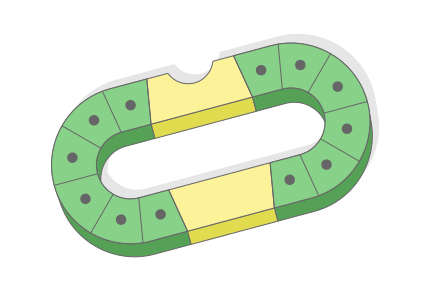 When you enter a land-based casino, you may come across baccarat tables in several different sizes. Although the fundamental rules of the game remain the same, playing at a larger or smaller table may change how bets are placed.
If you learn to differentiate baccarat tables by size, you should have no problem identifying the game at a brick-and-mortar casino. Online variations of baccarat may also feature tables of different sizes, so it is useful to understand how they work.
Full-Size Baccarat
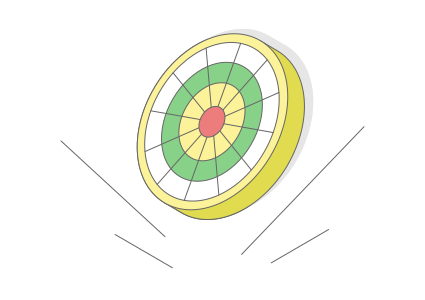 Full-size baccarat tables are typically found in brick-and-mortar casinos that accommodate many players and cater to a large number of baccarat fans simultaneously. Usually, full-size baccarat tables have several dealers who handle the bets.
The full-size baccarat table has several specific characteristics:
- Full-size tables accommodate between 12 and 14 players at the same time.
- Full-size baccarat tables are found in secluded areas of the casino floor, as they are typically dedicated to high rollers.
- A full-size baccarat table requires three dealers to conduct the gameplay: one caller and two house dealers.
- Since full-size baccarat tables cater to high rollers, the betting limits are typically higher.
- The two house dealers stand at opposite ends of the table, assisting the players on their respective sides.
Midi-Baccarat
 The midi-baccarat table has a layout and playing rules similar to those of the full-size table, but it is smaller. Several features of midi-baccarat help players distinguish it from other versions of the game.
- Midi-baccarat tables accommodate only 9 players at a time.
- In midi-baccarat, players are allowed to handle their cards.
- The betting limits are lower than those at full-size baccarat tables.
Mini Baccarat
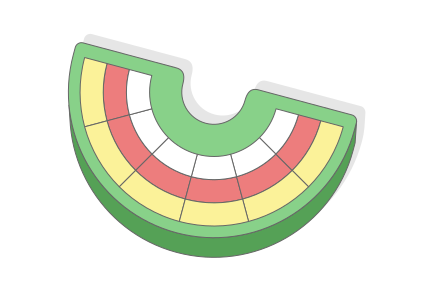 Full-size baccarat tables are typical of land-based casinos and are often suitable only for high rollers. Meanwhile, those who would like to enjoy the game while placing more modest bets can try Mini Baccarat. Online variations of baccarat also commonly use the Mini Baccarat layout, as there is no need for a large table when each player is playing individually.
While the rules of the game are essentially the same, several features of Mini Baccarat can help you identify these tables at land-based casinos.
- Mini Baccarat tables accommodate only 7 players at a time.
- Betting limits are significantly lower.
- The Mini Baccarat table is much smaller than the full-size version.
- Players are not allowed to handle the cards.
The Role of the Banker
 In Chemin de Fer, participants take turns acting as the banker and dealing the cards. Usually, the first player to become the banker sits in the first position at the table. The role of the banker passes to the next player from right to left, and the banker’s turn ends when they lose a hand. A player may also decline the role, in which case the next player automatically becomes the banker. Another important point is that the banker has the same betting options as the other participants. However, it is customary for the banker to place a wager in the “Banker” section.
Gaming Process
 As mentioned above, the three possible bets are “Player” (Punto), “Banker” (Banco), and the less commonly chosen “Tie” (Standoff). After players have chosen and placed one of these bets, their role is complete, and there are no further decisions to make. It is worth noting that the “Player” bet should be viewed as an independent wager. The same applies to the “Banker” bet, as these labels identify the two hands rather than the bettor or the casino. To clarify this point, let us examine the gaming process and the rules behind it.
In baccarat, regardless of the number of participants, only two hands are dealt, with each initially consisting of two cards. The game follows a straightforward sequence: first, players place their wagers, and then the banker deals two face-down cards to each hand. The caller passes the Player hand to the participant who placed the highest bet in the “Player” section. That player looks at the two cards before returning them to the banker.
If none of the participants has placed such a bet, the caller takes this role. After the cards are dealt, the Player hand is revealed first, followed by the Banker hand. The totals are then announced, after which the dealer may draw a third card. Players should check the third-card rules for the version they are playing. If either hand totals 8 or 9, no more cards are dealt because the hand is a natural. The final stage of the game is the payout, which is handled by the dealers.



Assigned Value of the Cards
 Like many other card games, baccarat assigns each card a particular point value. Card suits are irrelevant. This is one of the most important rules of the game, so players should learn it before playing. Compared with those of other card games, the assigned values in baccarat are relatively easy to remember, which makes the game more straightforward. The assigned value of each card is as follows:
- Cards from 2 to 9 are counted at face value.
- Aces are worth 1 point.
- 10s and face cards (Jack, Queen, and King) are worth 0 points.
Every combination of two cards totaling 10 or more must be adjusted. In such cases, players remove the first digit of the total because the highest possible value in the game is 9. For instance, if the two cards are 8 and 5, their total is 13. The first digit, which is one in this case, is removed, resulting in a three-point hand. Following the same logic, if the total of both cards is 14, the hand has a value of 4 because the first digit is omitted.
Naturals
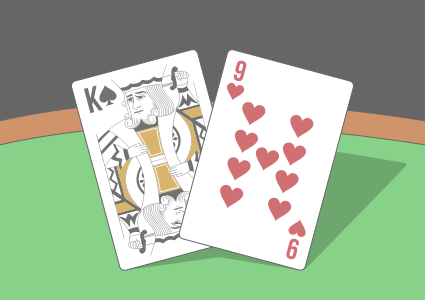 A hand whose first two cards have a value of 8 or 9 is considered a “natural,” and no more cards are dealt. If both the Banker and Player hands have a natural, the hand with the higher value wins.
The Third-card Rule
 If neither the Player nor the Banker hand has a natural, a third card may be dealt. One or both hands may receive a third card, depending on their totals and the applicable drawing rules. Although the third-card rule is applied automatically, players should become familiar with it to understand how each round progresses. The maximum number of cards a hand can have is three, and the minimum is two.
As previously indicated, the caller is responsible for various tasks, including helping players understand the third-card rule and guiding them through the gaming process. In most versions, if the Player hand has a value of 5 or less, it draws another card. If the Player hand totals 6 or 7, it must stand. In variants where the player may decline the draw, the Banker hand stands on 6 or more and takes a third card only if its total is 5 or less. However, if the Player hand draws a third card, the following rules determine whether the Banker hand must draw:
| Baccarat Drawing Rules | ||||||||||
|---|---|---|---|---|---|---|---|---|---|---|
| Banker’s Score | Player’s Third Card | |||||||||
| 0 | 1 | 2 | 3 | 4 | 5 | 6 | 7 | 8 | 9 | |
| 7 | S | S | S | S | S | S | S | S | S | S |
| 6 | S | S | S | S | S | S | H | H | S | S |
| 5 | S | S | S | S | H | H | H | H | S | S |
| 4 | S | S | H | H | H | H | H | H | S | S |
| 3 | H | H | H | H | H | H | H | H | S | H |
| 2 | H | H | H | H | H | H | H | H | H | H |
| 1 | H | H | H | H | H | H | H | H | H | H |
| 0 | H | H | H | H | H | H | H | H | H | H |
- If the Banker hand has a total of 2 or less, another card is drawn regardless of the Player’s third card.
- If the Banker hand has a total of 3, another card is drawn unless the Player’s third card is 8.
- If the Banker hand has a total of 4, another card is drawn unless the Player’s third card is 0, 1, 8, or 9.
- If the Banker hand has a total of 5, another card is drawn if the Player’s third card is 4, 5, 6, or 7.
- If the Banker hand has a total of 6, another card is drawn if the Player’s third card is 6 or 7.
- If the Banker hand has a total of 7, it is required to stand.
Conclusion
 Baccarat is a popular card game found in numerous land-based and online casinos. Online versions allow players to enjoy the game from home, while land-based tables provide a traditional casino experience. Players can familiarize themselves with the game’s relatively simple rules before taking part.
This casino game is known for offering high-limit tables that appeal to high rollers. However, many variations are also available to suit different bankrolls and betting styles. Baccarat’s simple rules and limited number of betting decisions make it an accessible and entertaining table game.