
Money Management in Baccarat
 | Updated:
 Minimizing Losses and Increasing Potential Baccarat Profits with Money Management
 One of baccarat‘s most appealing aspects is its simplicity, which provides an equally exciting experience for new and seasoned players. While the card game was once available only to high rollers, with most baccarat tables imposing high betting limits, nowadays baccarat games cater to players with different budgets. That said, all players are advised to set a bankroll and stick to it once they start playing.
To keep track of their spending and minimize long-term losses, some players prefer using betting systems while wagering real money on baccarat. Such systems can provide structure, but players should be wary of those that do not suit smaller budgets. While some betting progressions use relatively low-risk patterns, others can quickly exhaust your balance during a losing streak. To help you determine which money-management approach may suit you, we have covered popular baccarat betting systems along with their strengths and weaknesses.

-
 Sign Up Bonus
Up to $3500
350% Bonus!9.7 -
Sign Up Bonus
Up to $500
400% Bonus!9.4 -
Sign Up Bonus
Up to $30000
100% Bonus!9.3







Importance of Money Management in Baccarat
 As mentioned above, baccarat is considered one of the simplest casino games ever created. It is also a game where you can start with very small bets if you are not confident in your knowledge or experience. Playing with small bets usually reduces the risk of losing too much, whether you play roulette, blackjack, or poker. However, baccarat’s fast pace can still lead to substantial cumulative losses, even when individual stakes are small.
Baccarat is a card-comparing game that is usually played with six to eight standard decks, with the Banker and the Player receiving two or three cards in each round. The objective is to correctly predict the outcome of each hand: which side will win or whether the result will be a tie. The Player bet pays 1:1, the Banker pays 0.95:1 because of the 5% commission, and the Tie pays 8:1. Cards from 2 to 9 count as their face values, cards from 10 to King count as zero, and the Ace counts as 1.
The rules may seem simple, but first-time players can find the game confusing because everything happens quickly. Up to 75 hands per hour may be played, which means players have less than a minute for each hand. The activity at a full table can make the game even more difficult to follow. Of course, this applies to baccarat played in brick-and-mortar casinos. The speed of virtual baccarat, on the other hand, depends largely on the player.
Yet it is precisely this fast pace that makes baccarat so intriguing. As with most casino games based on chance, the odds favor the casino. The house edge is 1.06% for the Banker bet and 1.36% for the Player bet. It is significantly higher for the Tie bet at 14.40%, hence the larger payout. These percentages suggest that the casino will have the advantage over the long term. The more hands you play, the closer the results may move toward the mathematical expectations. Because you can play roughly 70 to 72 hands per hour, the effects of the house edge may become apparent faster than in slower games such as roulette.
For this reason, baccarat players need to optimize their gameplay and manage their bankroll to control their spending and limit losses. There are basic tips every player should follow, as well as several betting systems that can structure stake sizes. However, none of these systems can guarantee a long-term profit.
Tips to Manage Your Bankroll
 Players planning to try baccarat for the first time should learn the rules and gain a thorough understanding of the game. Most online casinos even offer games in demo mode, using virtual credits instead of real money. Once you have practiced enough, spend some time researching the casino where you plan to play, whether it is an online or brick-and-mortar establishment. There may be deviations from the standard baccarat rules, as well as different payouts.
The Pocket Trick
 This is a simple yet effective trick for controlling your losses at the baccarat table, and it applies to both online gaming and land-based casinos. Before you start playing, you simply set a bankroll limit, which is an amount of money that you plan to bet and are prepared to lose. In a land-based casino, you can put it in one pocket and use only this money to place your bets. The other pocket is reserved for your winnings.
Once you run out of funds in the bankroll pocket, you should stop playing. Another option is to take a break and review how much you have lost and won. If your winnings exceed your initial bankroll, you can set aside some of them and use the rest for a second baccarat session. Sticking to this rule helps prevent you from putting set-aside winnings back into play. By using the pocket trick, you can avoid overspending, which is a common pitfall for inexperienced players.
Setting Limits for Losses and Winnings
 Another effective way to avoid overspending is to set limits on your losses and winnings. If your bankroll is $100, decide how much you are prepared to lose. If your loss limit is $50, you should quit playing when you have $50 left. While this sounds logical and many players try to follow this rule, setting a maximum limit for winnings may seem counterintuitive.
The logic is straightforward: once you reach your maximum win limit, you quit playing and ensure that you leave with more money than you had when you started. For instance, you can set a profit target of $50 and stop playing once your bankroll reaches $150. If you continue to bet, you may lose your profit and even your initial bankroll. This is why setting limits beforehand is recommended. Some players also find it useful to limit the number of rounds. Once they reach 10, 20, or 50 rounds, they stop playing.
Things to Avoid
 The first thing casino patrons should avoid in any game, including baccarat, is making an all-in bet. Putting all your money on a single wager is a poor decision, although Hollywood movies sometimes portray it as the ultimate way to gamble and win big. Real-life casino games are not as glamorous, and you are more likely to lose your entire bankroll than to secure a large profit.
Another useful piece of advice for those who play baccarat in brick-and-mortar casinos is to avoid alcohol, even when drinks and snacks are complimentary. It is always best to stay alert and focused when gambling, as alcohol can cloud your judgment and impair your decision-making ability.
When playing baccarat, especially in brick-and-mortar casinos, you should keep track of your winning Banker bets if the casino records the 5% commission and collects it later. Although the commission is relatively small, it can reduce your net return if you fail to account for it.
Last but not least, you should avoid chasing your losses. It is a common mistake among casino players, even though there is no guarantee that they can win back money lost on games of chance. Each baccarat hand is determined by the deal rather than a player’s decisions, so increasing your stakes to recover previous losses can put even more of your bankroll at risk.
Basic Baccarat Strategy
 The basic baccarat strategy is simple and easy to apply. One approach is to choose a primary bet type and use consistent stakes throughout the session. This does not change the odds, but it makes spending easier to track and discourages impulsive changes based on short-term results.
Some beginners prefer the Player bet because it pays 1:1 without a commission. However, the Banker bet has the lowest house edge at 1.06%, followed by the Player bet at 1.36% and the Tie bet at 14.40%. The Tie bet has a significantly higher house advantage, despite its larger payout. Players choosing the Banker bet should remember that a standard 5% commission reduces a winning bet’s payout to 0.95:1.
This may not be the ultimate strategy for winning at baccarat, but it is straightforward and easy for beginners to follow. There are other methods that may suit your preferences, but even advanced strategies cannot guarantee consistent winnings.




Advanced Money Management Systems in Baccarat
 There are multiple betting systems for baccarat, although some were originally developed for other casino games. They are often called strategies, even though they include no advice on how to play individual hands because baccarat requires no hand-by-hand decision-making. Instead, these systems are designed to provide structure for bet sizing and reduce impulsive decisions.
Martingale System
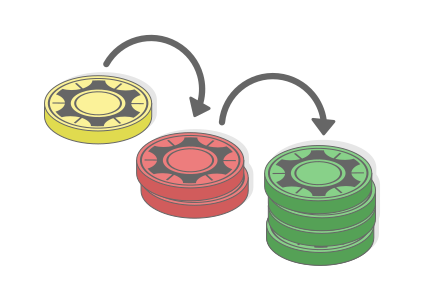 The Martingale is probably the most famous betting system and is used for wagers that pay even money or close to it, such as coin tosses and roulette bets. It involves a negative progression in which the player doubles their bet after a loss. After a win, the bet returns to its initial size. The idea is to recover all previous losses with the first win and gain a profit equal to the original stake, although commissions can affect the result in baccarat.
In theory, the Martingale may appear effective, at least in the short term. In reality, however, it is a high-risk strategy that may increase your bets dramatically and lead to substantial losses. Let us start with a bet of $1. If you lose, your second bet will be $2, followed by $4 for the third, $8 for the fourth, and $16 for the fifth bet. If you win only on the fifth attempt, you will have wagered a total of $31 and received $32 from the winning wager, leaving a profit of $1 before any applicable commission. If you start with $10 bets and lose six hands in a row, you will have wagered $630, and the next required bet will be $640.
As you can see, you can easily reach the table limit or lose your entire bankroll while trying to recoup your losses. Such high-risk systems should be used very carefully, especially by inexperienced players with limited budgets.
Betting on the Trends Strategy
 Many baccarat strategies found online or presented in guides and books promise success based on observing and betting on trends. In baccarat, the term “trend” refers to the same winning bet occurring several times, or at least twice, in a row. Examples include three consecutive Player wins or five consecutive Banker wins.
Most strategies that rely on this concept recommend placing a bet on the same outcome up to eight consecutive times once you notice a trend. Some strategies use flat betting, meaning equal-sized bets, while others use progressions that increase the stake each time. Although long winning streaks can occur, each round is random and independent of the previous one. A series of Player or Banker wins does not make the same result more likely on the next hand.
Similarly, some so-called strategies have you switch your bet from Player to Banker each round and vice versa. However, changing sides does not improve the odds of the next wager. Overall, trend-based strategies should be approached with caution, as they can lead to large losses if applied persistently with increasingly high stakes.
1-3-2-6 and 1-3-2-4 Baccarat Strategy
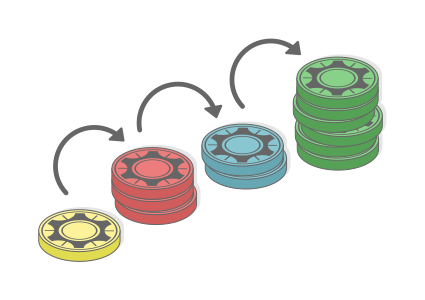 The 1-3-2-6 baccarat strategy is a relatively popular betting system designed to generate returns from short winning streaks. Although such streaks cannot be predicted, this system provides a predetermined sequence for adjusting stake sizes. The numbers in the strategy’s name indicate the size of each consecutive bet and represent the number of units wagered.
For example, a unit could be $1, $5, $10, or any other amount you prefer. If one unit is $10, your first bet will be $10, followed by a $30 bet, a $20 bet, and a $60 bet. An important part of the strategy is choosing either Player or Banker bets and sticking to that choice throughout the sequence. The idea is to increase the returns generated by a potential winning streak while following a predetermined wagering pattern. If some bets win while others lose, the result depends on where those outcomes fall within the sequence.
To reduce the amount risked on the final wager, players can replace the final 6 units with 4 units, creating the more conservative 1-3-2-4 sequence. After completing the four-bet sequence, you start again from the beginning. Both systems use less aggressive progressions than strategies such as the Martingale, but neither can guarantee a profit. The potential gains may appear slow compared with systems that advertise large winnings, but the stakes are easier to control.
Regression Baccarat Systems
 Betting systems that use regression require you to reduce the size of your bet after a win. If the next bet loses, the smaller stake may help preserve some of the previous profit. If you win, your profit increases. Different models and sequences are available for different types of players. Some regressions are steep, while others are more balanced. The appropriate option depends on your experience and personal preferences.
One example is the 2-1-2 system, in which you start with a 2-unit bet and, if you win, reduce it to a single-unit bet. The final bet is once again 2 units. This is a simple sequence with relatively controlled stakes, making it suitable for different types of players, including those with little or no experience. You should choose either Player or Banker bets. If you win a 2-unit bet, such as a $20 wager, you reduce the next stake to $10. If you win again, your next bet is $20. The series ends whenever a bet loses.
A completed winning sequence may produce a profit, but losses remain possible. If the first 2-unit bet loses, for example, the sequence ends with a loss. Keeping betting sequences short can limit your exposure and prevent stakes from escalating. Over the long term, the casino retains its mathematical advantage.
Conclusion
 When playing baccarat, it is generally better to focus on small, controlled wagers than to pursue high-risk, high-return strategies. Casinos always have a mathematical advantage over players. It is impossible to turn the fixed odds in your favor through a betting system, but disciplined bankroll management can help you avoid costly mistakes.
Money management is essential for disciplined baccarat play, and it does not require extensive knowledge of complex strategies. Choosing a casino with favorable payouts is also important. If you find a baccarat table where the commission is less than 5%, you might consider placing Banker bets after reviewing the applicable rules and payouts. Sticking to one type of bet can make bankroll tracking easier for first-time players. More experienced players may prefer greater variety, but changing bets does not improve the underlying odds.
Determining a playing budget and setting minimum and maximum limits are essential for controlling losses, protecting your bankroll, and preserving any profits before they are wagered again.