
Basic Poker Tips
 | Updated:
 Ask any skilled poker player, and they will tell you that poker is relatively easy to learn, but mastering it can take a lifetime. Unlike most casino games, poker is not based solely on chance; players must develop a range of skills to consistently outperform their opponents. Some fundamental skills include reading opponents, maintaining concentration for prolonged periods, understanding mathematical probability, and controlling one’s emotions.
Above all, mastering the game takes patience, practice, and perseverance: the three Ps of becoming a successful poker player. If you are new to this fascinating game of skill, reviewing the basic tips outlined below is a good way to begin your poker training.

-
 Sign Up Bonus
Up to $100
100% Bonus!9.7 -
Sign Up Bonus
Up to $30000
100% Bonus!9.4 -
Sign Up Bonus
Up to $1000
200% Bonus!9.3



Never Underestimate the Power of Observation
 The main objective in poker is to gather as much information as possible from your opponents while revealing as little as possible in return. One way to achieve this is to closely monitor other players’ reactions and observe how they behave in different situations. Closely observing how each opponent plays different pots can help you identify important tells and patterns in their style of play. Watch the gestures and facial expressions your opponents display throughout the game, as these may provide useful information.
One possible tell is a player leaning forward before the flop after checking their hole cards. This movement may indicate that the player is confident in their starting hand and preparing for action on the flop. In this situation, folding may be wise unless you hold an exceptionally strong hand. Watching your opponents’ eyes is equally important. If a player immediately looks at their chips after the flop, it might mean the flop has greatly improved their hand and they are preparing to act.
Avoid Becoming Predictable
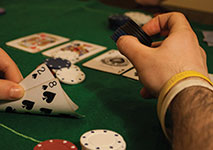 Bluffing is a tactic many poker players use when they believe their hand is not strong enough. While bluffing is an essential part of poker, overusing it is not a suitable strategy. If you bluff simply for the sake of it, you risk becoming too predictable, which will eventually make your bluffs ineffective.
It is important to remember that the main purpose of a bluff is to persuade your opponent to fold. This is unlikely to happen if they hold a hand they consider superior, no matter how hard you try to intimidate them. A good poker player varies their approach so that opponents struggle to identify reliable patterns or tells. Predictable play makes you exploitable and an easy target for your opponents.
Consider Your Table Position
 Table position is another factor to consider, and by that, we do not mean taking the seat closest to the restroom. In cash games and tournaments, two players must contribute to the pot by posting forced bets called the small blind and the big blind. These two players sit to the left of the player who occupies the “button” position. The positions of the button, small blind, and big blind rotate clockwise after every hand.
This is important because the button acts last during post-flop betting rounds, which gives the player in that position a considerable tactical advantage. The other players have already acted, providing the button with valuable information.
In addition, players in early position (i.e., close to the blinds) have no way of knowing how large the pot will become by the end of the betting round or how many opponents will compete for it. Because of this, it is generally recommended to play more hands when you are in late position, as this enables you to make better-informed decisions in each betting round.
Choose the Starting Hands You Play Carefully
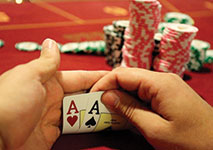 There is little point in fighting a losing battle, which is why players should carefully select which starting hands to play and which to discard. If you have been dealt a weak starting hand, it may be better to fold instead of continuing and putting more money into the pot.
Poker novices may initially find it difficult to evaluate the strength of their starting hands, which is perfectly natural. The good news is that starting-hand charts can serve as useful reference points, especially in online poker tournaments. However, such charts should be used only as guides and do not apply to every situation. Poker, like other card games, involves many variables. As your understanding of the game improves, you can gradually begin to deviate from the charts.
Do Not Overvalue Suited Cards
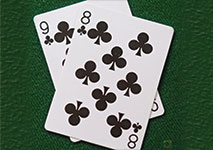 One of the most common mistakes poker novices make is overestimating the value of suited cards, which can potentially help them complete one of the strongest hands in the game: a flush. However, because a flush is one of the highest-ranking hands in poker, it does not occur very often. In fact, the probability of forming a flush is well below 1%, which is far from impressive.
If you intend to invest a substantial amount in the pot simply because you hold two low-ranked suited cards, you should reconsider. Even if you eventually complete a flush, a higher flush may still beat yours. Remember that receiving cards of the same suit provides only a marginal improvement of less than 2%, which is not enough to justify calling other players’ pre-flop raises. As mentioned earlier, folding may sometimes be the best course of action, especially if your hand consists of low-ranked suited cards.
Select the Games You Play Depending on Your Skill Level
 One of the biggest advantages of playing poker online is the extensive range of variations and betting limits available. Some tables cater to high rollers, while others are designed for less experienced players who are still mastering the game. Until they gain more experience, players should stick to tables with betting limits that correspond to their skill level and bankroll size. If you start at a $2/$4 table, you may compete against players with roughly the same level of skill and experience.
However, do not make the mistake of immediately moving to a table with higher limits, such as $5/$10, even if you have built a good stack in lower-limit games. One important thing to remember is that higher limits can bring larger financial swings. Higher-limit tables often attract more experienced players with a greater level of skill. Reaching that level takes time, practice, and plenty of discipline.
Try Not to Tilt on Losing Hands
 Our final tip is perhaps the most important. In poker, players must remain in control of their emotions at all times. If you fail to do so and your opponents notice, there is a good chance they will exploit it. Losing a hand or two is an unavoidable part of the game; how you respond is what matters.
When players become angry and frustrated, they are said to “go on tilt”. This clouds their judgment and prevents them from playing at their best because it disrupts their decision-making. Poor decisions, in turn, lead to losses. Whenever you feel frustration getting the better of you, it is best to step away from the game until you regain control of your emotions.