
Most Profitable Casino Games
 | Updated:
If you have any gambling experience, you have probably heard the adage “Gamblers rely on luck; casinos rely on math,” and it is indeed true. Casino games are designed to give gaming operators a long-term mathematical advantage over players. This advantage is known as the “house edge,” and there is little players can do to overcome it in games where outcomes are governed entirely by chance.
You can cross your fingers or squeeze your lucky rabbit’s foot as much as you want, but there is no consistently beating chance-based games such as roulette, slots, or baccarat. In other games, including blackjack and video poker, players can considerably decrease the house advantage by implementing mathematically sound strategies. It is sometimes even possible to sway the odds slightly in your favor through advanced techniques such as card counting, although these techniques are largely inapplicable to online casino games.
The surest way to minimize your losses and potentially earn a short-term profit is to pick your games wisely, basing your choice on their house edges and theoretical payback percentages. Which categories of casino games offer the highest Return to Player (RTP)? What exactly is the house edge? Are there ways to make your gambling sessions more profitable? We answer all these questions in this article.

-
 Sign Up Bonus
Up to $100
100% Bonus!9.7 -
Sign Up Bonus
Up to $30000
100% Bonus!9.4 -
Sign Up Bonus
Up to $1000
200% Bonus!9.3



House Edge and RTP Explained
 Integral to all casino games, the house edge and Return to Player (RTP) are essentially two sides of the same coin. The term “house edge,” also known as the house advantage, refers to the average percentage of all wagers that casinos retain as profit in the long term. To give you a specific example, if you place one million wagers of $1 each on a game with a 5% casino advantage, the house would retain approximately $50,000 of your money over the long term.
House edges vary widely among casino games and the bet types they support. They are built into all gambling games either by adjusting the rules to mathematically favor the house or by reducing the payouts on winning wagers, and sometimes by doing both.
Consider single-zero roulette, which uses a wheel with 36 alternating black and red numbered pockets, plus one additional green pocket for zero. The green zero is precisely what gives casinos their edge over roulette players.
The true odds against winning with a straight bet on any single roulette number are 36 to 1 because there are 37 pockets in total, but the house pays at reduced odds of 35 to 1. This gives it an edge of 2.70% over players. Double-zero roulette gives the house roughly twice this edge (5.26%) because it uses a 38-pocket wheel with two green zeros, while its payouts are the same as those in single-zero variations.
Players can calculate the house edge of simple chance-based games such as roulette by comparing the number of ways to lose with the number of ways to win and factoring in the number of bet units they are expected to lose or win. This is what the formula looks like for single-number bets in roulette games with 37 pockets: (-1 x 36/37) + (35 x 1/37) = -0.9729 + 0.9459 = -0.027.
Multiplying the absolute value of this decimal by 100 converts it into a percentage (2.70%). Calculating the house edges in games such as slots and blackjack is considerably more difficult because of the enormous number of possible card or symbol combinations they can produce. The bottom line is that the higher the house edge, the worse it is for players, and vice versa.
Return to Player (RTP), also known as the theoretical return, mirrors the house edge. It reflects the average percentage of all wagers that the house will pay back to players over time. It is typically listed in the information section of online casino games. If you know the RTP of a given game, you can easily calculate its house edge by subtracting the theoretical return from 100%. Conversely, you can use the house edge to calculate the game’s RTP.
It follows that the theoretical return of single-zero roulette is 97.30% (100% – 2.70%), and this percentage applies to all supported bet types in the game. This is not the case in games such as craps, where each type of wager has a distinct house advantage. To summarize, you should look for games with the lowest house edges and the highest theoretical returns, as they result in lower expected long-term losses.
Which Are the Most Profitable Casino Games
 As previously mentioned, each casino game has a specific house edge and RTP. You should always check the theoretical return and house edge of the games you are interested in before playing them for real money.
With that in mind, casino games are commonly grouped into two main categories. Some, such as roulette, craps, and slots, are based entirely on chance, and there is no way for players to influence the outcomes in their favor. These are also known as games of “independent events” or “independent trials,” where previous results have no impact on future outcomes. Simply put, there is nothing you can do to sway the odds in your favor or predict the result of the next spin.
The opposite is true of games of “dependent events” such as blackjack, where the odds change in favor of either the dealer or the player as cards are dealt. This characteristic makes it possible for players to reduce the house edge and improve their long-term theoretical return by using skill and strategy.
As a general rule, the easier a casino game is to play, the higher its house edge tends to be. The rules of blackjack are considerably more complex than those of slots or roulette, for example, which is one reason blackjack generally has a lower casino advantage. By contrast, slots are extremely simple to play: all you do is press a button and wait for the reels to stop spinning. It is therefore unsurprising that slots are associated with some of the highest house edges among online casino games.
Blackjack
 Blackjack is perhaps the first game that comes to mind when someone mentions low house edges. A typical multi-deck variation usually has a house edge of 0.50% or less, provided players always follow basic blackjack strategy. This percentage can increase to 2% or more if you play your hands haphazardly based on intuition and gut feelings.
House edges in blackjack are largely influenced by the number of decks in play and the set of rules that dealers and players must follow. More favorable rules result in lower house edges, and vice versa.
With that in mind, the dealer still retains a small advantage because players must act on their hands first and can bust before the dealer flips over the hole card. The house edge is also influenced by the payouts on winning blackjack hands, which should return at odds of at least 3 to 2, or one and a half times your original bet.
Reduced blackjack payouts, such as even money or 6 to 5, result in greater casino advantages. Players are generally advised to avoid such variations because the 6-to-5 payout reduces their long-term expected return by 1.39%.
A decent blackjack game should offer player-friendly conditions for splitting and doubling down. Players should be able to double on any two-card total and split at least three times to form four hands. Doubling down after a split should also be available. Blackjack variations that offer late surrender are even more advantageous to players because they provide an opportunity to fold weak starting hands against strong dealer upcards in exchange for half of the original bet. The late-surrender rule reduces the overall house edge of a blackjack variation by 0.07%.
The number of decks in play also affects the house edge in blackjack. The more decks in use, the higher the house edge becomes. However, software developers sometimes increase the house advantage in single-deck games by introducing unfavorable doubling and splitting rules or reducing blackjack payouts. In essence, you may be better off sticking to multi-deck variants such as Microgaming’s Atlantic City Blackjack (0.35% HE) rather than playing games such as Play’n GO’s Single-Deck Blackjack (1.24% HE).
The fixed dealer rules also deserve consideration when you are looking for more profitable blackjack variations to play online. Ideally, the dealer should be required to stand on soft totals of 17 rather than hit them, as this decreases the house advantage by 0.22%. Hitting soft 17 is disadvantageous to players because it gives the dealer an opportunity to improve a subpar hand total without the risk of busting on the next card. As you may know, it is impossible to bust a soft total with a single hit.
Another thing to consider is whether the dealer takes a hole card or draws the second card after players have acted on their hands. In games where the dealer takes a hole card and checks for blackjack when showing an ace or a ten-value card, the round ends immediately if the dealer has blackjack. This prevents players from losing additional money on splits or double downs.
This can save you money over time, especially if you play online blackjack consistently. Here are several more suggestions for blackjack players looking for lower house edges: Vegas Strip Blackjack by Microgaming (0.35% HE), Blackjack Switch by Playtech (0.13% HE), and Red Queen Blackjack by 1X2gaming (0.20% HE).
Craps
 Craps is another game worth considering for players seeking better value. It has also become a mainstay in the game libraries of most online casinos. Despite its appeal, craps stands out for its complexity due to the large number of bet types it offers. Each bet type carries a unique house edge, which further adds to the complexity.
You must learn the ins and outs of craps bets to reduce your expected losses. Some wagers have enormous house edges that exceed 10%, while others give the casino an advantage of less than 1.5%. Savvy craps players generally stick to multi-roll wagers on the Pass Line, such as Pass/Don’t Pass and Come/Don’t Come, and for good reason. Pass and Come bets carry house edges of 1.41% per bet, while their Don’t Pass and Don’t Come counterparts give the casino an even lower advantage of 1.36% per bet.
Players can decrease these house edges even further by combining their Pass Line wagers with so-called Odds bets, as the latter pay at true odds instead of casino odds. Odds bets are placed in increments of the base bet (1x, 2x, 3x, and so on) and become available after the shooter establishes a point for the Pass Line. The higher the odds you take, the lower the combined house edge. You should therefore consider taking the maximum odds available, provided your bankroll allows it.
Lastly, you should refrain from making riskier single-roll wagers because they have some of the worst house edges in casino gambling. One notorious example is the Any 7 wager, whose house edge amounts to 16.67%, costing players approximately 17 cents for every dollar wagered. Do not be fooled by its higher payout (4 to 1), as this bet offers poor value in the long run. Other prominent examples of craps bets players should not place include Any Craps (11.11% HE), the Hardways (9.09% to 11.11% HE), and Place 4 and 10 (6.67%).
Roulette
 Roulette is a timeless casino classic that continues to attract both experienced players and complete beginners. Some are drawn to the game’s fast pace, while others enjoy its simplicity. However, one of roulette’s biggest appeals is its moderate house edge. As mentioned earlier, single-zero (European) roulette is preferable because it carries a casino advantage of 2.70%, which applies to all supported bet types.
Variations with the La Partage rule are even more advantageous to players because La Partage reduces the house edge of even-money wagers to 1.35%. This is lower than the disadvantage imposed by Pass Line wagers in craps. You will find this rule at some live-dealer roulette tables powered by Evolution Gaming. When this rule is in place, players lose only half of their wagers on red/black, odd/even, and high/low bets when the green zero hits, resulting in a significant house-edge reduction.
We recommend avoiding roulette games that use American wheels with two zero pockets. The addition of the double zero results in an almost doubled house edge of 5.26%, meaning that almost every bet you make in American roulette will cost you approximately five cents per dollar wagered over time. There are plenty of single-zero variants to explore online, so there is little reason to choose a game with a considerably higher house edge.
Speaking of which, there is one particular wager in double-zero roulette that deserves a dishonorable mention and should be avoided. The Five Number bet, also known as the Top Line bet, covers numbers 0, 00, 1, 2, and 3 on the double-zero wheel. It pays at casino odds of 6 to 1 and carries a house edge of 7.89%.
A few final words of warning can also help you save money. Never pay for roulette systems sold online because they are largely ineffective and usually rely on bet sizing, which has no impact on the house edge or your expected return. If these systems offered a genuine mathematical advantage, their sellers could use them to beat the house rather than sell them online.
The same applies to progressive betting systems, which you should also avoid. While available for free, such systems require players to increase or decrease their wagers based on previous outcomes. As already explained, previous outcomes have no influence on future results.
Video Poker
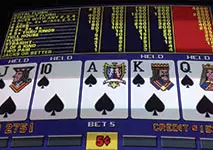 Video poker is another low-house-edge game found in almost every online casino. Its appeal is often attributed to the fact that it combines features of both slots and poker. One of the best things about video poker is that it provides casino players with far more advantageous odds than many other casino games. Moreover, gambling enthusiasts looking to improve their expected returns can use a solid video poker strategy that identifies the optimal decisions based on the five cards received after the initial deal.
Return-to-Player percentages in video poker usually range from 96% to 99%, or slightly higher, depending on the specific variation and its paytable. Games with “short-pay” paytables offer poorer odds because of payout reductions for specific hands, such as the Flush and Full House. Full-pay 9/6 variants of Jacks or Better have a satisfactory expected return of 99.54%.
Full-pay versions of Deuces Wild offer even better value because their RTP exceeds 100%, meaning that players have a small theoretical advantage (0.76%) over the house. However, you must follow the optimal strategy on every hand and always bet the maximum number of coins (five) to benefit from the low house edges and higher returns available in video poker. Some video poker games with a house advantage of less than 1% include Jacks or Better and Aces and Eights by Microgaming.
Baccarat
 Baccarat is another game worth considering if you prefer a lower house edge. It is often favored by high-stakes players, which might make you think baccarat is a demanding game that requires extensive knowledge and skill. This could not be further from the truth. Baccarat requires no decision-making on the part of players beyond choosing whether to bet on Player, Banker, or Tie.
The game has gained popularity among gambling enthusiasts because it combines simplicity with sophistication and a low casino advantage. Only three main bet types are available, and each has a different house edge. Of the three, the Banker bet offers the highest value because it carries a casino advantage of 1.06%, despite the 5% commission the house deducts from winning wagers.
Second is the Player wager, whose house edge is slightly higher but still moderate at 1.24%. Avoid the Tie bet, however, because it is one of the worst wagers you can make in a casino game. Do not be tempted by its higher payout (8 to 1), as this does not compensate for the Tie bet’s 14.36% house edge.
Which Casino Games to Avoid
 Gambling enthusiasts should be aware that there are also casino games they should generally avoid. Many players may be surprised to learn that slots belong to this category. Even though slots remain among the most popular casino games, the substantial house edges they produce, exceeding 15% in some cases, are their biggest drawback. What is more, slots rank among the fastest-paced casino games. Once immersed in the gameplay, you can easily lose track of your spending and deplete your bankroll.
American roulette is another casino game players are advised to avoid. As already stated, this variation features an additional double-zero pocket, which significantly increases its house advantage.
Keno also ranks among the games on which online casino players should avoid spending money. This casino game has a house edge of around 25%.
Tips on How to Make Your Gambling More Profitable
 First, gambling enthusiasts should know and understand the game they are playing. Some games have numerous variations, meaning the rules may also differ. Before you join a blackjack or roulette table, for example, you should ensure you know the rules inside and out. Familiarity with the game and its rules can help you avoid costly mistakes and make more informed decisions.
One simple yet extremely useful tip is to practice if you want to improve your skills and knowledge. To become a better player, you should take the time to study and put what you have learned into practice. Of course, this applies only to strategy-based games such as blackjack and video poker. Most web-based casinos also allow their patrons to play games in fun mode, providing an opportunity to learn the ins and outs of a game before risking real funds.
Knowing your limits is also one of the most important tips we can offer. Some players may consider money management insignificant, but in fact, the opposite is true. Gamblers should bear in mind that it is always wise to decide how much money they can afford to lose before they start wagering.